
US Nuclear Submarine USS Greeneville Arrives in South Korea, Bolstering Alliance Amid Regional Tensions
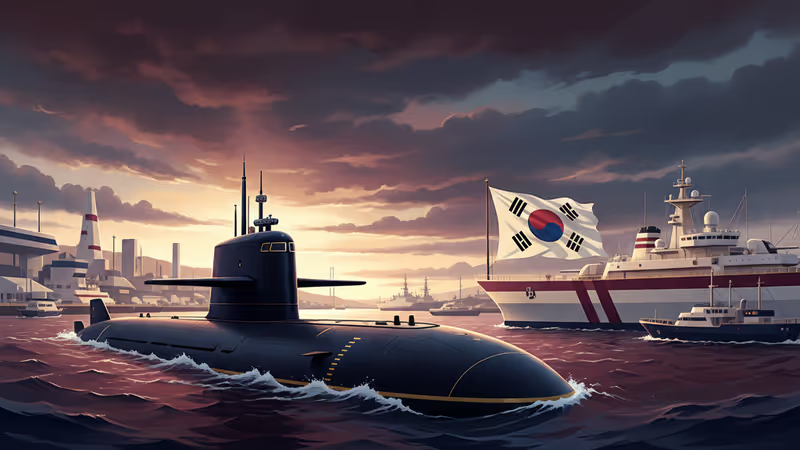
The U.S. nuclear-powered submarine USS Greeneville arrived in Busan, South Korea, on Dec. 23, 2025, for a port call aimed at strengthening the U.S.-South Korea alliance amid regional tensions with North Korea.
A U.S. nuclear-powered attack submarine, the USS Greeneville, docked at a key naval base in Busan, South Korea, on Tuesday, December 23, for a routine port call intended to replenish supplies and provide crew rest. According to South Korea's Navy, the visit serves as a powerful symbol of the robust military alliance between Washington and Seoul.
A Display of Combined Defense Posture
The Los Angeles-class attack submarine entered the naval base in Busan, located approximately 330 kilometers southeast of Seoul, early in the day. South Korea's Navy stated that the arrival provides an opportunity to enhance bilateral military ties.
The Navy plans to boost exchanges and cooperation between the navies of South Korea and the United States and strengthen our combined defense posture on the occasion of the USS Greeneville's entry.
— South Korean Navy Statement
Political Context and North Korea's Stance
This visit is notable as it marks the first arrival of a U.S. nuclear-powered submarine since President Lee Jae Myung took office in June. It is the USS Greeneville's fourth visit to the country, with its last port call in 2016. The arrival follows a similar visit by another Los Angeles-class submarine, the USS Alexandria, about 10 months ago in February.
Such deployments have historically drawn sharp criticism from North Korea. Pyongyang has previously accused Washington of escalating tensions and ignoring its security concerns, warning that it is prepared to use any means necessary to defend its national security.
More than a routine logistical stop, the USS Greeneville's presence in Busan is a calculated act of strategic messaging. For Washington, it's a tangible demonstration of its 'extended deterrence' commitment to Seoul, reassuring its ally while simultaneously signaling military readiness and resolve to Pyongyang. These port calls serve as a constant reminder of the U.S. military's forward-deployed capabilities in a region of escalating geopolitical complexity.
This content is AI-generated based on source articles. While we strive for accuracy, errors may occur. We recommend verifying with the original source.
Related Articles
U.S. President Trump warns Venezuelan President Maduro that 'it would be smart to leave' power as the U.S. seizes oil tankers, sparking condemnation from Russia and China and raising geopolitical tensions.

Analysts note a 'significant departure' in President Trump's foreign policy during the first year of his second term. PRISM explores what this 2025 strategic shift means for key global relationships with NATO and China.
Donald Trump claims he will build the most powerful warship ever, but the promise clashes with the U.S. Navy's recent cancellation of a smaller ship due to cost overruns, raising questions about feasibility.
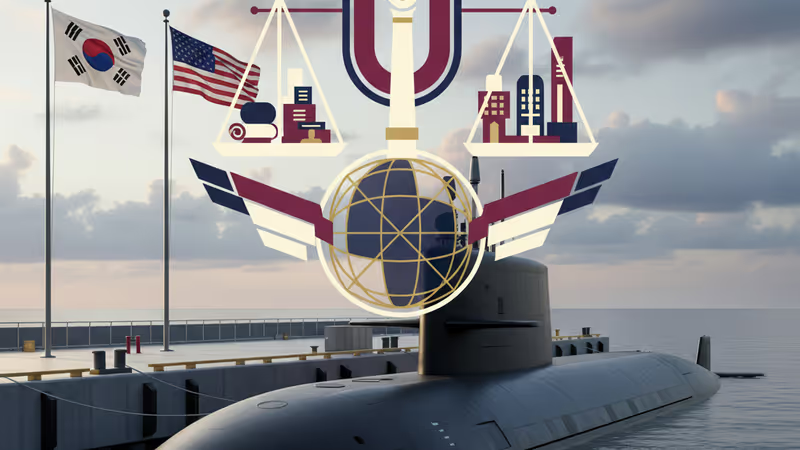
The U.S. nuclear submarine USS Greeneville arrived in Busan, South Korea, on Dec. 23, 2025, for a logistical stop. This visit reinforces the U.S.-South Korea defense alliance and serves as a strategic signal of deterrence in the region.