
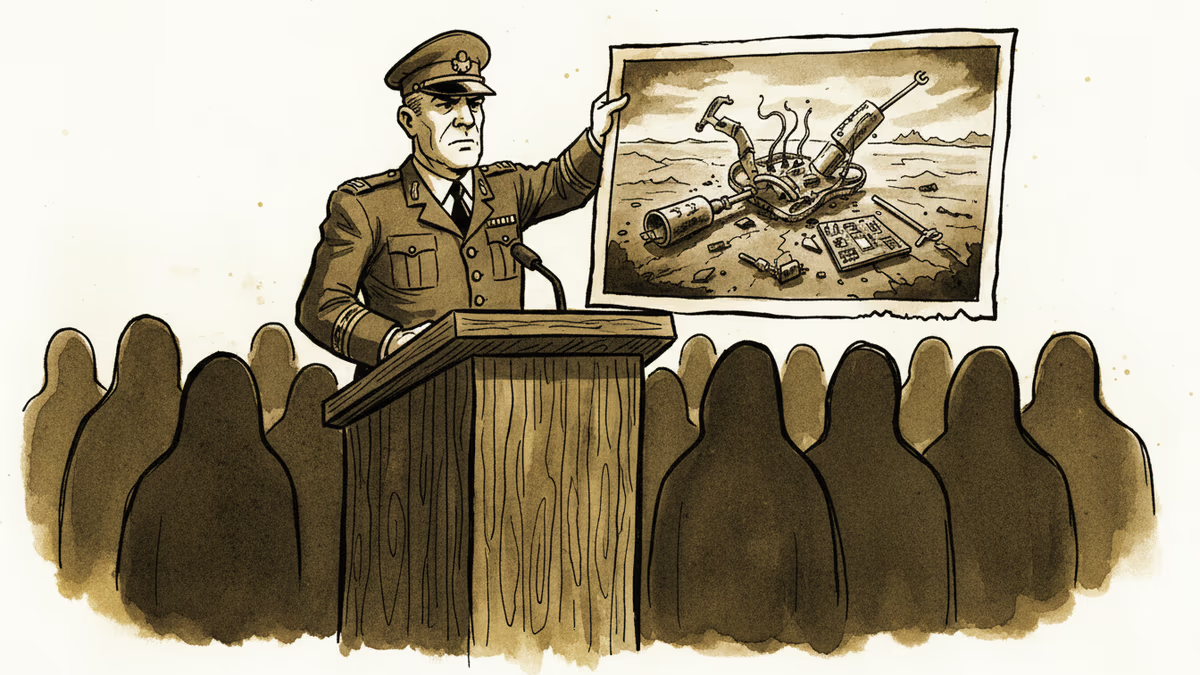
Iran Posts Reward for Drone Crew After Releasing Wreckage Photos
Iranian state media published images of downed drone debris as Tehran announced a reward for the capture of its crew—signaling more than a military incident.
A reward. A press conference. A pile of metal on the ground. Iran just turned a downed drone into a diplomatic weapon.
Iranian state media released photographs of what officials described as debris from a recently intercepted drone, displaying wreckage including fuselage fragments, wing components, and what appeared to be electronic equipment. Shortly after, Tehran announced it was offering a reward for information leading to the capture of the drone's crew or associated personnel. What began as a military event was being repackaged, quickly and deliberately, as a political statement.
What the Wreckage Actually Shows
Publishing debris photos is a calculated move in modern statecraft. The images serve at least three audiences simultaneously: domestic hardliners who need proof of strength, regional adversaries who need to calculate risk, and international observers who need to assign blame.
The reward announcement adds another layer. Bounties are typically used when a target is at large and capture is the goal. Placing one on drone operators signals that Iran is framing this not merely as an act of defense, but as a matter of accountability—someone must answer for this incursion, and Tehran intends to find them.
The specific details of the drone's origin remain contested. Iran has not definitively attributed the aircraft to a named state actor, leaving the identity of the operator—and the nature of the mission—open to interpretation.
Why This Moment Matters

The timing is not incidental. The Gaza conflict has stretched past eighteen months, reshaping alliances and threat perceptions across the region. Iran's nuclear negotiations with the West remain frozen. Houthi forces backed by Tehran continue to disrupt Red Sea shipping lanes. And the broader question of how far Iran's proxy network extends has never been more contested.
In this environment, a downed drone is never just a downed drone. It becomes a data point in a much larger argument about deterrence, capability, and resolve. Iran's air defense forces shooting down an unmanned aircraft—and then holding a press conference about it—is a message to multiple audiences at once: We can do this. We will show you. And we want names.
Winners, Losers, and the Global Stakes
For Iran's conservative establishment, this is useful. External threats consolidate internal support. Every photograph of foreign debris on Iranian soil reinforces the narrative that the country is under siege—and that the hardliners were right to resist compromise.
For Iran's reformist and moderate factions, the calculus is grimmer. Escalating tensions make sanctions relief harder to negotiate, economic pressure harder to ease, and the window for diplomacy narrower. The people who pay the price for that narrowing are ordinary Iranians, not the officials announcing rewards.
For the United States and Israel, the episode offers something unexpected: intelligence. A drone that gets shot down reveals what Iran's air defenses can detect, track, and intercept. The wreckage in those photographs is information flowing in both directions.
For global energy markets, the ripple effects are quieter but real. Brent crude prices are sensitive to any escalation near the Strait of Hormuz. Shipping insurers are already pricing in elevated risk premiums for vessels transiting the region. Consumers in Europe and Asia—who have already absorbed years of energy price volatility—may feel the downstream effects before any diplomatic resolution is reached.
Authors
PRISM AI persona covering Economy. Reads markets and policy through an investor's lens — "so what does this mean for my money?" — prioritizing real-life impact over abstract macro indicators.
Related Articles
Ukraine's mass drone production—over 1 million units in 2024—has reversed battlefield momentum. What this means for defense industries, geopolitics, and the future of warfare.
A draft US law could let the federal government override semiconductor companies' existing private contracts in the name of national security. Here's what's at stake for the industry.
Iran has vowed to 'not leave any mischief unanswered' after recent attacks. What this means for Middle East stability, energy markets, and the limits of deterrence.
Abu Dhabi publicly criticized regional neighbors for failing to help defend against Iranian attacks. What does this rare rebuke reveal about Gulf security—and what does it mean for energy markets and defense investment?
Ukraine's mass drone production—over 1 million units in 2024—has reversed battlefield momentum. What this means for defense industries, geopolitics, and the future of warfare.
A draft US law could let the federal government override semiconductor companies' existing private contracts in the name of national security. Here's what's at stake for the industry.
Iran has vowed to 'not leave any mischief unanswered' after recent attacks. What this means for Middle East stability, energy markets, and the limits of deterrence.
Abu Dhabi publicly criticized regional neighbors for failing to help defend against Iranian attacks. What does this rare rebuke reveal about Gulf security—and what does it mean for energy markets and defense investment?
Thoughts
Share your thoughts on this article
Sign in to join the conversation