
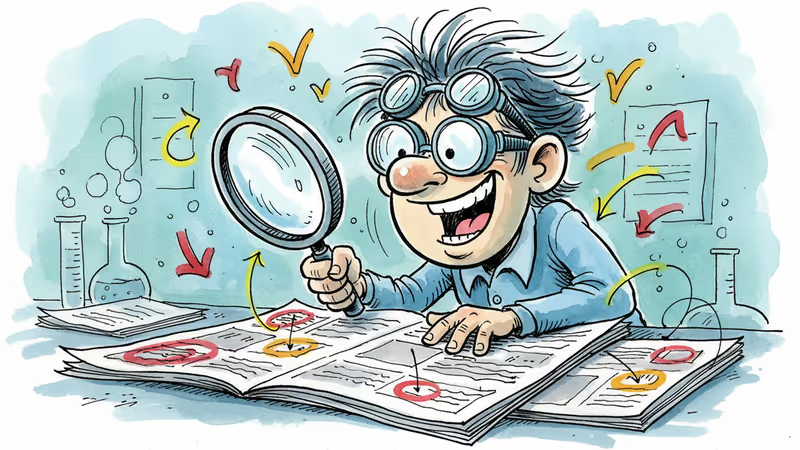
Dissecting the Same News in 4 Languages — Practical Comparative Reading
If you read Part 1 and thought "Okay, but how exactly?" — this is your answer.
If you read Part 1 and thought "Okay, but how exactly?" — this is your answer.
The previous article explained why news is effective for learning and what makes PRISM's adaptation approach different. Now we'll demonstrate with an actual article. Comparative reading, expression collection, structure analysis. Three learning methods, one by one.
Before we start, here's something to keep in mind. Foreign language reading has two modes:
- Deep reading days: Analyze short texts. Look up unknown words, identify expression differences.
- Light reading days: Speed through longer texts. Skip unknown words, rely on context.
You need both. Among the three methods below, comparative reading and expression collection are deep reading modes. Structure analysis and free category reading are light reading modes. Deep reading builds precision; light reading builds speed and intuition. Balance is key.
Method 1: Comparative Reading — Practical Demo
The core of comparative reading is simple: understand the content in your native language first, then re-read in your target language. Since you already know the content, you can infer unknown expressions from context.
One important point: the unit of comparison is information, not sentences. How is "Apple unveiled an AI chip" expressed in Korean? What word does Japanese use? Compare at this level. Since PRISM uses adaptation, sentences don't match 1:1, but the same information is conveyed, making information-level comparison possible.
Let's try it. Below is a Tech article example in PRISM style.
Step 1: Understand the Content in English
Apple unveiled its in-house AI chip, the M5 Ultra. It's 2.3 times faster than the M4, while drawing 18% less power. CEO Tim Cook called it "not just an upgrade — it's an architectural shift." Analysts say Nvidia's dominance could face its first real crack.
Identify the key information:
- Who: Apple
- What: Unveiled AI chip M5 Ultra
- Key figures: 2.3x faster, 18% less power
- Quote: Tim Cook's statement
- Context: Impact on Nvidia's dominance
Step 1.5: Predict Before Switching
Before switching to Korean, pause. How would they express "unveiled"? How about "2.3 times faster"? Right or wrong doesn't matter. The act of predicting and then checking locks memories in place. It sticks far better than passive reading.
Step 2: Switch to Korean Version
애플이 자체 개발한 AI 칩 'M5 Ultra'를 공개했다. 기존 M4 대비 연산 속도가 2.3배 빨라졌고 전력 소비는 18% 줄었다. 팀 쿡 CEO는 "이 칩은 단순한 업그레이드가 아니라 아키텍처 자체의 전환"이라고 말했다. 반도체 업계는 엔비디아의 독주 체제에 균열이 생길 수 있다고 분석한다.
You already know the content, so Korean becomes much easier to read. Compare with your predictions. If "unveiled" was "공개했다" (gong-gae-haet-da) — that word won't be forgotten now.
Step 3: Identify Contrast Points
Find parts where the same content uses different expressions. This is where learning happens.
Contrast 1: Verb Choice
- EN: "unveiled" → KR: "공개했다" (gong-gae-haet-da)
- Korean uses 공개 (public + open) rather than a word literally meaning "unveil." Different conceptual framing.
Contrast 2: Number Expressions
- EN: "2.3 times faster, while drawing 18% less power"
- KR: "2.3배 빨라졌고 전력 소비는 18% 줄었다"
- English uses "while + -ing" to connect two facts. Korean uses "~고" (and) as a connective.
Contrast 3: Quote Handling
- EN: called it "..."
- KR: ~라고 말했다 (~rago malhaetda)
- English uses varied reporting verbs (called, noted, warned). Korean typically uses 말했다 (said).
Contrast 4: Metaphorical Expressions
- EN: "dominance could face its first real crack"
- KR: "독주 체제에 균열이 생길 수 있다" (crack may form in the solo-run system)
- Both use "crack" imagery, but Korean adds 독주 체제 (solo-run system) for "dominance."
Step 4: Japanese/Chinese Key Contrasts
Let's pick 1-2 points from Japanese and Chinese too.
Japanese:
Appleが独自開発したAIチップ「M5 Ultra」を発表しました。
- "独自開発した" (dokuji kaihatsu shita) means "self-developed" — equivalent to "in-house."
- "発表しました" (happyou shimashita) is more neutral than "unveiled." Japanese news tends to strip nuance from verbs and stick to facts.
Chinese:
蘋果揭曉自研AI晶片M5 Ultra,運算速度較M4快2.3倍,功耗卻降低18%。
- "揭曉" (jiē xiǎo) means "to reveal" — similar feel to "unveiled."
- "卻" (què) is a contrast connector meaning "yet/however." It highlights the contrast: speed went up, but power went down. One character does what English does with "while."
This is comparative reading. By identifying expression differences based on the same content, you build intuition for each language.
Method 2: Expression Collection — Practical Demo
Organize expressions you discover through comparative reading. Just reading lets them evaporate. Writing them down makes them stick.

In language learning, this process is called Sentence Mining. There's one key principle: 1T (One Target) — each sentence you collect should have only one unknown element. Trying to memorize a sentence with 3 unknown words at once kills efficiency. "The only new thing in this sentence is this one word" — that's the state that sticks best.
From the same article, collect expressions in 4 categories:
Category 1: Number/Statistics Expressions
| English | Korean | Japanese | Chinese |
|---|---|---|---|
| 2.3 times faster | 2.3배 빨라졌다 | 2.3倍速い | 快2.3倍 |
| 18% less | 18% 줄었다 | 18%削減 | 降低18% |
| compared to ~ | ~대비 | ~と比較して | 較~ |
The numbers are the same, but structures differ. English uses "X times faster" comparative pattern. Chinese uses "快2.3倍" (fast 2.3 times) — adjective + multiplier order.
Category 2: Key Terms
| English | Korean | Japanese | Chinese |
|---|---|---|---|
| in-house | 자체 개발 | 独自開発 | 自研 |
| processing speed | 연산 속도 | 演算速度 | 運算速度 |
| power consumption | 전력 소비 | 消費電力 | 功耗 |
| chip industry | 반도체 업계 | 半導体業界 | 半導體產業 |
| dominance | 독주 체제 | 独占状態 | 獨霸格局 |
Chinese-character-based terms share similarities across Korean, Japanese, and Chinese. "半導体" (semiconductor) uses the same characters in all three. Know one, and the others come easier.
But beware of traps. Same characters, different meanings happen. Japanese "勉強" means "study," but Chinese "勉強" means "reluctantly." Japanese "手紙" means "letter," but Chinese "手紙" means "toilet paper." Don't assume same characters = same meaning. When you encounter new character compounds in news, verify through context first.
Category 3: Verbs/Expressions
| English | Korean | Japanese | Chinese |
|---|---|---|---|
| unveiled | 공개했다 | 発表した | 揭曉 |
| shake up | 뒤흔들다 | 揺るがす | 撼動 |
| face a crack | 균열이 생기다 | 亀裂が生じる | 出現裂痕 |
| called it ~ | ~라고 말했다 | ~と述べた | 表示~ |
Category 4: Collocations (Word Combinations)
Collecting words that go together boosts fluency faster than individual words.
| English | Korean | Japanese | Chinese |
|---|---|---|---|
| raise concerns | 우려를 제기하다 | 懸念を示す | 引發擔憂 |
| raise rates | 금리를 올리다 | 金利を引き上げる | 升息 |
| markets react | 시장이 반응하다 | 市場が反応する | 市場反應 |
Memorizing "raise" alone gives you 10 possible meanings. Memorizing "raise concerns" locks the meaning to one. News repeats these combinations, making it great for collection.
With these 4 categories, one article yields many expressions. Don't try to collect everything. Pick 3-5 per article. Get greedy and review burden piles up, eventually stopping you.
Method 3: Structure Analysis — Practical Demo
At intermediate level and above, go beyond sentence comprehension to analyze paragraph structure. Each language arranges information differently.
Let's compare the paragraph structure of the same article.
English: Inverted Pyramid
Paragraph 1: Core fact (Apple unveiled M5 Ultra)
Paragraph 2: Specific figures (2.3x faster, 18% less power)
Paragraph 3: Quote (Tim Cook's statement)
Paragraph 4: Industry reaction/analysis
Most important information comes first. You can understand the gist from just the first sentence. This is standard English news structure.
Japanese: Background → Fact → Explanation
Paragraph 1: Background context (Amid intensifying AI chip competition...)
Paragraph 2: Core fact (Apple announced...)
Paragraph 3: Detailed figures + quote
Paragraph 4: Expert analysis
Japanese lays out background first. Articles often start with "~という背景のもと" (against the backdrop of...). It guides readers to understand context before reaching the core.
Korean: Hook → Development → Context
Paragraph 1: Strong hook (suddenly unveiled)
Paragraph 2: Figures and evidence
Paragraph 3: Quote
Paragraph 4: Industry context and outlook
Korean puts the core first like English, but starts with emotional vocabulary like "전격" (sudden), "술렁인다" (stirring). Connectors like "~지만" (but), "~한편" (meanwhile) create flow between paragraphs.
Chinese: Compressed Development
Paragraph 1: Fact + figures compressed into one sentence
Paragraph 2: Quote
Paragraph 3: Analysis (brief)
Chinese is overall shorter. The same information in fewer sentences. Four-character idioms and compressed expressions are common.
Connectors Between Paragraphs
Just as important as structure are the connectors that link paragraphs. Knowing these words lets you predict "Is the next paragraph a rebuttal or support?" before reading.
| Function | English | Korean | Japanese | Chinese |
|---|---|---|---|---|
| Contrast | however, but | ~하지만, 그러나 | しかし、ただし | 然而、但 |
| Meanwhile | meanwhile, while | ~한편, 반면 | 一方で、その一方 | 與此同時、另一方面 |
| Addition | furthermore, moreover | 또한, 게다가 | さらに、加えて | 此外、而且 |
| Result | as a result, therefore | 따라서, 결국 | その結果、結局 | 因此、最終 |
Consciously spotting these connectors in news helps you quickly grasp the overall text flow.
Recognizing these structural differences lets you predict "what comes next" when reading foreign texts. Reading speed increases and comprehension improves.
Category-Specific Learning Points
Each category offers different vocabulary and expressions. Here are 3 representative ones.
Tech: Mastering Industry Jargon
English Tech articles use powerful verbs. "Apple dominates," "Google scrambles" — pay attention to these. Japanese uses lots of katakana loanwords, so knowing English gives you an advantage. Chinese translates English neologisms into characters — "人工智能" (artificial intelligence), "雲端運算" (cloud computing).
Key expressions: launch, unveil, roll out / リリース、発表 / 推出、發布
Economy: The Language of Money
Number unit conversion is key. English "billion" (10^9) doesn't map intuitively to Korean's 억/조 system. Japanese economy articles use lots of Chinese-character terms that Korean speakers recognize easily: "金利" (interest rate), "株価" (stock price).
Key expressions: rally, plunge, surge / 急騰、急落 / 飆漲、暴跌
Culture: Cultural Expressions and Trends
A treasure trove of colloquial and cultural expressions you can't learn from textbooks. Japanese has internet slang like "草" (lol), "炎上" (going viral for bad reasons). Chinese has unique metaphorical expressions like "吃瓜" (watching drama unfold), "翻車" (epic fail).
Key expressions: go viral, trending / バズる、トレンド / 瘋傳、熱搜
Politics and K-Culture can be approached the same way. Start with categories that interest you.
Single-language learning has limits. Reading only Korean, you can't resolve "Is this just how it is?"
Comparing two or more languages makes each language's characteristics clearer. When English writes "dropped," Japanese writes "発表しました." Recognizing this difference deepens your understanding of both languages. Comparison is also a tool for better learning one language.
Linguistics calls this "cross-linguistic awareness" — the ability to understand one language's structure by contrasting it with another. This ability develops only when you have something to compare with.
Put the three methods from today into the two modes: If you have 20 minutes daily, spend 15 minutes on deep reading (comparative reading + expression collection) and 5 minutes on light reading (skimming other articles). These ratios aren't absolute. What matters is experiencing both modes.
Previous Part: Part 1 — What Your Textbook Never Taught You
Next Part Preview: Reading alone leaves you at "I understand but can't use it." Input alone isn't enough — you need to practice output too. Part 3 covers how to turn this method into a habit and connect it to writing and speaking. A 90-day roadmap, tool combinations, and progress checklists await.
Authors

Combining the sharp eye of a financial auditor with the warm sensibility of a picture book editor, writing stories that read the currents of the AI era. Currently Editor-in-Chief at Liabooks.
Related Articles
You've tried for three days and quit. You're not alone.
Have you ever used what your textbook taught you?
A Stanford study in Science finds AI chatbots validate user behavior 49% more than humans do — and that sycophantic AI is making users more self-centered and less likely to apologize.
Suno's v5.5 update introduces Voices, My Taste, and Custom Models — shifting AI music from novelty to personalized creative tool. Here's what it means.
You've tried for three days and quit. You're not alone.
Have you ever used what your textbook taught you?
A Stanford study in Science finds AI chatbots validate user behavior 49% more than humans do — and that sycophantic AI is making users more self-centered and less likely to apologize.
Suno's v5.5 update introduces Voices, My Taste, and Custom Models — shifting AI music from novelty to personalized creative tool. Here's what it means.
Thoughts
Share your thoughts on this article
Sign in to join the conversation