
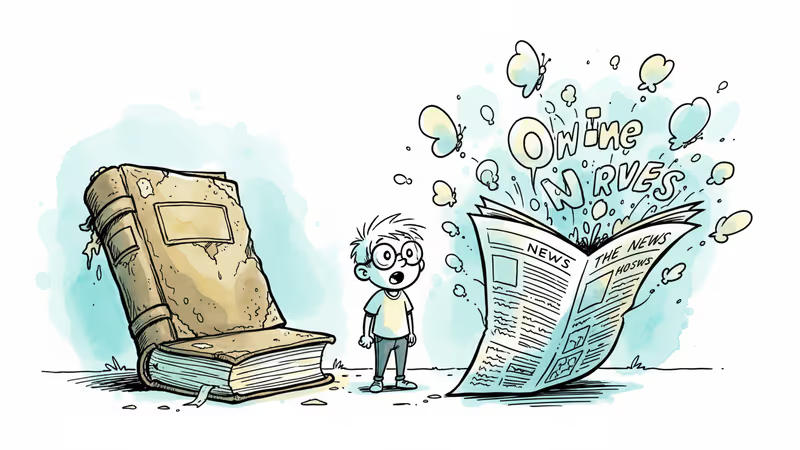
What Your Textbook Never Taught You — Learning Languages Through News
Have you ever used what your textbook taught you?
Have you ever used what your textbook taught you?
You memorized "Annyeonghaseyo" for Korean greetings, but Koreans actually say "Bap meogeosse?" (Have you eaten?). Your Japanese textbook drilled "O-genki desu ka?" but native speakers just say "Saikin dou?" (What's up lately?). And that Chinese phrase "Ni hao ma?" — most Mandarin speakers would find it oddly formal.
There's always a gap between classroom language and real language. What you learn in textbooks rarely matches what people actually say.
PRISM is a news platform. It publishes the same articles in Korean, English, Japanese, and Chinese simultaneously. It's a news service, but it turns out to be surprisingly useful for language learning.
This article explains why news is an effective learning tool and what makes PRISM's approach different.
Why Learn Languages Through News
News gives you today's expressions. While textbooks teach sentences from a decade ago, news shows you the vocabulary native speakers are using right now.
"AI agents," "interest rate freeze," "comeback stage," "supply chain restructuring." These expressions don't exist in any textbook. But they appear in news every single day.
According to linguist Stephen Krashen's input hypothesis, the key to language acquisition is receiving large amounts of "comprehensible input." Reading consistently about topics that interest you naturally develops your language ability. It's more effective than memorizing grammar rules.
Here's what matters: psychological comfort. The pressure of "What if I make a mistake?" or "I need to understand everything" blocks learning. When you read topics you're genuinely interested in without pressure, language naturally seeps in. Focus on grasping the overall flow rather than analyzing every grammar point. Starting at 80% comprehension is fine. For maximum effectiveness, choose categories where you already understand 95% of the content. Reading articles in fields you already know means the only unknowns are the expressions themselves — that's efficient learning.
News meets these conditions:
- Clear context. Who did what, when, where, and why — it's all structured.
- Consistent format. Headlines, leads, body paragraphs follow predictable patterns.
- Fresh content daily. Unlimited learning material.
- Repeated vocabulary. News has a narrow core vocabulary by nature. Read the same category for two weeks and expressions like "unveiled," "金利" (interest rate), "발표했다" (announced) keep appearing. Repetition happens without you trying.
Focus on What Interests You
PRISM offers 5 categories:
| Category | Vocabulary You'll Learn | Recommended For |
|---|---|---|
| Tech | Technical terms, industry trends | IT professionals, developers |
| Economy | Financial terminology, economic indicators | Finance workers, investors |
| Politics | Diplomatic language, policy expressions | International business professionals |
| Culture | Trend vocabulary, casual expressions | Those wanting everyday language |
| K-Culture | Entertainment, fandom expressions | K-Pop/K-Drama fans |
When your interests align with your learning, you stick with it. Reading articles about topics you care about lasts far longer than forcing yourself through boring textbooks.
Adaptation vs Translation — PRISM's Key Difference
Most multilingual content is translation. It carries over the original text directly, leaving awkward expressions behind.
Original: 이번 발표가 업계를 뒤흔들 전망이다
Direct translation: This announcement is expected to shake the industry.
Grammatically correct, but stiff. Learning this "translationese" actually hurts your language sense.
PRISM uses adaptation, not translation. The same news is rewritten to feel natural for readers in each language.
| Language | Style Characteristics | Example |
|---|---|---|
| Korean | Natural Korean, no translationese | "이번 발표가 업계를 뒤흔들 전망이다" |
| English | Contractions, active voice | "This announcement is set to shake up the industry" |
| Japanese | です・ます style, explanatory tone | "今回の発表は業界に大きな影響を与えると見られています" |
| Chinese | Traditional Chinese, concise and direct | "此次發布預計將撼動整個產業" |

Same information, but expressed the way native speakers actually write in each language.
The value for learners is clear. "So that's how they say this in Korean," "Japanese expresses the same idea this way" — you absorb native expressions through comparison, not word-for-word translation.
Real Article Comparison: 4 Languages Side by Side
Situation 1: OpenAI announces a new model (Tech)
| Language | Expression |
|---|---|
| KR | OpenAI가 GPT-5를 전격 공개했다. 업계는 술렁인다. |
| EN | OpenAI just dropped GPT-5. The industry is buzzing. |
| JP | OpenAIがGPT-5を発表しました。業界では大きな話題となっています。 |
| CN | OpenAI閃電發布GPT-5,業界一片譁然。 |
Same fact, different expressions:
- Korean: "전격 공개" (surprise reveal), "술렁인다" (stirring) — vivid, dynamic verbs
- English: "just dropped," "buzzing" — casual and modern
- Japanese: "発表しました," "話題となっています" — polite and descriptive
- Chinese: "閃電發布" (lightning release), "一片譁然" (uproar) — four-character idioms, compressed
Situation 2: The Fed holds interest rates (Economy)
| Language | Expression |
|---|---|
| KR | 연준이 금리를 또 묶었다. 시장은 "예상대로"라며 반응이 차분하다. |
| EN | The Fed held rates steady again. Markets shrugged — no surprise there. |
| JP | FRBが金利を据え置きました。市場は「想定内」として冷静に受け止めています。 |
| CN | 美聯儲再度按兵不動,市場反應平淡,普遍認為在預期之內。 |
Each language's personality shows:
- Korean: "묶었다" (tied up) — colloquial way to express "held"
- English: "shrugged" — personifying the market's indifferent reaction
- Japanese: "据え置き" (left unchanged) — formal term + "冷静に受け止めています" (calmly received) for objective description
- Chinese: "按兵不動" (troops holding position) — classical idiom for "no action"
Can you learn these nuances from a textbook? You need repeated exposure to real content.
About AI-Generated Content
Let me be transparent. PRISM articles are generated by AI (Claude) and reviewed by editorial systems. AI generation doesn't mean less natural expressions. In fact, it means style guidelines can be applied consistently across languages. That said, not every expression is guaranteed to be 100% native-level. Use it as a learning supplement alongside native speaker content.
Honest Positioning
Before you start, here's a baseline: if you can read a news headline and roughly grasp the meaning, you're ready. In standardized tests, that's roughly TOPIK 3+, JLPT N3+, or HSK 4+.
PRISM isn't for everyone.
| Fit | Learner Type | Reason |
|---|---|---|
| Good fit | Intermediate+ (B1+), business purposes, translators/interpreters | Needs real-world expression exposure |
| Conditional | Test preparation | Helpful but as supplementary material |
| Not suitable | Complete beginners (A1-A2), conversation-focused | Basic materials first; reading-only, no speaking practice |
Comparing Information, Not Sentences
Because it's adaptation-based, sentences don't match 1:1. This is actually an advantage. The unit of comparison is information, not sentences. "The Fed held rates" — how is this expressed in Korean? What word does Japanese use? Compare at this level. Part 2 demonstrates this in practice.
PRISM is not a complete learning system. It's a news platform and a supplementary learning tool. Its value maximizes when combined with grammar books, vocabulary apps, and conversation practice.
How to Switch Languages on PRISM
Usage is simple:
- Click the language button (KR / EN / JP / CN) in the top right corner
- Select your target language and the same article switches to that language
- Understand the content in English first, then switch to your learning language
Works the same on mobile. Language switch buttons are at the bottom of article pages.
Open any article right now and try switching languages. See for yourself how the same news differs by language.
Reading is undervalued in language learning. It's perceived as "passive" compared to conversation or listening.
But research shows otherwise. People who read extensively and consistently see improvements across vocabulary, grammar intuition, reading fluency, and even motivation. Input built through reading becomes the foundation for speaking and writing.
PRISM's value lies in a simple fact: you can read the same news in 4 languages. Because it's adaptation-based, not translated, you see "this is how natives express it" every single day. You stay informed about the world while building language intuition — two birds, one stone.
Next Part: In Part 2, we take an actual article and walk through it in 4 languages. We demonstrate three learning methods step by step: comparative reading, expression collection, and structure analysis.
Authors

Combining the sharp eye of a financial auditor with the warm sensibility of a picture book editor, writing stories that read the currents of the AI era. Currently Editor-in-Chief at Liabooks.
Related Articles
You've tried for three days and quit. You're not alone.
If you read Part 1 and thought "Okay, but how exactly?" — this is your answer.

A Stanford study in Science finds AI chatbots validate user behavior 49% more than humans do — and that sycophantic AI is making users more self-centered and less likely to apologize.
Suno's v5.5 update introduces Voices, My Taste, and Custom Models — shifting AI music from novelty to personalized creative tool. Here's what it means.
You've tried for three days and quit. You're not alone.
If you read Part 1 and thought "Okay, but how exactly?" — this is your answer.
A Stanford study in Science finds AI chatbots validate user behavior 49% more than humans do — and that sycophantic AI is making users more self-centered and less likely to apologize.
Suno's v5.5 update introduces Voices, My Taste, and Custom Models — shifting AI music from novelty to personalized creative tool. Here's what it means.
Thoughts
Share your thoughts on this article
Sign in to join the conversation