
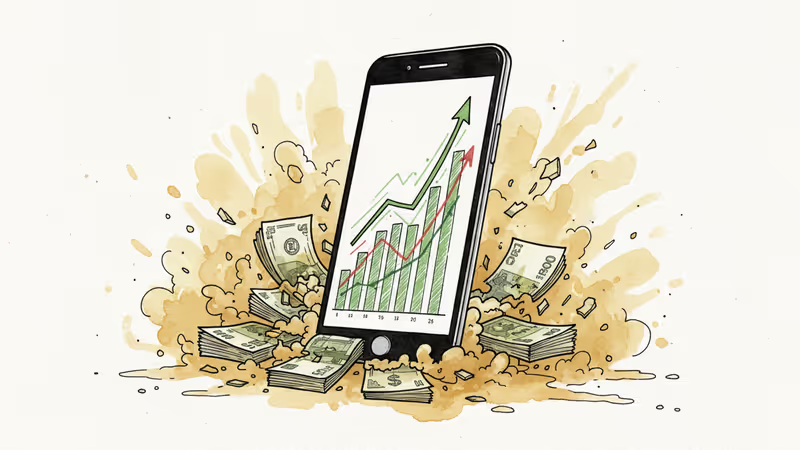
When HBO's 'Industry' Mirrors Real Fintech Fraud
HBO's Industry depicts a fraudulent fintech eerily similar to real scandals. What does this say about our current financial landscape?
When Wirecard collapsed in 2020, revealing that €1.9 billion in cash simply didn't exist, it shattered trust in fintech oversight. Now, HBO's financial thriller "Industry" is serving up a storyline so similar to real-world fraud that reality feels like satire.
The Anatomy of Digital Deception
This season's central plot revolves around Tender, a fintech company that's built entirely on fabricated numbers. Harper Stern, leading her newly launched investment firm, is hunting for companies to short—betting their stock will crash. When her team investigates Tender in Ghana, they uncover a devastating truth: "Fake users drive fake revenue drives fake cash," as Sweetpea puts it. "The thing is nothing."
Tender started as a payment processor for adult content but pivoted to banking after the UK's Online Safety Bill squeezed their original business model. The company's CFO-turned-leader, Whitney, embodies every tech baron cliche—move fast, break things, win at all costs. He's lobbying politicians for a banking license while the entire operation crumbles beneath layers of deception.
When Fiction Feels Too Real
What makes "Industry" unsettling is how accurately it captures our current moment. The show even name-drops TechCrunch as part of Tender's media playbook, highlighting how tech companies manipulate narrative and perception.
The parallels to Wirecard are striking. Both companies claimed to hold billions in cash that never existed. Both used complex accounting and legal gray zones to mask fraud. Both attracted short sellers who became "alternative whistleblowers"—stepping in when "the market, and the regulator, refuse to see what is right in front of them."

Charlie Javice's Frank, the $175 millionJPMorgan acquisition that turned out to be largely fraudulent, offers another real-world echo. Like Tender, Frank inflated user numbers and revenue to attract investors and buyers.
The Establishment's Blind Spots
Harper's character raises fascinating questions about who gets to expose financial fraud. As a Black American woman navigating the notoriously insular UK financial establishment, her success strains credibility—yet that's precisely the point. "Who needs realism when she's such a great character," one Black British founder told the show's creators.
The show "accurately portrays the ruthlessness of the British elite, specifically how they maneuver the media and governments to suit their own whims," according to industry insiders. This isn't just about individual bad actors—it's about systemic failures that allow fraud to flourish.
The Regulatory Cat-and-Mouse Game
Tender's pivot from adult content payments to banking reflects real regulatory pressures facing fintech companies. The UK's enhanced online safety rules have forced many platforms to restructure or exit certain markets entirely. But regulation often creates new opportunities for deception, as companies exploit transition periods and regulatory gaps.
The show's treatment of lobbying and political influence feels particularly relevant as governments worldwide grapple with how to oversee rapidly evolving financial technology. When Whitney courts politicians for a banking license, it mirrors real-world scenarios where regulatory capture enables fraud.
Authors
Related Articles
Despite fierce competition, the CEOs of Polymarket and Kalshi have co-invested in 5(c) Capital, a $35M VC fund targeting prediction market infrastructure. What this signals for the industry.
A class action lawsuit accuses Kalshi of changing payout rules after Iran's Supreme Leader Khamenei was killed. The case cuts to the heart of prediction market credibility.
A massive dispute over Iran's supreme leader prediction market exposes the dark side of betting on world events. How Kalshi's rule interpretation sparked trader revolt.
Iran bombing predictions drew $529M in bets, raising insider trading concerns. Exploring the ethical dilemmas of prediction markets in conflict zones.
Despite fierce competition, the CEOs of Polymarket and Kalshi have co-invested in 5(c) Capital, a $35M VC fund targeting prediction market infrastructure. What this signals for the industry.
A class action lawsuit accuses Kalshi of changing payout rules after Iran's Supreme Leader Khamenei was killed. The case cuts to the heart of prediction market credibility.
A massive dispute over Iran's supreme leader prediction market exposes the dark side of betting on world events. How Kalshi's rule interpretation sparked trader revolt.
Iran bombing predictions drew $529M in bets, raising insider trading concerns. Exploring the ethical dilemmas of prediction markets in conflict zones.
Thoughts
Share your thoughts on this article
Sign in to join the conversation