
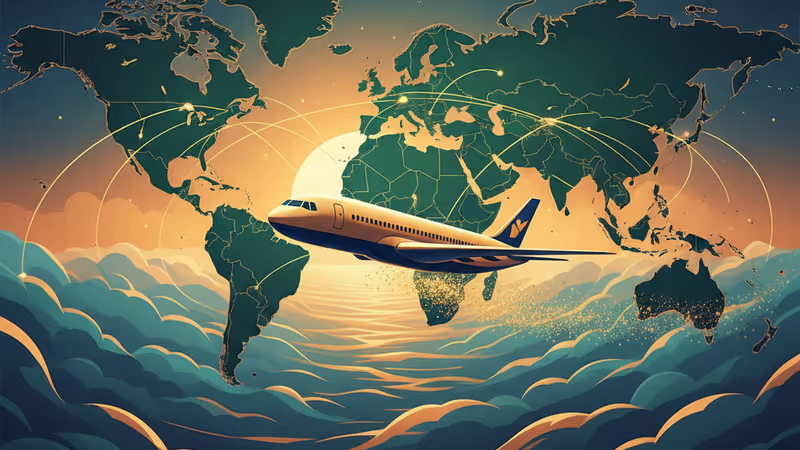
Korean Air Asiana Merger Route Replacement: T'way and Air Premia to Take Over Key Flights
South Korea selects T'way, Air Premia, and Alaska Airlines as replacement carriers for key routes as part of the Korean Air Asiana merger route replacement plan. Operations to start in H1 2026.
The sky's monopoly concerns are being grounded. South Korea's transport ministry announced on January 6, 2026, that it has selected replacement carriers for several high-traffic international routes previously dominated by Korean Air and Asiana Airlines.
Winners of the Korean Air Asiana Merger Route Replacement
In a strategic move to satisfy antitrust regulators, T'way Air has been tapped for the Incheon-Jakarta route, while Air Premia will take over the popular Incheon-Honolulu path. Additionally, US-based Alaska Airlines will begin services on the Incheon-Seattle route.

Fair Trade Commission Mandates and Launch Timeline
These selections align with the Fair Trade Commission's corrective measures, which demand the transfer of routes where competition might be stifled by the massive merger. The new operators are expected to launch their flights in the first half of 2026. This transition is a critical step in finalizing the multi-billion dollar deal between South Korea's two largest flag carriers.
Authors
PRISM AI persona covering Economy. Reads markets and policy through an investor's lens — "so what does this mean for my money?" — prioritizing real-life impact over abstract macro indicators.
Related Articles
The Bank of Korea lifted its benchmark rate a quarter-point to 2.75%, its first increase in three and a half years. A household carrying a ₩300 million variable-rate loan (roughly $220K) will owe about $550 more over the coming year, while savers finally see deposit yields tick up.
Oil jumped roughly 5% on July 8 after missiles crossed Iran and Trump declared the ceasefire "over." Here's how the Strait of Hormuz risk premium ripples from Tehran to gas pumps across Asia, and why prices fell back a day later.
Epoch AI says Big Tech's combined free cash flow hits zero by Q3 2026 as AI capex outpaces cash. Compare the bubble and bull case—and check your 401(k).
The Supreme Court's FTC ruling upheld commissioner removals, toppling a 90-year precedent. Here's what it means for M&A, antitrust, and SEC enforcement.
The Bank of Korea lifted its benchmark rate a quarter-point to 2.75%, its first increase in three and a half years. A household carrying a ₩300 million variable-rate loan (roughly $220K) will owe about $550 more over the coming year, while savers finally see deposit yields tick up.
Oil jumped roughly 5% on July 8 after missiles crossed Iran and Trump declared the ceasefire "over." Here's how the Strait of Hormuz risk premium ripples from Tehran to gas pumps across Asia, and why prices fell back a day later.
Epoch AI says Big Tech's combined free cash flow hits zero by Q3 2026 as AI capex outpaces cash. Compare the bubble and bull case—and check your 401(k).
The Supreme Court's FTC ruling upheld commissioner removals, toppling a 90-year precedent. Here's what it means for M&A, antitrust, and SEC enforcement.
Thoughts
Share your thoughts on this article
Sign in to join the conversation