
Korea's $200B US Investment: Joint Fact Sheet Has No Alaska LNG Figure
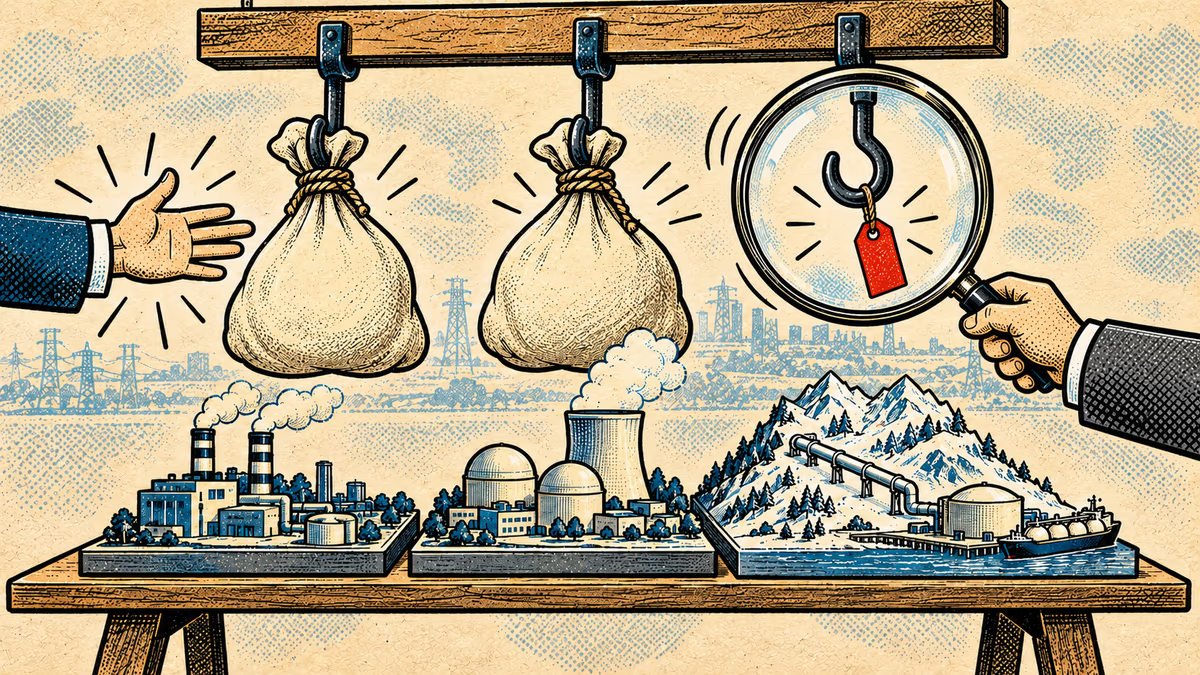
Trump said South Korea will invest up to $200 billion. The joint US-Korea fact sheet prices two projects, gas power and nuclear. Alaska LNG has no figure.
In the space of three days, three different accounts emerged of South Korea's investment in the United States. On September 30 at the White House, President Donald Trump said Korea would invest "up to $200 billion" in the US. The next day in Seoul, Korea's Ministry of Trade, Industry and Resources said that on the Alaska LNG project, "nothing has been decided on whether to invest or how much." On October 2, Trump took to Truth Social with a new item: an enhanced oil recovery (EOR) project worth "8.4 Billion Dollars."
We traced each of those numbers back to the document it appears in. There are four: the transcript of the September 30 White House remarks; the joint fact sheet the US and Korean governments released the same day; an October 1 press release from Korea's Ministry of Economy and Finance; and the US-Korea strategic investment memorandum of understanding (MOU) signed on November 14, 2025. In the document the two governments put out together, two projects carry dollar figures. Alaska LNG has none.
The Numbers in Four Documents
The joint fact sheet gives the three projects code names: Project Star for a gas-fired power plant in Texas, Project Power for nuclear reactors, and Project North for Alaska LNG. The figures in the table below shouldn't be added together. The $22.3 billion is the total cost of a single power plant, while the $120 billion is funding allocated to the nuclear program. Two more figures come up later — $2.4 billion, the first remittance, and $10 billion, a planned advance payment for the nuclear projects — and each of those measures something different, too. Commerce Secretary Howard Lutnick's Alaska figure comes from remarks he made at the event; it doesn't appear in the joint document. We checked the September 30 remarks against a transcript of the White House event and reporting by The Korea Times. The other three are documents issued by governments.
| Document | Texas gas power (Star) | 8 nuclear reactors (Power) | Alaska LNG (North) | Where $200 billion comes in |
|---|---|---|---|---|
| Sept. 30 White House remarks | Lutnick: "over $22 billion" | Lutnick: "$100 billion plus a $20 billion contingency" | Lutnick: "just over $50 billion" | Trump: "up to $200 billion"; Lutnick: "Three projects just under $200 billion" |
| Sept. 30 joint US-Korea fact sheet | $22.3 billion facility (6,472 MW) | $120 billion allocated out of $200 billion | No figure | Once, in the nuclear allocation sentence ("out of $200 billion") |
| Oct. 1 Ministry of Economy and Finance press release | Total project cost of $22.3 billion | $120 billion drawn from the fund | No figure ("begin a review") | "An investment ceiling of $20 billion a year and $200 billion in total" |
| Nov. 14, 2025 US-Korea MOU | N/A (predates project selection) | N/A (predates project selection) | N/A (predates project selection) | Total "Investments" of $200 billion, capped at $20 billion a year |
The combined-cycle gas plant planned for Encinal, Texas, appears at the same size in all three documents. The nuclear numbers line up across all three as well. Lutnick's "$100 billion plus a $20 billion contingency" matches the fact sheet's allocation right down to its components: "Of the $120 billion, $100 billion is slated for construction costs (overnight costs) and $20 billion for contingency reserves." The Ministry of Economy and Finance, for its part, wrote that the eight reactors would be built "using $120 billion from the Korea-US strategic investment fund."
Alaska LNG is the project without a dollar figure in the joint document. On September 30, Lutnick said there would be "just over $50 billion invested in Alaska for the Alaska LNG project." The corresponding sentence in the fact sheet the two governments released that same day contains no number. It reads: "The United States and Korea have agreed to commence working on the Alaska LNG project, subject to meeting commercial reasonableness under the Strategic Investment MOU and all applicable domestic legal requirements." In its Korean-language press release, the Ministry of Economy and Finance rendered "commence working" as an agreement to "begin a review," adding that it "will decide whether to proceed" once the conditions are met. According to the Anchorage Daily News, Trade Minister Kim Jung-kwan said the US announcement went "far beyond what was agreed."
The $200 billion figure traces back to the 2025 MOU. Its preamble puts the total Korea commits to invest under the memorandum, defined there as the "Investments," at $200 billion, with shipbuilding investment set aside as a separate category. In the new fact sheet, the number appears exactly once, in the sentence explaining the nuclear allocation: "Funding allocated under Project Power totals $120 billion out of $200 billion." No sentence in the fact sheet says the three projects add up to $200 billion. The "up to $200 billion" in the September 30 remarks is the same size as the MOU's entire ceiling.
Where Each Project Stands on Paper
All three projects were announced on the same day, but the documents place them at different stages. The fact sheet says the Texas plant "was assessed to meet the commercial reasonableness standard under the Strategic Investment MOU." Of the three, it's the only one carrying that determination. The Ministry of Economy and Finance said the project has also cleared Korea's domestic procedures, including deliberation and approval by the fund's project management committee and steering committee and a report to the National Assembly. On October 4, the Korean business daily Financial News, citing the Ministry of Economy and Finance, reported a first remittance of $2.4 billion. According to the ministry, the money came from foreign-currency assets entrusted by the Bank of Korea and the Foreign Exchange Stabilization Fund, and it will go toward getting the Texas plant started, including placing orders.
The nuclear projects made it into the document with both a dollar amount and an advance-payment plan. The fact sheet provides for a "$10 billion advance payment by the end of the year," with the qualifier "in accordance with all applicable domestic legal requirements." The nuclear section contains no commercial reasonableness determination. Financial News reported that the government decided to pay up to $10 billion in advance by year-end, provided requirements under Korean law are met, including a commercial reasonableness review and a report to the National Assembly. Alaska LNG has no dollar amount, and commercial reasonableness is written in as a condition still to be satisfied.
The project's economics have drawn skeptical assessments. Reuters reported on October 1, citing estimates from developer Glenfarne, that Alaska LNG would cost $44.5 billion to $54.5 billion in total. That works out to $2.2 billion to $2.7 billion per million tonnes of annual capacity. According to the same report, US LNG projects approved since Russia's invasion of Ukraine have generally been built for about $1 billion or less per million tonnes. Energy consultancy Rapidan, quoted in that article, said the project "may not be able to meet commercial thresholds for investment."
Here's the developer's plan. Glenfarne intends to make a final investment decision (FID) once it has sales contracts for 16 million tonnes a year, and so far it has lined up 13 million tonnes under preliminary agreements. The preliminary buyers include Japan's JERA and Tokyo Gas and Korea's POSCO International. Glenfarne CEO Brendan Duval told energy news outlet Rigzone on October 1 that the company would "work with the U.S. and Korean governments to finalize the investment structure and complete the remaining steps required to reach FID."
The Sequence the MOU Lays Out

Read the MOU clause by clause, and you get the steps that have to happen before any money moves. It starts with the Investment Committee. The US president establishes the committee (§3), and the US secretary of commerce chairs it (§4). The committee "intends to only recommend Investments to the President which it believes are Commercially Reasonable" (§1), and Appendix A makes the committee the body that judges commercial reasonableness. Section 1 also states: "The President of the United States of America shall select Investments that have been recommended by the Investment Committee."
Consultation with Korea comes before any recommendation. Before recommending an investment to the president, the Investment Committee consults Korea, either directly or through a Consultation Committee (§5). That committee is chaired by Korea's trade minister and provides "input" on each country's strategic and legal considerations. Nothing in the text gives the Consultation Committee a vote.
Payment follows selection. Under §7, Korea funds in tranches matched to the project's funding milestones, on a date "no less than forty-five (45) Business Days" after it's informed that the president has selected the investment. Section 8 says that in any calendar year, Korea won't be required to fund more than $20 billion in total. Investment commitments can be made until January 19, 2029 (§2).
The MOU also spells out an option not to pay. Section 9 says Korea "may, in its sole discretion, elect not to fund" an investment, after consulting the United States first. If it does, the profit-sharing terms shift against Korea, and "the United States may also impose tariff rate or rates on Korean imports into the United States at the rate determined by the President." The same section closes with a sentence pointing the other way: as long as Korea is faithfully implementing the memorandum and hasn't failed to fund any investment, the United States "intends to adhere to" the tariff commitments in the November 2025 joint fact sheet.
Under the profit-sharing rule (§15), distributions are split 50-50 until Korea has received back the amount deemed its share, then 90% to the United States and 10% to Korea. Section 25 states that the memorandum "does not create legally binding rights and obligations."
The fact sheet records Alaska LNG as a project on which the two sides will "commence working," subject to meeting commercial reasonableness. The payment clock under §7 starts from notice of the president's selection. Following the order the documents set out, Alaska is still recorded at a stage before recommendation and selection. None of the published documents says the committee has recommended Alaska to the president. Korean domestic procedures are attached as a condition, too: the fact sheet cites "all applicable domestic legal requirements," and the Ministry of Economy and Finance cites "conditions under relevant domestic law."
Same MOU Framework: Japan's First Projects
Japan signed a $550 billion investment MOU with the United States on September 4, 2025, a little over two months before Korea. For Japan's memorandum, we worked from the Japanese provisional translation (仮訳) published by Japan's Cabinet Secretariat; we weren't able to review the English original. Set the two memoranda side by side, clause by clause, and their frameworks are nearly identical.
| Item | Korea MOU (Nov. 14, 2025) | Japan MOU (Sept. 4, 2025) |
|---|---|---|
| Total investment | $200 billion ($150 billion for shipbuilding is a separate category) | $550 billion (shipbuilding included among the sectors) |
| Project selection | Recommended by the Investment Committee (chaired by the US commerce secretary), selected by the US president | Same |
| Partner country's role | Consultation Committee chaired by Korea's trade minister provides input | Consultation Committee of designees from both countries provides input (no chair specified) |
| Timing of payment | At least 45 business days after notice of selection, in tranches by project stage | At least 45 business days after notice of selection |
| Annual cap | $20 billion a year | No such language |
| Declining to fund | Allowed at Korea's sole discretion; allocation shifts against Korea, and the US "may" impose tariffs | Same |
| Profit split | 50:50, then 90:10 (US:Korea) | 50:50, then 90:10 (US:Japan) |
| Deadline and legal status | Commitments through Jan. 19, 2029; not legally binding | Same |
Of the differences between the two memoranda, the one that bears directly on the flow of money is the annual cap. The "$20 billion a year" language in §8 of Korea's MOU doesn't appear in the Japanese provisional translation. The provision tying installment payments to project stages also shows up only on the Korean side.
Here's how Japan's first projects were announced under the same rules. Trump posted them on social media first, on February 17 this year (US Eastern time). We weren't able to review the original release from Japan's Ministry of Economy, Trade and Industry (METI), but according to reporting by Jiji Press and Nikkei, the Japanese government announced the same three projects at the same amounts on February 18. Together they came to about $36 billion, and the largest was a gas-fired power plant in Ohio (about $33.3 billion). A second round followed on March 19 in a joint statement issued at a summit between the two leaders, and its amounts were labeled "up to."
Looking only at the September 30 announcement, the difference between Korea's and Japan's experience shows up in Alaska LNG. For the Texas plant and the nuclear projects, the amounts in the US announcement and the Korean documents match, as they did for Japan's first projects. Alaska LNG has a dollar figure only in what the US side said.
Numbers Outside the Documents
On the morning of October 2 (US Eastern time), Trump wrote on Truth Social that "the Republic of Korea Deal keeps getting BETTER! 8.4 Billion Dollars for an enhanced Oil Recovery Project." The post gives no location, no project sponsor and no funding structure. We couldn't find the item anywhere in the three September 30 projects, the MOU or the fact sheet. According to Reuters, Korea's trade ministry said the agreement "covers only what both governments laid out in a joint fact sheet issued in November 2025."
According to Korean news channel YTN and other Korean outlets, Trump told reporters at the White House the same day, in effect, that he would double it if Korea didn't agree soon. The English wording of the remark differs from outlet to outlet, and it isn't clear what he meant to double. Most Korean outlets read it as the amount Korea would be charged, while the English-language service of Korean broadcaster SBS interpreted it as a threat to raise tariffs.
News outlets in different countries chose different words. CNN ran a headline saying South Korea said Trump had "jumped the gun." Newsweek and Bloomberg linked the announcement to the midterm elections: Newsweek wrote that Republican Sen. Dan Sullivan, who is running for reelection, has championed the project and that his Democratic opponent supports it too, while Bloomberg's Japanese edition put "amid a tough midterm fight" (中間選挙苦戦の中) in its headline. In Japan, Nikkei's headlines featured "fait accompli" (既成事実化), "conflicting explanations" (説明食い違い) and "lingering doubts over profitability" (採算性に残る疑念). In mainland China, the business paper 21st Century Business Herald (21世纪经济报道) attached the word "unilateral" (单方面) to the $50 billion announcement and "threat" (威胁) to the "double" remark.
What to Watch
The nearest date on the calendar was the October 6 session of Korea's annual parliamentary audit, the yearly round in which lawmakers question government ministries and agencies. That day, the National Assembly's trade and industry committee audited the Ministry of Trade, Industry and Resources, and lawmakers raised the agreement to "begin a review" on Alaska. According to Financial News, Trade Minister Kim Jung-kwan said, "I've said repeatedly that beginning a review is premised on commercial reasonableness." Asked whether the Alaska LNG investment President Trump had mentioned had been finalized, he answered, "Not yet," according to the Korean news outlets Etoday and MediaPen. Etoday also reported him as saying, in substance, that low commercial viability was indeed why the project hadn't moved forward until now, but that the Middle East war had given it some strategic value. Next come the October 12 audit of Korea Electric Power Corp. (KEPCO) and Korea Hydro & Nuclear Power and the October 19 audit of Korea Gas Corp. and Korea National Oil Corp. The first could take up the eight reactors and the $10 billion year-end advance payment, and the second Alaska LNG. (Updated October 7)
Outside the National Assembly, the first thing to watch is whether the nuclear advance payment actually goes out by year-end and, if it does, which domestic procedures the government says it went through. On Alaska LNG, the questions are whether the developer fills out its remaining sales contracts and reaches a final investment decision, and whether a document emerges showing that the Investment Committee led by the US commerce secretary has recommended the project to the president. None of the published documents sets a deadline for the Alaska review. The $8.4 billion project Trump floated can be checked against the same standard: whether it ever makes it into a document the two governments issue jointly.
This content is AI-generated based on source articles. While we strive for accuracy, errors may occur. We recommend verifying with the original source.
Related Articles
Businesses are paying thousands of dollars in extra logistics costs as trade barriers force trucks to run half-empty. Here's who pays, who profits, and what it means for prices.
Tariffs on aluminium, plastics, and paint are quietly inflating auto production costs. Here's who pays, who profits, and what it means for the EV transition.
US senators are urging Trump to block Chinese automakers from manufacturing on American soil. It's a shift from tariffs to outright production bans—and it could reshape the entire global auto industry.
Energy analysts are stress-testing an 'Armageddon scenario' for gas markets — a strike on Qatar's LNG infrastructure. Here's what it means for prices, supply chains, and your wallet.
Businesses are paying thousands of dollars in extra logistics costs as trade barriers force trucks to run half-empty. Here's who pays, who profits, and what it means for prices.
Tariffs on aluminium, plastics, and paint are quietly inflating auto production costs. Here's who pays, who profits, and what it means for the EV transition.
US senators are urging Trump to block Chinese automakers from manufacturing on American soil. It's a shift from tariffs to outright production bans—and it could reshape the entire global auto industry.
Energy analysts are stress-testing an 'Armageddon scenario' for gas markets — a strike on Qatar's LNG infrastructure. Here's what it means for prices, supply chains, and your wallet.
Thoughts
Share your thoughts on this article
Sign in to join the conversation