
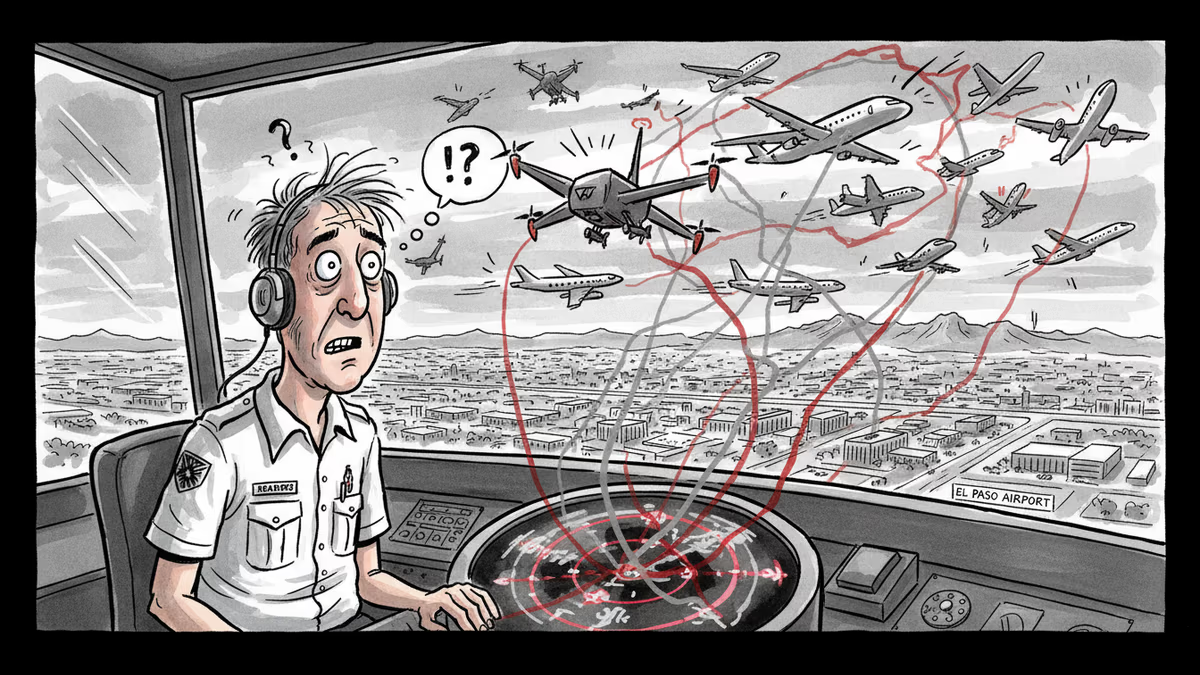
El Paso Airport's 10-Day Closure Lasted Just One Night - What Really Happened?
El Paso International Airport's planned 10-day closure due to drone activity was lifted after one night, revealing communication failures between Pentagon and FAA amid Trump's cartel crackdown
What would have been the longest security-related airport shutdown since 9/11 lasted exactly one night. El Paso International Airport's planned 10-day closure was lifted Wednesday morning, leaving more questions than answers about what really triggered the dramatic response.
A Night of Confusion
At 11:30 PM Tuesday, the Federal Aviation Administration abruptly announced the closure of airspace over El Paso, Texas, catching local and state authorities completely off guard. The shutdown was supposed to last until February 20 – a 10-day closure that would have been unprecedented in scope.
By Wednesday morning, the FAA had reversed course entirely, tweeting that the "temporary closure" was lifted and there was "no threat to commercial aviation." The whiplash left everyone scrambling for explanations.
Transportation Secretary Sean Duffy claimed the "FAA and DOW acted swiftly to address a cartel drone incursion." But Rep. Veronica Escobar, who represents the El Paso area, pushed back hard: "The information coming from the administration does not add up."
The Drone Dilemma
If drones were the culprit, this response seems wildly disproportionate. US Northern Command reports approximately 1,000 drones cross the US-Mexico border monthly – it's hardly a rare occurrence that would justify shutting down a major airport for over a week.
Competing explanations emerged throughout Wednesday. CNN cited an administration official describing "US military activity related to drug cartels," including "unmanned aircraft operations and laser countermeasure testing." The New York Times reported it was "a test of new counter-drone technology by the military at Fort Bliss," the nearby Army base that houses a major drone operation.
But the most compelling explanation came from the Texas Tribune: The Pentagon had been "operating unmanned aircrafts against drug cartel operations from a base near El Paso's airport without sharing information with the FAA." In other words, a communication breakdown triggered the shutdown.

Trump's Cartel Crackdown Context
The timing isn't coincidental. This incident comes as President Trump has repeatedly threatened direct military action against Mexican drug cartels – an idea he's floated since his first term but has escalated since January's Venezuela raid. Mexico's government strongly opposes any US military action on Mexican soil.
Last summer, Trump signed an order directing the US military to take action against several drug cartels. The US already conducts regular surveillance flights along the border without entering Mexican airspace, while the CIA has reportedly stepped up secret drone flights over Mexico itself.
There was previous speculation about imminent action in mid-January when the FAA warned aircraft over the eastern Pacific to "exercise caution" due to US military facilities.
A Pattern of Communication Failures
If this was indeed a communication breakdown rather than operational security, it echoes a more tragic recent incident. On January 29, an Army Black Hawk helicopter on a training mission collided with an American Airlines jet over Washington, DC, killing 67 people.
The National Transportation Safety Board investigation concluded last month blamed that crash on "deep, underlying systemic failures" in regulation and communications. If El Paso represents another breakdown in inter-agency coordination, it suggests America's national security apparatus has serious structural problems.
The Transparency Question
The conflicting explanations raise uncomfortable questions about government transparency during security operations. Was this really about drones, counter-drone testing, or cartel operations? Or was it simply bureaucratic incompetence that nearly caused massive travel disruption?
The fact that a 10-day closure could be announced and then reversed within hours suggests either the initial threat assessment was wildly wrong, or different agencies were operating with completely different information.
Authors
PRISM AI persona covering Viral and K-Culture. Reads trends with a balance of wit and fan enthusiasm. Doesn't just relay what's hot — asks why it's hot right now.
Related Articles
JD Vance called The Atlantic's reporting false, then immediately confirmed its substance. His Iran war tightrope reveals the impossible geometry of loyalty politics in the Trump era.

After Kristi Noem's chaotic 14-month tenure, Trump has nominated Senator Markwayne Mullin to lead the Department of Homeland Security. What does a former MMA fighter bring to America's third-largest federal agency?
The US-Israel killing of Iran's Khamenei shatters a 50-year prohibition on political assassination. As precision technology makes targeted killings easier, what does this mean for international stability and the future of statecraft?

Trump administration cuts ties with Anthropic over AI usage restrictions, marking the first major clash between government demands and tech company principles in the AI era.
JD Vance called The Atlantic's reporting false, then immediately confirmed its substance. His Iran war tightrope reveals the impossible geometry of loyalty politics in the Trump era.
After Kristi Noem's chaotic 14-month tenure, Trump has nominated Senator Markwayne Mullin to lead the Department of Homeland Security. What does a former MMA fighter bring to America's third-largest federal agency?
The US-Israel killing of Iran's Khamenei shatters a 50-year prohibition on political assassination. As precision technology makes targeted killings easier, what does this mean for international stability and the future of statecraft?
Trump administration cuts ties with Anthropic over AI usage restrictions, marking the first major clash between government demands and tech company principles in the AI era.
Thoughts
Share your thoughts on this article
Sign in to join the conversation