
Silicon Valley's Super Bowl Takeover Reveals the Real AI Power Play
Tech billionaires flock to Silicon Valley's Super Bowl while Google, OpenAI, and Anthropic battle in AI ads. What this reveals about the future of AI competition and consumer choice.
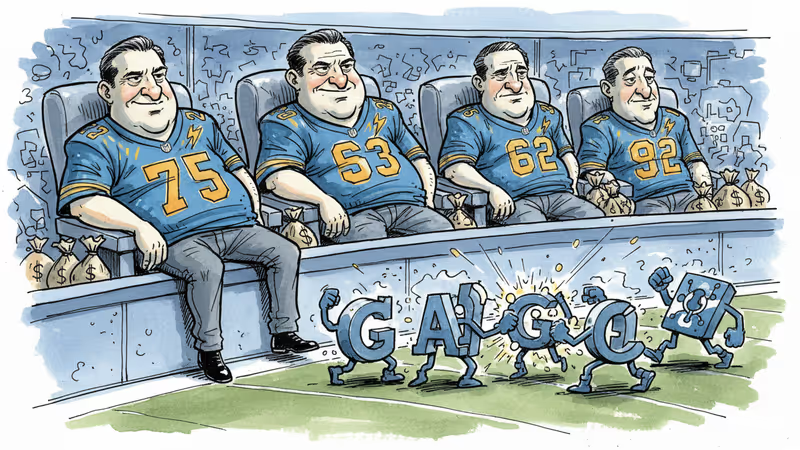
Tech billionaires are paying $50,000 for Super Bowl tickets this Sunday, and it's not just about the game.
The Patriots-Seahawks showdown at Levi's Stadium has become Silicon Valley's most expensive networking event. YouTube CEO Neal Mohan will be there. So will Apple'sTim Cook, who's become a Super Bowl fixture since Apple Music started sponsoring the halftime show. Menlo Ventures' veteran VC Venky Ganesan put it bluntly to the New York Times: the Bay Area Super Bowl is "tech billionaires who got picked last in gym class paying $50,000 to pretend they're friends with the guys who got picked first."
Ganesan would know—and he could afford that $50,000 ticket. His firm went all-in on Anthropic, creating a $100 million fund with the AI company last summer to invest in other AI startups. They've also joined multiple funding rounds for Anthropic itself. The company is reportedly closing a $20 billion funding round next week at a $350 billion valuation.
The Economics of Elite Access
Super Bowl tickets average nearly $7,000 this year, with some last-minute seats available on StubHub for around $3,600. Only a quarter go to the general public—the rest are distributed to NFL teams. The largest group of ticket buyers (27%) are Washington State fans supporting the Seahawks, who've won just one Super Bowl compared to the Patriots' six titles under Tom Brady.
But the real action isn't in the stands—it's in the commercial breaks. Google, OpenAI, Anthropic, Amazon, and Meta are all running competing ads about whose AI is best for customers. Their CEOs will likely be watching from premium seats, all living within an hour of Sunday's game (except Amazon'sAndy Jassy, who splits time between Seattle and Santa Monica).
The Cultural Conquest Strategy

This is only the third time the Bay Area has hosted the Super Bowl. The first was in 1985 at Stanford Stadium when the 49ers beat the Dolphins. The second happened 10 years ago at the same Levi's Stadium, with the Broncos defeating the Panthers.
What's different this time is how tech money has fundamentally altered the event's dynamics. These aren't just wealthy individuals buying expensive seats—they're industry leaders using America's biggest cultural moment to shape public perception of AI.
Apple's halftime show sponsorship exemplifies this strategy. By owning cultural moments, tech companies soften their image and make complex technologies feel familiar. It's the same playbook that turned smartphones from luxury gadgets into everyday necessities.
The AI Advertising Arms Race
The competing AI commercials represent something more significant than typical Super Bowl marketing. When Google, OpenAI, and Anthropic claim their AI is "best for customers," they're framing AI competition as a consumer choice issue rather than a question of societal impact or regulation.
This messaging strategy is crucial timing. As AI capabilities rapidly advance and regulatory scrutiny intensifies, these companies are working to establish AI as a consumer product category—like choosing between iPhone and Android—rather than a public utility or regulated technology.
The $350 billion valuation for Anthropic isn't just about the company's technology; it reflects investor confidence that AI will remain a competitive marketplace rather than becoming heavily regulated or nationalized.
Authors
Related Articles
Indian venture capital has quietly displaced Silicon Valley in its own backyard. Only one American VC made India's top 10 investor list last year. Here's why that matters beyond India.
After two weeks of witnesses calling him a liar, OpenAI CEO Sam Altman testified in his own defense, claiming Elon Musk tried to kill the company twice.
OpenAI CEO Sam Altman's San Francisco residence was attacked twice in three days — first a Molotov cocktail, then a shooting. What does this say about tech power, public anger, and the real-world risks facing AI leaders?
In CA-17, tech founder Ethan Agarwal is challenging five-term incumbent Ro Khanna — backed by billionaires opposed to a wealth tax. It's already getting dirty.
Indian venture capital has quietly displaced Silicon Valley in its own backyard. Only one American VC made India's top 10 investor list last year. Here's why that matters beyond India.
After two weeks of witnesses calling him a liar, OpenAI CEO Sam Altman testified in his own defense, claiming Elon Musk tried to kill the company twice.
OpenAI CEO Sam Altman's San Francisco residence was attacked twice in three days — first a Molotov cocktail, then a shooting. What does this say about tech power, public anger, and the real-world risks facing AI leaders?
In CA-17, tech founder Ethan Agarwal is challenging five-term incumbent Ro Khanna — backed by billionaires opposed to a wealth tax. It's already getting dirty.
Thoughts
Share your thoughts on this article
Sign in to join the conversation