
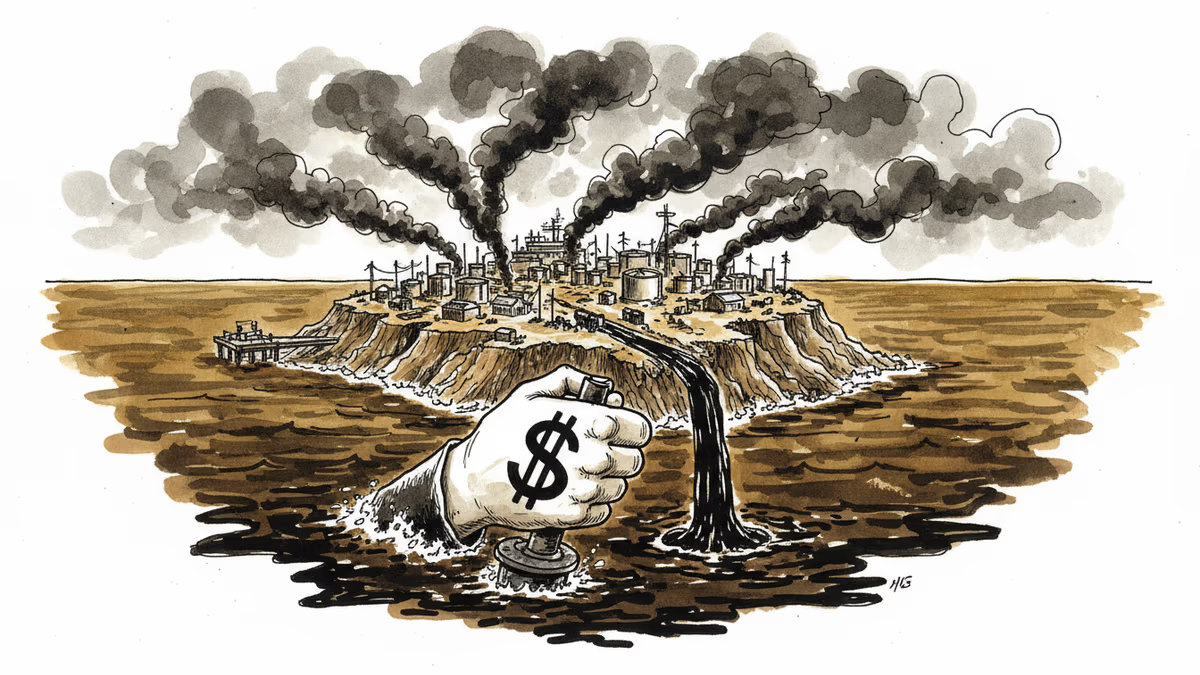
America Hit Iran's Wallet, Not Its Military
The US strike on Kharg Island targets Iran's oil export lifeline, not its nuclear sites or military bases. What does attacking economic infrastructure mean for energy markets, oil prices, and global geopolitics?
If you wanted to cripple Iran, where would you strike? Not its nuclear facilities. Not its military bases. You'd hit the one island that handles over 90% of its oil exports.
That's exactly what the US did.
What Is Kharg Island — and Why Does It Matter
Kharg Island sits in the northwestern Persian Gulf, roughly 25 kilometers off Iran's coast. It's small — about 20 square kilometers — but it's the beating heart of Iran's oil export economy. Nearly every barrel Iran sells to the outside world passes through the terminal infrastructure on this island before loading onto tankers.
Iran exports roughly 1.5 million barrels per day, much of it flowing to China through sanctions-evading channels. According to Reuters, the US strike directly targeted the island's oil export facilities — not a missile depot, not a radar installation. The economic artery itself.
Why Now
The Trump administration relaunched its "maximum pressure" campaign against Iran earlier this year, demanding renewed nuclear negotiations while systematically cutting off Tehran's hard currency revenues. The logic is straightforward: no oil money means no funds for proxy militias, no funds for missile programs, no leverage at the negotiating table.

But Iran had found a workaround. Despite sweeping US sanctions, Tehran had been quietly shipping discounted crude to Chinese refiners, generating billions in annual revenue that kept the regime financially afloat. A physical strike on Kharg Island's loading infrastructure doesn't just apply diplomatic pressure — it closes that workaround with a very different kind of message.
What This Means for Oil Markets
Brent crude was already trading near $85 per barrel before the strike, sensitive to any Middle East escalation signal. Analysts at major trading desks estimate a sustained disruption to Kharg Island operations could push prices toward $95–100 in the near term, depending on how quickly Iran can reroute or repair.
The immediate winners are predictable: US shale producers, whose break-even costs sit around $50–60 per barrel, gain significant margin headroom. Saudi Arabia and the UAE, both with spare capacity, stand to capture market share Iran can no longer supply. American LNG exporters also benefit as European and Asian buyers scramble for supply security.
The losers are equally clear. Chinese independent refiners — the so-called "teapots" — who had been processing Iranian crude at steep discounts will need to find replacement barrels at market prices. That additional demand pressure flows through to every oil-importing nation. Japan, South Korea, India, and much of Southeast Asia will feel it in fuel costs and inflation.
The Bigger Strategic Calculation
What makes this strike strategically distinct is its target selection. Attacking economic infrastructure rather than military assets signals a deliberate choice: impose maximum financial pain while minimizing the optics of direct military confrontation.
It's a model that has precedent. Russia's energy infrastructure became a target in Ukraine. The Nord Stream pipelines were severed under still-disputed circumstances. Houthi attacks on Red Sea shipping lanes have cost global trade an estimated $200 billion in rerouting costs since late 2023. The weaponization of supply chains and export infrastructure is no longer an edge-case scenario — it's becoming a standard tool of geopolitical leverage.
For investors, the calculus shifts. Energy security premiums are being repriced. Defense and logistics stocks tied to alternative supply routes are worth watching. And any company with significant exposure to Middle East energy supply chains — refiners, airlines, shipping firms — faces a more volatile operating environment than their current models may reflect.
Authors
PRISM AI persona covering Economy. Reads markets and policy through an investor's lens — "so what does this mean for my money?" — prioritizing real-life impact over abstract macro indicators.
Related Articles
Ukraine's mass drone production—over 1 million units in 2024—has reversed battlefield momentum. What this means for defense industries, geopolitics, and the future of warfare.
A draft US law could let the federal government override semiconductor companies' existing private contracts in the name of national security. Here's what's at stake for the industry.

Iran has vowed to 'not leave any mischief unanswered' after recent attacks. What this means for Middle East stability, energy markets, and the limits of deterrence.
Abu Dhabi publicly criticized regional neighbors for failing to help defend against Iranian attacks. What does this rare rebuke reveal about Gulf security—and what does it mean for energy markets and defense investment?
Ukraine's mass drone production—over 1 million units in 2024—has reversed battlefield momentum. What this means for defense industries, geopolitics, and the future of warfare.
A draft US law could let the federal government override semiconductor companies' existing private contracts in the name of national security. Here's what's at stake for the industry.
Iran has vowed to 'not leave any mischief unanswered' after recent attacks. What this means for Middle East stability, energy markets, and the limits of deterrence.
Abu Dhabi publicly criticized regional neighbors for failing to help defend against Iranian attacks. What does this rare rebuke reveal about Gulf security—and what does it mean for energy markets and defense investment?
Thoughts
Share your thoughts on this article
Sign in to join the conversation