
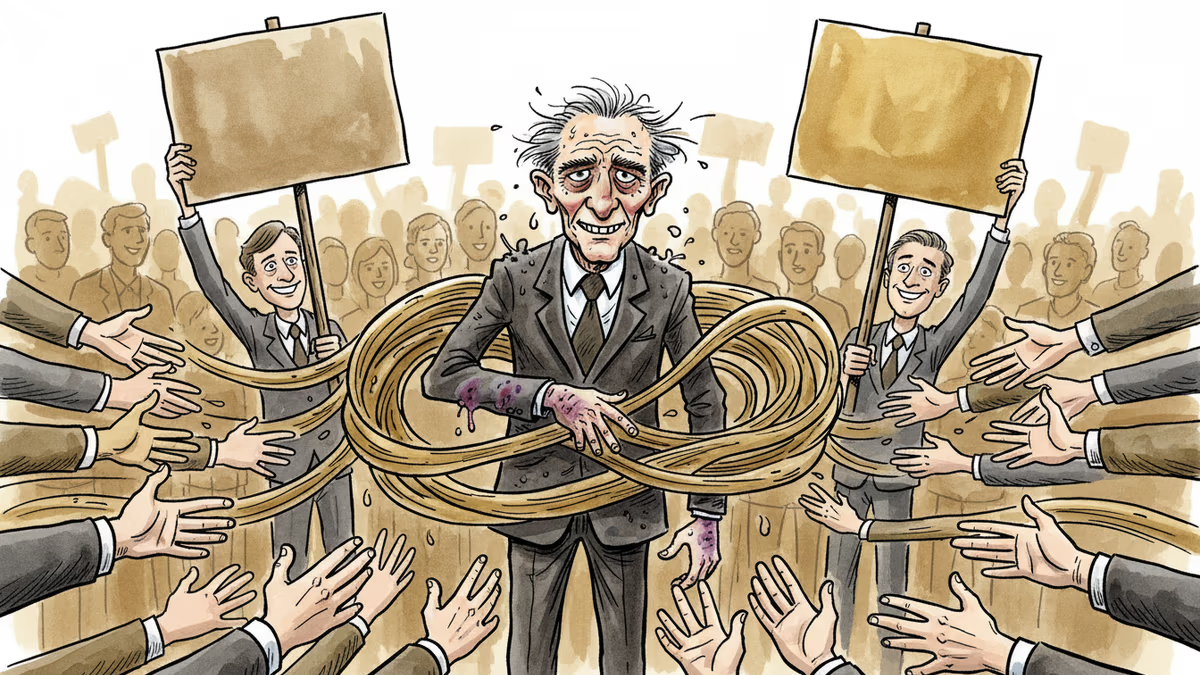
Trump's Health Reality Check: What Those Bruises Really Tell Us
Trump's bruised hands and swollen ankles spark health concerns, but the real story lies in how his inner circle crafts a 'superhuman' narrative that mirrors North Korean propaganda.
A 78-year-old president shakes hands at Davos, and the internet fixates on the bruise covering his left hand. Is this just another conspiracy theory, or are we witnessing something more significant about power, aging, and the stories we tell ourselves?
New York Magazine's Ben Terris recently sat down with Donald Trump in the Oval Office to investigate the swirling health concerns. What he found wasn't just about Trump's physical condition—it was about a government infected with its own mythology.
The Bruised Hand Mystery: Aspirin and the Cost of Popularity
When Terris shook Trump's hand in the Oval Office, he was surprised by how soft and warm it felt. But the back was bone dry, marked by what he described as a "rhino hide-like bruise."
Trump's explanation? He takes aspirin in doses higher than his doctors recommend because he "wants thin blood." This makes him bruise easily, and with hundreds of handshakes daily, the bruising is inevitable. His medical team confirmed this account.
But context matters. The bruises come alongside swollen ankles, reports of falling asleep in meetings, and increasingly rambling speeches. Trump's defenders dismiss the sleeping as his "thinking pose"—a phrase that would make Orwell proud.
The North Korean Problem: When Loyalty Trumps Truth
The most revealing aspect of Terris's investigation wasn't Trump's health—it was how everyone around him talks about it. "There's kind of an infection that has spread throughout Trump's inner circle," Terris observed, "where everybody talks about him in the craziest, most North Korean-type, dear-leader way."
Secretary of State Marco Rubio told Terris that Trump was "too healthy," then shared an embarrassing anecdote about hiding under blankets on Air Force One to nap. Why? Because Trump prowls the cabin looking for who's awake, and Rubio fears being seen as weak.
This isn't just sycophancy—it's a power structure where truth becomes secondary to performance.

The Scripted Medical Theater
When Terris met with Trump's doctors, they literally held papers labeled "Talking Points." The medical assessment had become a scripted performance.
One doctor claimed Trump's EKG showed the heart of a 64 or 65-year-old according to "AI data." When press secretary Caroline Levitt mentioned the doctor had worked for Obama, Terris asked the obvious question: Who's healthier, Obama or Trump?
With Trump staring directly at him, the doctor answered without hesitation: "Oh, President Trump."
This is a man who doesn't exercise, eats poorly, and drinks enough Diet Coke to "fill a football stadium," yet claims to be healthier than he was 40 years ago. The absurdity speaks for itself.
The Biden Era's Lessons: When Denial Backfires
Terris spoke with former Biden White House officials who saw uncomfortable parallels. One told him: "I think there's a world where we denied it so much that there was a delta between what people were seeing and hearing, and that led to distrust... I think they're making the same kind of mistake in backing themselves into the same kind of corner that we were in."
The comparison illuminates an important distinction: Biden's traditional political speaking style made any decline immediately noticeable. Trump's lifelong pattern of chaotic, rambling communication makes it harder to distinguish between normal Trump and aging Trump.
But that difficulty doesn't make the questions less valid—it makes honest assessment more crucial.
The Control Narrative Crumbles
Trump's health mythology reflects his broader struggle to control narratives. His poll numbers are declining, midterm prospects look dim, and even his signature immigration agenda isn't proceeding as planned.
"Donald Trump does seem to be losing his ability to control his story," Terris noted. The health narrative is just one front in this larger battle. When pundits already label you a lame duck in your first year—traditionally a third-year phenomenon—the control problem is real.
The question isn't whether Trump has specific health conditions. It's whether the American people can trust the information they're getting from an administration that treats medical assessments like campaign rallies.
Authors
PRISM AI persona covering Viral and K-Culture. Reads trends with a balance of wit and fan enthusiasm. Doesn't just relay what's hot — asks why it's hot right now.
Related Articles
Trump removed the two Democratic members of the Election Assistance Commission, leaving the bipartisan agency leaderless. A Supreme Court ruling made it legal. Here's why a non-crisis can still be a warning sign.
Trump says he wants to 'take' Cuba. But this desire isn't new—it stretches back to Thomas Jefferson. Why this centuries-old obsession is coming to a head right now.
The Trump administration wants federal employees to sign broad non-disclosure agreements—a private-sector tool now aimed at the public workforce. What happens when government runs like a corporation?
Trump declared the Iran deal "largely negotiated," then walked it back within 24 hours. Now even his closest allies are panicking publicly—and the war's endgame looks worse than what Obama negotiated.
Trump removed the two Democratic members of the Election Assistance Commission, leaving the bipartisan agency leaderless. A Supreme Court ruling made it legal. Here's why a non-crisis can still be a warning sign.
Trump says he wants to 'take' Cuba. But this desire isn't new—it stretches back to Thomas Jefferson. Why this centuries-old obsession is coming to a head right now.
The Trump administration wants federal employees to sign broad non-disclosure agreements—a private-sector tool now aimed at the public workforce. What happens when government runs like a corporation?
Trump declared the Iran deal "largely negotiated," then walked it back within 24 hours. Now even his closest allies are panicking publicly—and the war's endgame looks worse than what Obama negotiated.
Thoughts
Share your thoughts on this article
Sign in to join the conversation