
The Pentagon Blacklisted an AI Company for Talking to the Press
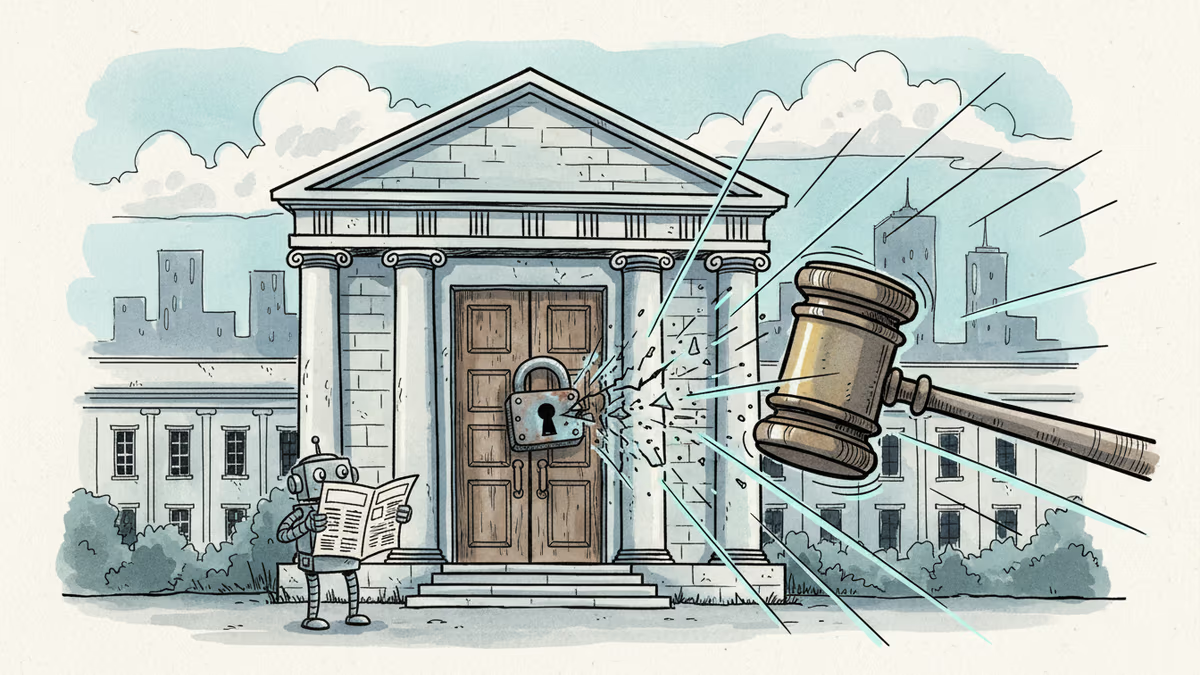
A federal judge blocked the Pentagon's blacklisting of Anthropic, ruling that punishing a company for public criticism of government policy is a textbook First Amendment violation.
The U.S. government put an AI company on a blacklist. The stated reason: it had been too vocal in the press.
What Actually Happened
Federal District Judge Rita F. Lin, sitting in the Northern District of California, granted Anthropic a preliminary injunction last week — a court order that temporarily blocks the Pentagon's blacklisting of the company while the underlying lawsuit proceeds. The injunction takes effect in seven days.
The reason it was granted matters more than the ruling itself. Court records show that the Department of Defense designated Anthropic as a "supply chain risk" specifically because of its "hostile manner through the press." Judge Lin's language in the order was unambiguous: "Punishing Anthropic for bringing public scrutiny to the government's contracting position is classic illegal First Amendment retaliation."
In plain terms: a federal agency put a private company on a blacklist because that company criticized the government publicly. A judge called that unconstitutional.
How We Got Here
Anthropic, the San Francisco-based AI safety company behind the Claude model family and backed by billions from Google and Amazon, had been locked in a weeks-long standoff with the Pentagon over a government contract. The specifics of what Anthropic said publicly — and what contract was at stake — haven't been fully disclosed. But the structure of the dispute is now on record: the company raised concerns, did so openly, and was removed from government contracting consideration as a result.

For any tech company, a federal blacklist isn't just about losing one contract. Being designated a supply chain risk can effectively close off the entire federal procurement market — a sector worth hundreds of billions of dollars annually, and one that every major AI company is actively courting.
Three Ways to Read This
For civil liberties advocates, this is a clean case. The First Amendment protects speech from government retaliation, and courts have long extended that protection to corporations in commercial contexts. A government agency using procurement power to punish a company for public criticism fits the definition of unconstitutional retaliation almost perfectly — which is likely why Judge Lin's language was so direct.
For the defense establishment, the picture is more complicated. "Supply chain risk" designations exist for legitimate national security reasons, and agencies have historically exercised broad discretion in that space. If this ruling is upheld and eventually made permanent, it would meaningfully constrain the government's ability to use procurement exclusions as a tool — even when framed in security terms.
For the broader AI industry, the stakes are quietly significant. OpenAI, Google DeepMind, Microsoft, and Meta all have existing or actively pursued relationships with defense and intelligence agencies. The unspoken question this case raises: can an AI company publicly object to how the government wants to use its technology — and still keep its government contracts? Until now, the answer was unclear. This case is beginning to draw a legal line.
The Tension Underneath
Anthropics's public identity is built around AI safety — the idea that powerful AI systems need careful oversight and that the company has a responsibility to flag risks, including risks posed by how AI gets deployed. That mission is straightforward when the concern is a consumer product. It becomes structurally awkward when the entity whose AI use you're questioning is also your largest potential customer.
This isn't unique to Anthropic. It's a tension baked into the entire enterprise of AI safety as a business model. Companies that market themselves on responsible development will inevitably face moments where responsible development means saying something inconvenient to a powerful stakeholder. The question is whether they can do that without losing the contracts that fund the research.
This case won't resolve that tension. But it may determine whether companies even have the legal right to try.
Authors
Related Articles
Anthropic shipped Claude Sonnet 5, its mid-tier agent model, on June 30. Behind the 'Opus-class power, budget price' headline sits a tokenizer catch and a three-horse race that's only half real. Here's what developers should actually run the numbers on.
China is restricting AI researchers and startup founders from traveling abroad as the U.S.-China AI performance gap narrows to just 2.7%. What Beijing's talent lockdown means for the global AI race.
A small but growing group of developers has gone all-in on AI coding agents like Claude Code and OpenClaw. History suggests the rest of us won't be far behind.
OpenAI's new Daybreak initiative uses the Codex AI agent to find and patch security vulnerabilities before attackers do—putting it in direct competition with Anthropic's secretive Claude Mythos.
Anthropic shipped Claude Sonnet 5, its mid-tier agent model, on June 30. Behind the 'Opus-class power, budget price' headline sits a tokenizer catch and a three-horse race that's only half real. Here's what developers should actually run the numbers on.
China is restricting AI researchers and startup founders from traveling abroad as the U.S.-China AI performance gap narrows to just 2.7%. What Beijing's talent lockdown means for the global AI race.
A small but growing group of developers has gone all-in on AI coding agents like Claude Code and OpenClaw. History suggests the rest of us won't be far behind.
OpenAI's new Daybreak initiative uses the Codex AI agent to find and patch security vulnerabilities before attackers do—putting it in direct competition with Anthropic's secretive Claude Mythos.
Thoughts
Share your thoughts on this article
Sign in to join the conversation