
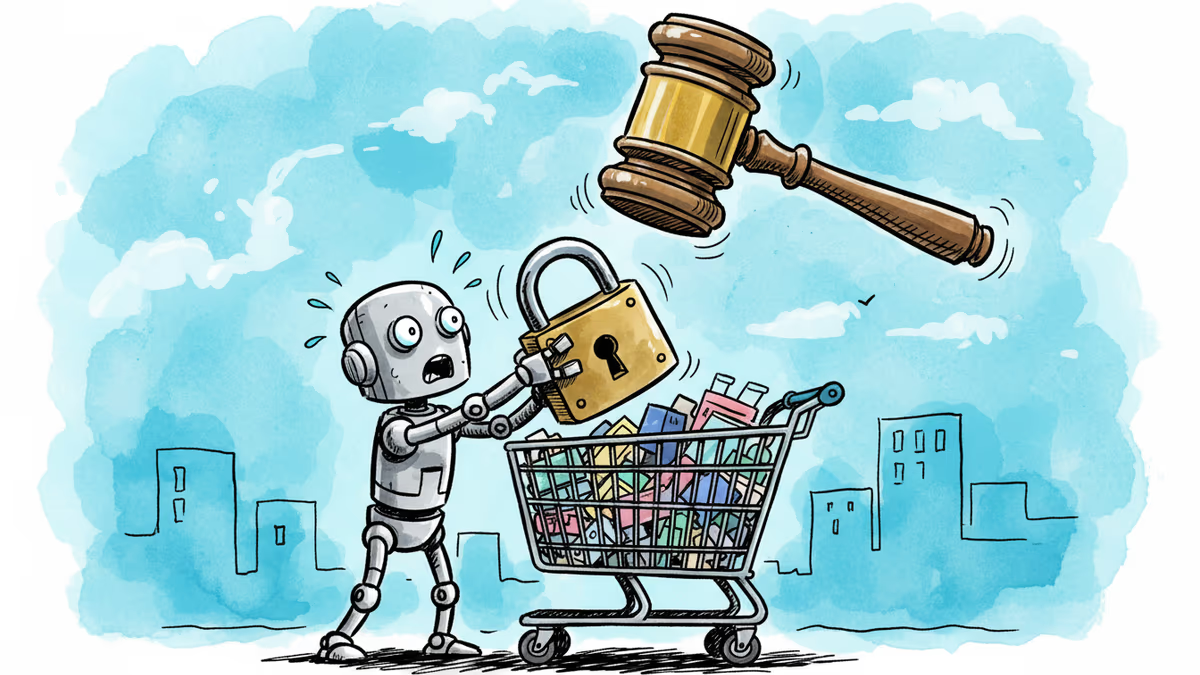
A Judge Just Drew a Line Around Your Amazon Account
A federal court has blocked Perplexity's AI agent from placing Amazon orders on users' behalf. The ruling sets a precedent that could reshape how AI agents operate across the entire internet.
Your AI assistant just got a restraining order.
You told your AI to order laundry detergent from Amazon. It logged into your account, found the product, and was about to hit 'Buy Now'—exactly what you asked it to do. A federal judge just said: not so fast.
What Happened
US District Judge Maxine Chesney issued a preliminary injunction on Monday blocking Perplexity's AI agent from placing Amazon orders on behalf of users. The ruling states that Amazon provided "strong evidence" that Perplexity's Comet browser accesses user accounts "without authorization" from the retail giant.
Amazon filed the lawsuit back in November, claiming it had "repeatedly requested" that Perplexity stop allowing its agents to shop for customers. The core accusation: Comet was "intruding" into Amazon's marketplace and user accounts through its agentic shopping feature.
For those unfamiliar with Comet: it's Perplexity's AI-powered browser where the AI doesn't just suggest—it acts. Tell it to reorder your coffee, and it navigates to Amazon, logs in with your credentials, finds the product, and completes the purchase. The AI does the clicking so you don't have to.
Why This Case Is Bigger Than Two Companies Fighting
This isn't a trademark spat or a patent dispute. It's a collision between two fundamentally different visions of how the internet should work in the age of AI agents.
2025 and 2026 are the years AI agents went from demo to deployment. OpenAI's Operator, Anthropic's Computer Use, Google's Project Mariner—every major AI lab has launched or is launching a product that browses the web and takes actions on your behalf. The entire premise of these products is that they operate on top of existing platforms, without those platforms' explicit permission.

Amazon's position is that this model is unacceptable. Every transaction flowing through a third-party AI is a transaction that bypasses Amazon's recommendation engine, its ad system, and its ability to collect behavioral data. The business model of the world's largest e-commerce company depends on owning the relationship between shopper and product. An AI middleman breaks that.
Perplexity's counter-argument, implicit in its product design, is that users have the right to delegate access to their own accounts to whomever they choose.
Three Stakeholders, Three Very Different Problems
For consumers, the ruling is uncomfortable in a specific way. You gave Perplexity permission to use your account. You wanted it to shop for you. The court just ruled that your permission wasn't enough—Amazon's permission matters too. That raises a genuine question about who actually controls your account.
For Amazon, this is a defensive move that's also strategically convenient. Yes, there are real security arguments: an AI agent accessing millions of accounts through a third-party browser creates attack surface. But Amazon is also protecting the commercial architecture that generates billions in advertising revenue. The two motivations aren't mutually exclusive.
For AI startups like Perplexity, the implications are existential. If every major platform can block AI agents from operating on their turf without a formal partnership agreement, then agentic AI becomes a game only well-capitalized incumbents can play. A startup can't negotiate API access deals with Amazon, Walmart, United Airlines, and Bank of America simultaneously. The legal landscape could quietly consolidate the AI agent market before it even fully forms.
The Authorization Problem Nobody Has Solved
The deepest issue this case surfaces is definitional: what counts as "authorization"?
Right now, US courts appear to be saying that user consent alone is insufficient—platform consent is also required. If that logic holds and spreads, the practical consequence is that AI agents will need formal agreements with every service they touch. That's either a massive bureaucratic hurdle or an opportunity for platforms to build monetized API ecosystems for AI access.
Some early movement in the latter direction is already visible. Certain airlines and hotel chains have begun experimenting with dedicated channels for AI agent bookings. It's possible the industry converges on an open standard—something like an "AI agent handshake" protocol—that lets platforms control access without banning it outright.
But that future isn't guaranteed. And until it arrives, every AI agent company is operating in legal territory that a single court ruling can redraw overnight.
Authors
Related Articles
Northeastern University researchers manipulated AI agents into divulging data, crashing systems, and spiraling into loops—just by exploiting their built-in good behavior.
Anthropic's new Auto Mode for Claude Code lets AI flag and block risky actions before they run. It's a clever fix for agentic AI's biggest problem — but who decides what "risky" means?
Anthropic has launched a research preview letting Claude autonomously operate your Mac—opening files, browsing the web, running dev tools. Here's what it means for work, privacy, and the AI agent race.
A California jury ruled Elon Musk intentionally misled Twitter investors with a 2022 tweet about bots. Damages could reach $2.6 billion — and the verdict raises bigger questions about CEO speech in the social media era.
Northeastern University researchers manipulated AI agents into divulging data, crashing systems, and spiraling into loops—just by exploiting their built-in good behavior.
Anthropic's new Auto Mode for Claude Code lets AI flag and block risky actions before they run. It's a clever fix for agentic AI's biggest problem — but who decides what "risky" means?
Anthropic has launched a research preview letting Claude autonomously operate your Mac—opening files, browsing the web, running dev tools. Here's what it means for work, privacy, and the AI agent race.
A California jury ruled Elon Musk intentionally misled Twitter investors with a 2022 tweet about bots. Damages could reach $2.6 billion — and the verdict raises bigger questions about CEO speech in the social media era.
Thoughts
Share your thoughts on this article
Sign in to join the conversation