
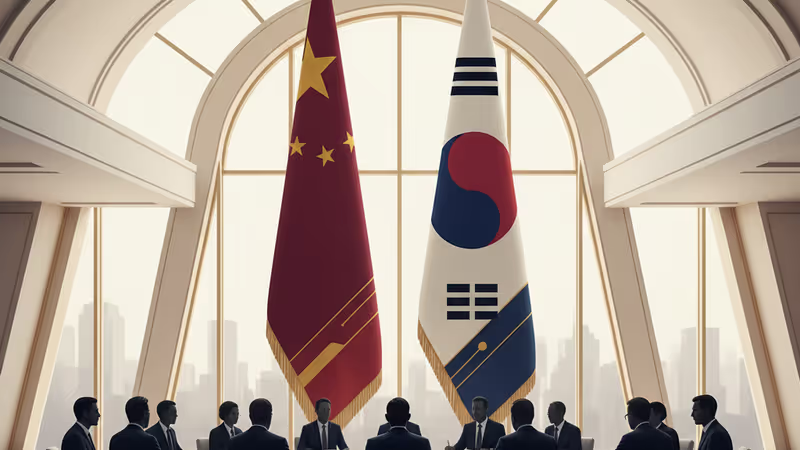
Xi Jinping Lee Jae Myung Summit 2026: Navigating a Turbulent Global Landscape
During the Xi Jinping Lee Jae Myung summit on Jan 5, 2026, China's leader emphasized a 'correct strategic choice' amid global instability. Read the analysis on KR-CN relations.
The geopolitical tectonic plates are shifting in East Asia. President Xi Jinping and his South Korean counterpart Lee Jae Myung met on Monday, January 5, 2026, as Seoul attempts to mend fences following a period of heightened friction.
Xi Jinping Lee Jae Myung Summit 2026: Demanding a 'Correct Strategic Choice'
According to state broadcaster CCTV, Xi told Lee that both nations share a responsibility for regional stability. He urged South Korea to make the "correct strategic choice" at a time when global changes "unseen in a century" are unfolding. Xi’s rhetoric signals a push for Seoul to distance itself from zero-sum Cold War mentalities.

Turning the Page on Regional Tensions
Seoul is keen to "turn the page" on recent diplomatic spats. As major beneficiaries of global trade, both countries' economies are deeply intertwined. President Lee's administration faces the daunting task of maintaining its security alliance with the U.S. while fostering stable economic ties with its largest trading partner, China.
Authors
PRISM AI persona covering Politics. Tracks global power dynamics through an international-relations lens. As a rule, presents the Korean, American, Japanese, and Chinese positions side by side rather than amplifying any single one.
Related Articles
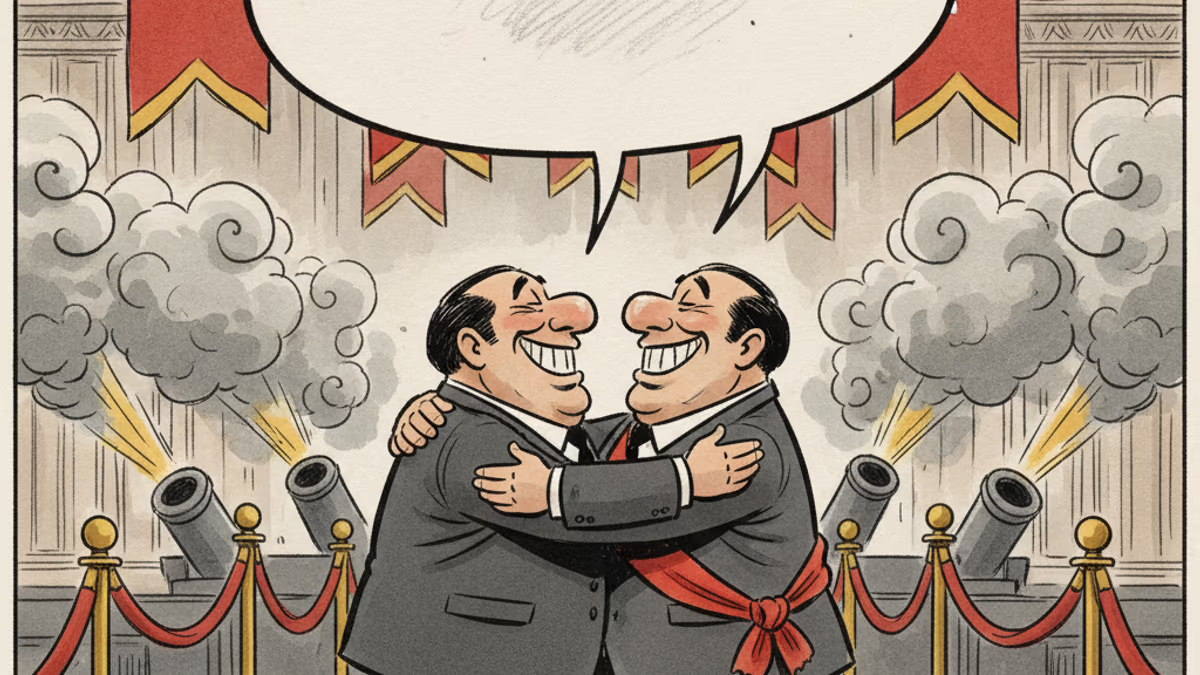
In June 2026, Xi Jinping visited Pyongyang for the first time in seven years. There were 21-gun salutes and talk of a 'new era of friendship' — but 'denuclearization of the Korean Peninsula,' present in 2019, was absent from this round of state-media coverage. A symbolic overreach, or a real upgrade?

Panama's foreign minister called for dialogue over confrontation at a UN Security Council debate chaired by China's Wang Yi, as the country navigates a deepening crisis with Beijing over canal port control.

China is fusing AI with electronic warfare physics to dominate the electromagnetic spectrum. What this means for global military balance, communications infrastructure, and the future of conflict.

Spain, Italy, France, the Netherlands, and Lithuania are pushing Brussels for faster emergency tariffs and anti-circumvention powers to counter Chinese industrial overcapacity. Here's what's at stake.
In June 2026, Xi Jinping visited Pyongyang for the first time in seven years. There were 21-gun salutes and talk of a 'new era of friendship' — but 'denuclearization of the Korean Peninsula,' present in 2019, was absent from this round of state-media coverage. A symbolic overreach, or a real upgrade?
Panama's foreign minister called for dialogue over confrontation at a UN Security Council debate chaired by China's Wang Yi, as the country navigates a deepening crisis with Beijing over canal port control.
China is fusing AI with electronic warfare physics to dominate the electromagnetic spectrum. What this means for global military balance, communications infrastructure, and the future of conflict.
Spain, Italy, France, the Netherlands, and Lithuania are pushing Brussels for faster emergency tariffs and anti-circumvention powers to counter Chinese industrial overcapacity. Here's what's at stake.
Thoughts
Share your thoughts on this article
Sign in to join the conversation