
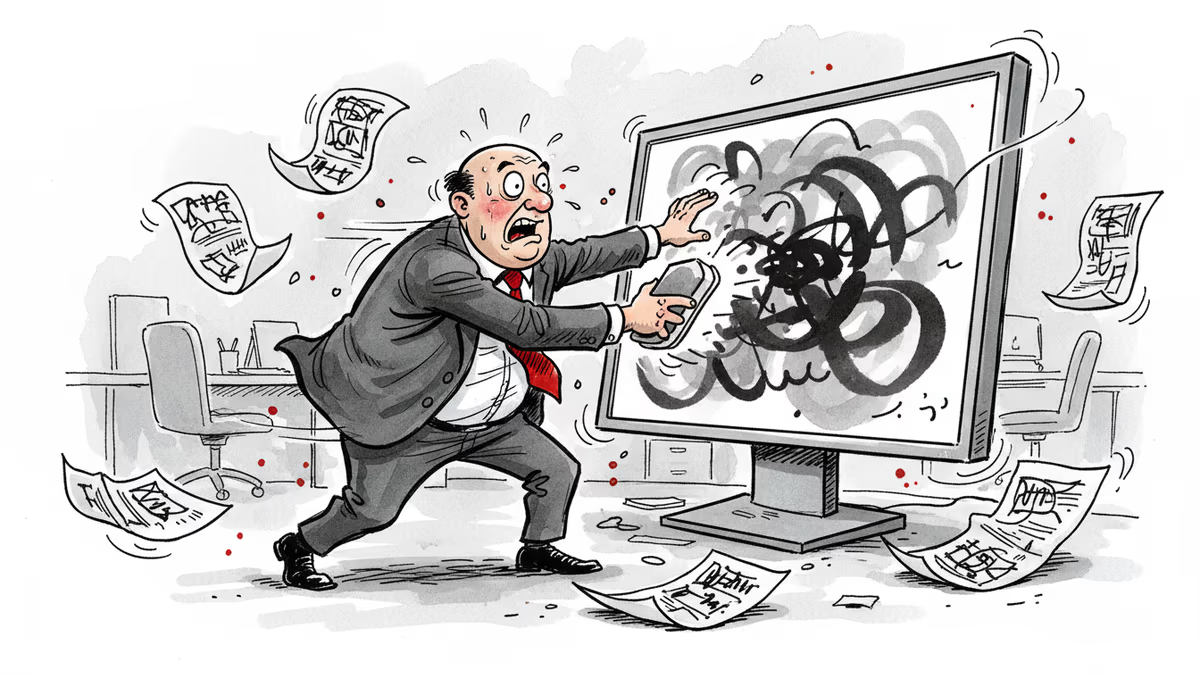
The Dead Predator's Guide to Erasing Yourself from Google
Jeffrey Epstein's systematic attempts to manipulate his online presence reveal how the powerful game digital truth in plain sight.
"I want the Google page cleaned." Five words. Sent on November 5th, 2010. The author? Jeffrey Epstein, a man who somehow found time between trafficking minors and schmoozing with world leaders to obsess over his Wikipedia entry.
Newly released court documents reveal Epstein's three-year campaign to scrub his digital footprint clean. From 2010 to 2013, he peppered associates with requests: fix my wiki page, clean up Google results, make the bad stuff disappear. It wasn't just vanity—it was a blueprint for how power manipulates truth in the digital age.
The Fixer's Playbook
Al Seckel was Epstein's digital cleaner. Not a household name, but the kind of person the powerful call when reality needs editing. Their methods were surprisingly straightforward, which makes them terrifyingly replicable.
Wikipedia warfare came first. Epstein repeatedly asked to "clean up" his Wikipedia page—that supposedly neutral, crowdsourced encyclopedia. The irony? Wikipedia's strength (anyone can edit) became its vulnerability (anyone can edit).
Next: reverse SEO manipulation. Push negative stories down in search results, promote positive or neutral content. It's search engine optimization in reverse—instead of rising to the top, you're burying the truth at the bottom.
The scary part? It worked. For years, Epstein maintained a public persona as a philanthropist and science patron while operating a sex trafficking ring.
The Epstein Method Goes Mainstream
What Epstein did manually in 2010, entire industries do systematically today. Online reputation management is now a $5 billion market. Companies like ReputationDefender and NetReputation offer "reputation protection" services to anyone with a credit card and something to hide.
The tools have evolved: AI-generated content farms, bot networks for fake reviews, sophisticated SEO manipulation, coordinated social media campaigns. What once required personal fixers now runs on automation.

Silicon Valley executives caught in scandals, politicians with inconvenient pasts, corporations with toxic track records—they're all using variations of the Epstein playbook. The difference is scale and sophistication.
The Wikipedia Problem
Epstein's obsession with Wikipedia wasn't random. It's often the first result for name searches, and Google frequently pulls from it for knowledge panels. Control Wikipedia, control the narrative.
But here's the catch: Wikipedia's editor community has grown wise to manipulation attempts. They've developed sophisticated tools to detect coordinated editing campaigns. Yet the arms race continues—for every defense Wikipedia builds, bad actors develop new workarounds.
The platform faces an impossible choice: remain open and editable (and vulnerable to manipulation) or become more restrictive (and lose its democratic character).
The Algorithmic Blindspot
Search engines and social platforms claim algorithmic neutrality, but Epstein's case shows how easily these systems can be gamed. Google's PageRank algorithm, Facebook's engagement metrics, Twitter's trending topics—they're all vulnerable to manipulation by those who understand the rules.
The platforms know this. They employ thousands of engineers to detect and prevent manipulation. But it's a cat-and-mouse game where the mice have unlimited resources and strong motivation.
What We're Not Seeing
Epstein's digital cleanup efforts raise an uncomfortable question: How much of what we see online is manufactured? If a convicted sex offender could maintain a positive online presence for years, what about people who haven't been caught?
Consider the implications:
- Business leaders with hidden scandals
- Politicians with scrubbed histories
- Products with buried safety issues
- Movements with manufactured grassroots support
We live in an information ecosystem where visibility equals legitimacy, where search rankings determine credibility, where the loudest voice often drowns out the truth.
Authors
Related Articles
Planet Labs halts Middle East satellite imagery release as regional war intensifies. When private companies control the eyes in the sky, who decides what the world gets to see?
Samsung Electronics' union branch revealed that 84% of survey respondents oppose the government's roughly $290 billion (₩400 trillion) semiconductor megaproject in Gwangju. Government, management, the union and shareholders are all reading the same national project in sharply different ways.
Nvidia shipped roughly a billion RISC-V cores in 2024, then announced it would run CUDA on the open standard. We break down how royalty-free instruction sets and open software stacks are trying to route around CUDA's lock-in. Part 2 of the Semiconductor Sovereignty series.
US AI-chip export controls split into three layers in the first half of 2026 — January easing, a May crackdown on circumvention, and a pending bill. Nvidia erased China from its guidance and still posted a record $81.6 billion quarter. A look at the export policy that both shields and cages it.
Planet Labs halts Middle East satellite imagery release as regional war intensifies. When private companies control the eyes in the sky, who decides what the world gets to see?
Samsung Electronics' union branch revealed that 84% of survey respondents oppose the government's roughly $290 billion (₩400 trillion) semiconductor megaproject in Gwangju. Government, management, the union and shareholders are all reading the same national project in sharply different ways.
Nvidia shipped roughly a billion RISC-V cores in 2024, then announced it would run CUDA on the open standard. We break down how royalty-free instruction sets and open software stacks are trying to route around CUDA's lock-in. Part 2 of the Semiconductor Sovereignty series.
US AI-chip export controls split into three layers in the first half of 2026 — January easing, a May crackdown on circumvention, and a pending bill. Nvidia erased China from its guidance and still posted a record $81.6 billion quarter. A look at the export policy that both shields and cages it.
Thoughts
Share your thoughts on this article
Sign in to join the conversation