

Japan's H3 Rocket Fails Mid-Flight, Dealing Blow to National Space Ambitions
Japan's next-generation H3 rocket failed 30 minutes after its December 22 launch, following a second-stage engine malfunction. The setback impacts Japan's commercial space launch ambitions.
The Breakdown
Japan's flagship H3 rocket launch failed on Monday, just 30 minutes after liftoff, after its second-stage engine shut down prematurely. Japan's space agency, JAXA, announced it is investigating the cause of the failure, which represents a significant setback for the nation's effort to build a competitive foothold in the crowded global launch market.
Japan's attempt to launch its next-generation H3 rocket ended in failure on December 22. According to a statement from the Japan Aerospace Exploration Agency (JAXA), the rocket, which lifted off from the Tanegashima Space Center, experienced a "premature end of engine burn" in its second stage.

The rocket was carrying the Michibiki No. 5 satellite, intended to join Japan's Quasi-Zenith Satellite System, a regional GPS augmentation network. The payload is presumed to be lost following the launch failure.
"We are investigating the cause," a JAXA representative stated in a press briefing following the event. This failure doesn't just delay a single mission; it casts a shadow over Japan's broader strategy to secure autonomous access to space and capture a larger share of the commercial satellite launch industry. The H3's success is critical for Japan to prove it can adapt to the new, cost-driven realities of the space economy.
Authors
Related Articles

Phantom Space acquired assets from bankrupt Vector Launch, showing how failed space companies' technologies are finding new life. Is this becoming the new normal in aerospace?
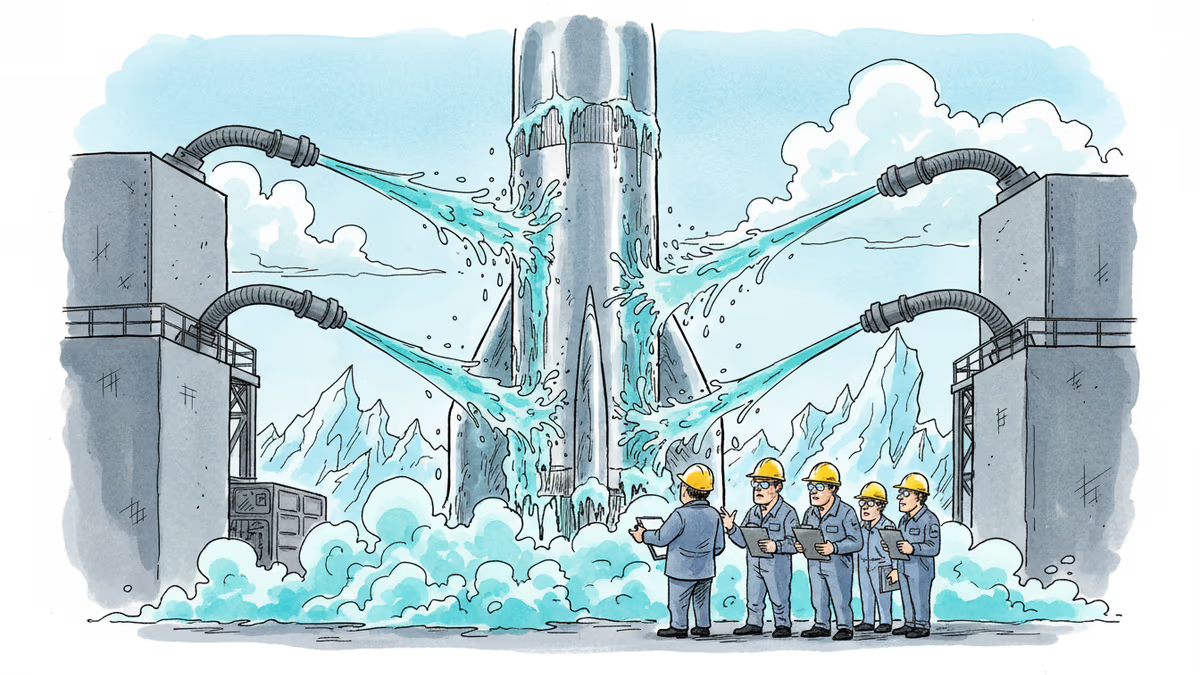
SpaceX completes cryogenic proof testing on Super Heavy booster, marking a critical safety milestone after previous rocket failures. What this means for the space industry.

GRU Space opens deposits up to $1 million for its ambitious lunar hotel project. Can a small startup build a luxury hotel on the Moon within 6 years?

Japan postpones the H3 Rocket Flight 9 launch to investigate Flight 8's issues. As the gov pledges 1 trillion yen for space tech, JAXA prioritizes reliability over speed.
Phantom Space acquired assets from bankrupt Vector Launch, showing how failed space companies' technologies are finding new life. Is this becoming the new normal in aerospace?
SpaceX completes cryogenic proof testing on Super Heavy booster, marking a critical safety milestone after previous rocket failures. What this means for the space industry.
GRU Space opens deposits up to $1 million for its ambitious lunar hotel project. Can a small startup build a luxury hotel on the Moon within 6 years?
Japan postpones the H3 Rocket Flight 9 launch to investigate Flight 8's issues. As the gov pledges 1 trillion yen for space tech, JAXA prioritizes reliability over speed.
Thoughts
Share your thoughts on this article
Sign in to join the conversation