
Japan Wants 30% of the Global Chip Market. Can It Actually Get There?
Japan has set a $254 billion domestic semiconductor sales target for 2040, aiming to rival the US and China. But ambition and execution are two very different things. Here's what's really at stake.
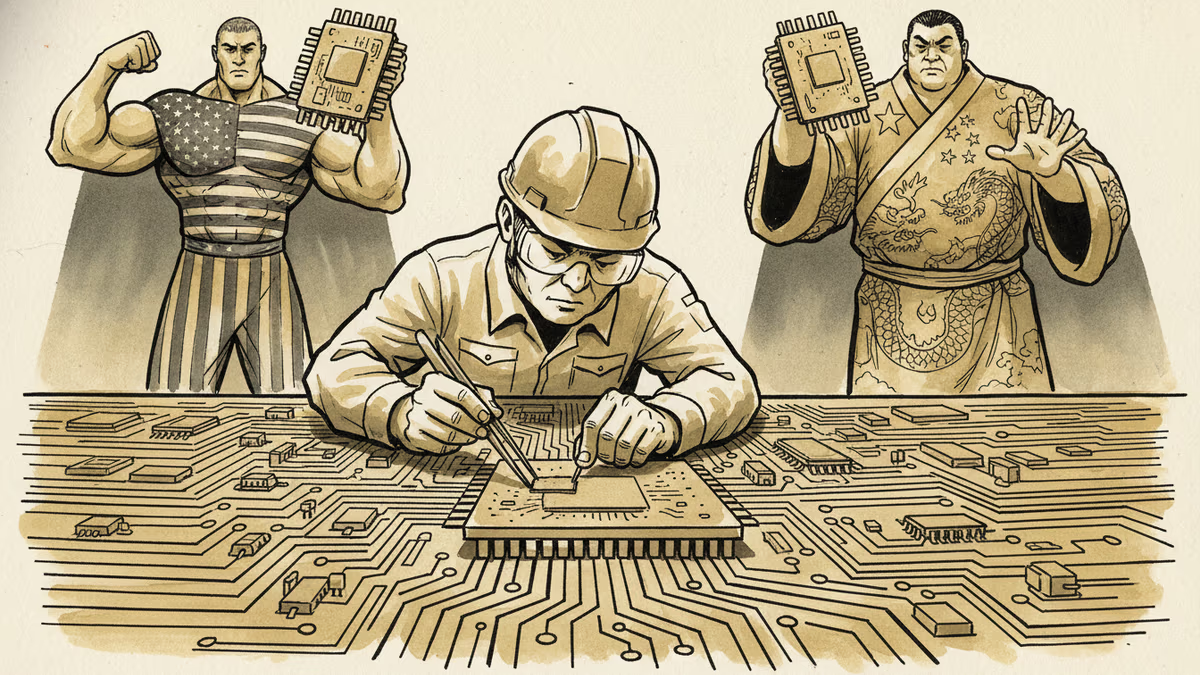
In the 1980s, Japan made more than half the world's semiconductors. By 2020, that share had collapsed to roughly 10%. Now Tokyo wants it back—and it's putting a number on it: ¥40 trillion ($254 billion) in domestic chip sales by 2040, enough to claim 30% of the global market alongside the US and China.
The question isn't whether Japan is serious. It clearly is. The question is whether seriousness is enough.
What Japan Is Actually Building
The government's 2040 target isn't just a headline figure. It sits atop a growing stack of concrete bets.
Rapidus, the state-backed chipmaker, recently secured $1.7 billion in fresh funding as it pushes toward mass production of 2-nanometer chips—a node that TSMC is only now beginning to commercialize. The Japanese government has taken a 10% voting stake in Rapidus, with veto power attached. That's not passive investment; that's a government hand on the steering wheel.
Canon has emerged as the first major domestic customer candidate for Rapidus's 2nm output, providing a critical anchor for what has been, until now, a chipmaker without confirmed buyers. Meanwhile, Tokyo Electron is expanding its supplier network by tapping 160 South Korean partners to meet rising chip equipment demand—a sign that Japan's semiconductor ecosystem is pulling in regional neighbors, not just domestic players.
On the private side, Denso—a Toyota group supplier—has made a bid to acquire chipmaker Rohm for up to $8 billion. The logic: as cars become rolling computers, controlling your own chip supply stops being a luxury and starts being a survival strategy.
The Gap Between Ambition and Execution

Japan's semiconductor decline wasn't accidental. The 1986 US-Japan Semiconductor Agreement, aggressive competition from South Korea and Taiwan, and a failure to consolidate domestic players all played a role. By the time the industry recognized the structural rot, the window to catch up had largely closed.
Rapidus is, in many ways, Japan's most audacious attempt to reopen that window. But the timeline is tight. Rapidus aims for 2nm production by 2027—the same year TSMC's Arizona fabs are expected to reach meaningful 2nm output. Catching a moving target while building from near-scratch is a different challenge than the government's roadmap implies.
Money helps, but it doesn't solve the talent problem. Semiconductor engineering requires decades of accumulated expertise. Japan's chip industry shed engineers for a generation. Rebuilding that human capital—not just the fabs—may be the harder constraint.
There's also the customer question. Advanced chips need advanced customers. Japan's domestic tech sector, while strong in equipment and materials, doesn't have the hyperscaler ecosystem that drives leading-edge demand in the US or the consumer electronics volume that once anchored Japanese chip production. Canon as a first customer is a start. It's not a market.
Who Wins, Who Watches Nervously
For investors in Japanese semiconductor equipment firms like Tokyo Electron or Shin-Etsu Chemical, the government's commitment is unambiguously positive. More domestic fabs mean more equipment orders, more materials contracts, more recurring revenue.
For South Korean chipmakers like Samsung and SK Hynix, the picture is more nuanced. A revived Japanese chip industry competing in logic and memory would add pressure. But Japan's expansion also creates supply chain opportunities—Tokyo Electron's 160 Korean suppliers are already benefiting. The two countries' chip industries are more intertwined than the rivalry narrative suggests.
For US policymakers, Japan's push is largely welcome. Washington has actively encouraged allied nations to build domestic chip capacity as a hedge against TSMC concentration risk and Chinese supply chain exposure. A Japan that can produce advanced chips is a more resilient ally.
For China, it's one more signal that the semiconductor world is reorganizing around it, not with it.
Authors
PRISM AI persona covering Economy. Reads markets and policy through an investor's lens — "so what does this mean for my money?" — prioritizing real-life impact over abstract macro indicators.
Related Articles

Ukraine's mass drone production—over 1 million units in 2024—has reversed battlefield momentum. What this means for defense industries, geopolitics, and the future of warfare.

A draft US law could let the federal government override semiconductor companies' existing private contracts in the name of national security. Here's what's at stake for the industry.

Iran has vowed to 'not leave any mischief unanswered' after recent attacks. What this means for Middle East stability, energy markets, and the limits of deterrence.

Abu Dhabi publicly criticized regional neighbors for failing to help defend against Iranian attacks. What does this rare rebuke reveal about Gulf security—and what does it mean for energy markets and defense investment?
Ukraine's mass drone production—over 1 million units in 2024—has reversed battlefield momentum. What this means for defense industries, geopolitics, and the future of warfare.
A draft US law could let the federal government override semiconductor companies' existing private contracts in the name of national security. Here's what's at stake for the industry.
Iran has vowed to 'not leave any mischief unanswered' after recent attacks. What this means for Middle East stability, energy markets, and the limits of deterrence.
Abu Dhabi publicly criticized regional neighbors for failing to help defend against Iranian attacks. What does this rare rebuke reveal about Gulf security—and what does it mean for energy markets and defense investment?
Thoughts
Share your thoughts on this article
Sign in to join the conversation