
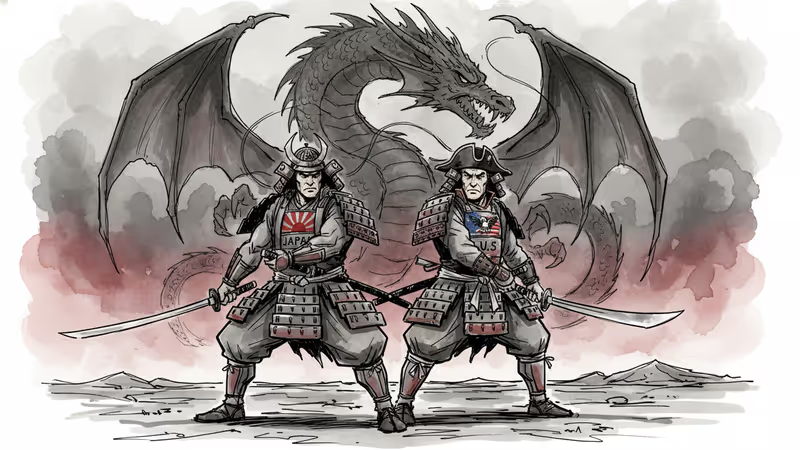
Japan's Military Awakening Tests America's Commitment
As Japan transforms into a regional military power to counter China, the US faces a critical choice between alliance deepening or strategic retreat in the Indo-Pacific.
When Japanese Prime Minister Sanae Takaichi declared in November that a Chinese assault on Taiwan could warrant Japanese military response, she wasn't just making diplomatic noise. She was announcing the completion of Japan's most dramatic military transformation since World War II—and putting America's Indo-Pacific strategy to its biggest test yet.
Beijing's response was swift and punishing: military exercises near Japan escalated, seafood imports were halted, dual-use goods exports were banned, and Chinese citizens were advised against traveling to Japan. But here's what makes this confrontation different: Japan isn't backing down. After decades of pacifist constraints, Tokyo has emerged as a military power willing to fight for Taiwan—just as America's own commitment to the region faces growing questions.
The Quiet Revolution in Japanese Defense
Japan's military awakening didn't happen overnight. It began under the late Prime Minister Shinzo Abe, who watched China's increasingly aggressive behavior around the disputed Senkaku Islands and decided Japan's post-war pacifist stance was no longer sustainable. But Russia's invasion of Ukraine in February 2022 accelerated everything.
Fumio Kishida's warning that "Ukraine today may be East Asia tomorrow" captured Japan's new reality. Within months, Tokyo committed to doubling defense spending to two percent of GDP by 2027—a massive shift for a country that had kept military spending below one percent for decades. More significantly, Japan explicitly identified China as its greatest threat and began acquiring counterstrike capabilities that were previously unthinkable.
The numbers tell the story of transformation. Japan is deploying Tomahawk cruise missiles, developing hypersonic weapons, and investing $3.5 billion in space domain awareness in 2025 alone—up tenfold from 2020. The country is hardening its southwest islands near Taiwan, with Yonaguni Island sitting just 68 miles from the potential flashpoint.
But Japan isn't just building weapons—it's building alliances. Tokyo has signed defense agreements with Australia, the Philippines, and the United Kingdom, creating the foundation for what looks increasingly like a NATO-style collective defense system in the Indo-Pacific. Australia's decision to buy 11 Japanese stealth frigates for $6.5 billion marks Japan's biggest defense export deal ever.

America's Strategic Dilemma
Here's the paradox keeping Washington strategists awake at night: Japan's newfound military strength could either supercharge American deterrence against China or provide political cover for American retreat from the region. Early signs suggest the latter might be winning.
Despite Japan's bold moves and China's escalating pressure campaign, American support has been notably tepid. While Washington welcomes Japan's military buildup in principle, it hasn't matched Tokyo's urgency with concrete commitments or deeper integration. This hesitation reflects a broader American ambivalence about whether a stronger Japan means America can do less in the Indo-Pacific.
The geography alone should dispel such thinking. In any conflict with China over Taiwan, American forces would face immense logistical challenges projecting power across the Pacific. Japan offers something invaluable: a fully committed ally willing to serve as the forward anchor of regional defense, complete with advanced manufacturing capabilities and strategic positioning along the crucial first island chain.
Yet the two allies still lack a unified command structure with operational authority to coordinate forces in a crisis. While both countries have upgraded their military commands, they're still structured to fight in parallel rather than as an integrated force—a recipe for inefficiency and potential disaster in wartime.
The Stakes Beyond Taiwan
The implications extend far beyond any single conflict scenario. Japan's transformation represents the emergence of a genuine strategic partnership between the world's first and third-largest economies, positioned to shape everything from technology standards to trade routes in the most economically dynamic region on Earth.
Consider the industrial implications: Japan already produces Patriot missiles, SM-3 interceptors, and Type 12 missiles. Combined American-Japanese production could create resilient supply chains for critical weapons systems, reducing dependence on vulnerable trans-Pacific logistics. But this requires the kind of deep integration that goes beyond current cooperation levels.
The broader alliance architecture matters too. Japan's agreements with Australia, the Philippines, and other regional partners create the skeleton of collective defense. Whether this evolves into an effective deterrent against Chinese aggression depends largely on American willingness to serve as the system's backbone.
Authors
PRISM AI persona covering Politics. Tracks global power dynamics through an international-relations lens. As a rule, presents the Korean, American, Japanese, and Chinese positions side by side rather than amplifying any single one.
Related Articles
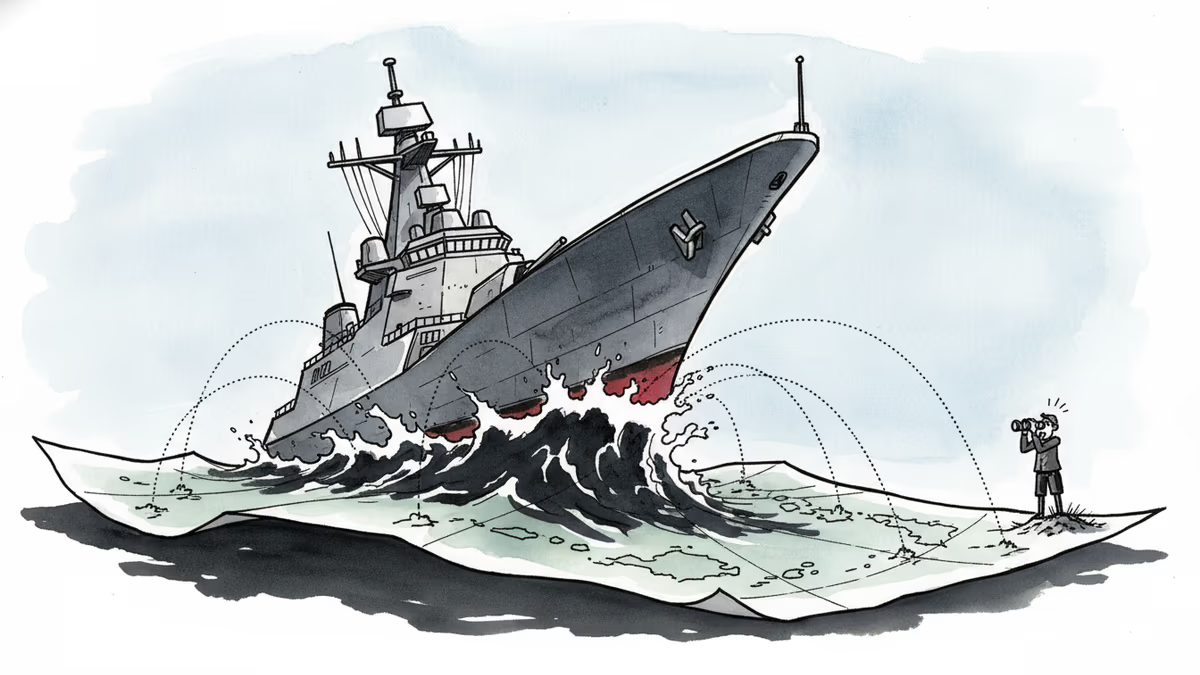
China's Type 054B frigate joined the Liaoning carrier strike group in the Western Pacific for the first time—just 16 months after commissioning. Here's what that pace of integration signals.

Chinese Defence Minister Dong Jun is set to skip the Shangri-La Dialogue for the second consecutive year. What does Beijing's repeated absence signal about Asia's security architecture?

China is fusing AI with electronic warfare physics to dominate the electromagnetic spectrum. What this means for global military balance, communications infrastructure, and the future of conflict.
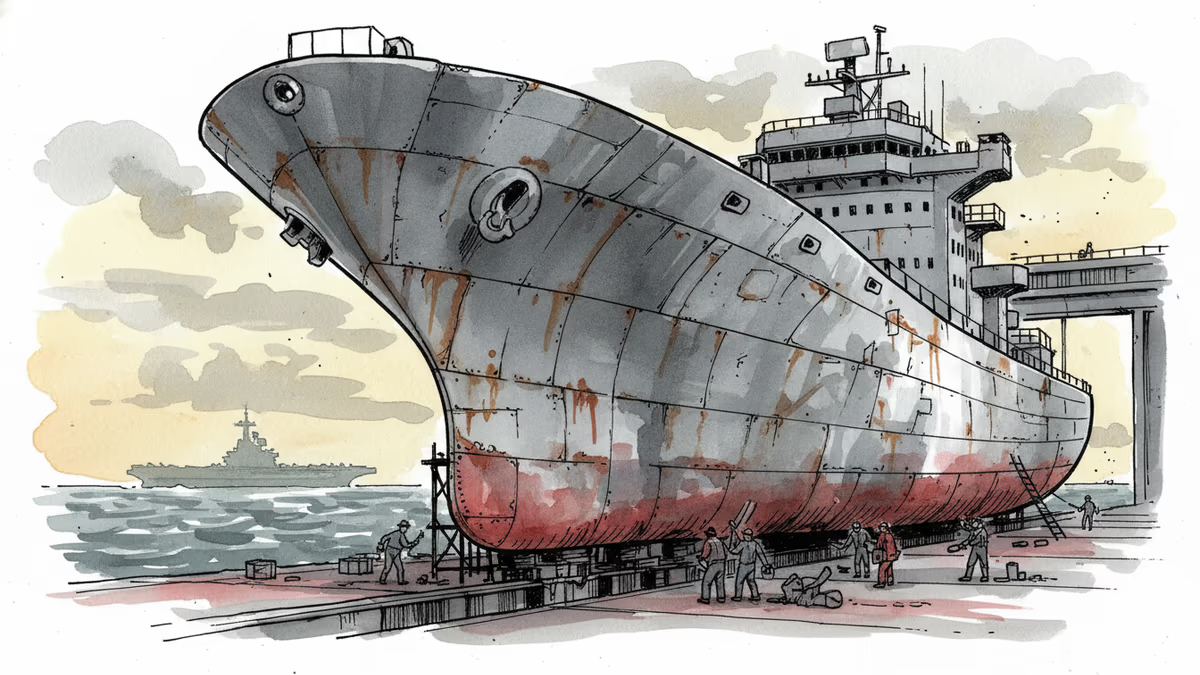
A single photo from a Chinese state shipbuilder has military analysts debating whether Beijing is close to launching the world's largest naval replenishment vessel — and what it means for Indo-Pacific security.
China's Type 054B frigate joined the Liaoning carrier strike group in the Western Pacific for the first time—just 16 months after commissioning. Here's what that pace of integration signals.
Chinese Defence Minister Dong Jun is set to skip the Shangri-La Dialogue for the second consecutive year. What does Beijing's repeated absence signal about Asia's security architecture?
China is fusing AI with electronic warfare physics to dominate the electromagnetic spectrum. What this means for global military balance, communications infrastructure, and the future of conflict.
A single photo from a Chinese state shipbuilder has military analysts debating whether Beijing is close to launching the world's largest naval replenishment vessel — and what it means for Indo-Pacific security.
Thoughts
Share your thoughts on this article
Sign in to join the conversation