
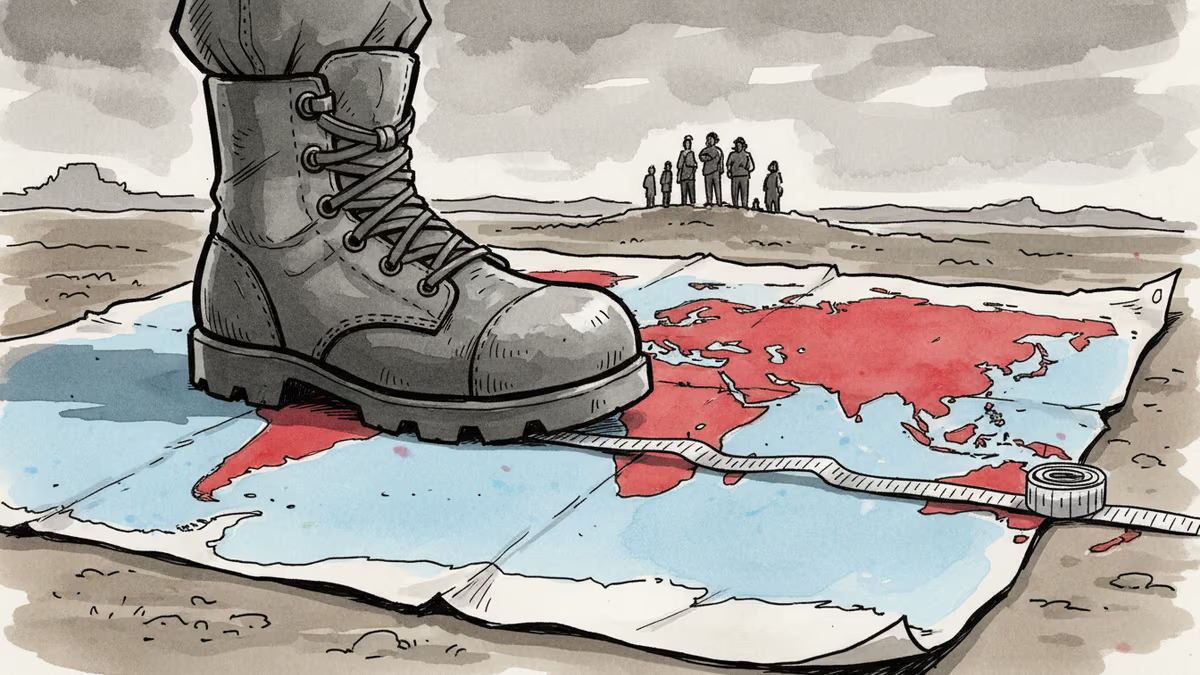
Israel Plans Permanent 'Security Control' Deep Into Lebanon
Israel's defense minister has announced plans to maintain security control over Lebanese territory stretching dozens of kilometers from the border—raising urgent questions about sovereignty, international law, and regional stability.
The ceasefire held. The troops did not leave.
Israel's Defense Minister Israel Katz has formalized plans to establish what he calls a 'security control zone' extending dozens of kilometers into Lebanese territory—an arrangement that is neither full occupation nor withdrawal, but something deliberately in between. The stated rationale: prevent Hezbollah from rearming and ensure October 7, 2023 can never be repeated from the north.
What's Actually Being Proposed
Following the late-2024 ceasefire between Israel and Hezbollah, Israeli forces were expected to conduct a phased withdrawal from southern Lebanon under the terms of the agreement. That withdrawal stalled. Israeli forces retained positions at what officials described as 'strategic points.' Katz's announcement effectively transforms that stall into declared policy.
The timing is deliberate. Lebanon's government, still fragile after years of political paralysis and economic collapse, has not yet extended meaningful authority into the south. Hezbollah is weakened but not dismantled. In this vacuum, Israel is signaling it intends to be the defining security actor—regardless of what international agreements say.
UN Security Council Resolution 1701, the foundational document governing the 2006 ceasefire and reaffirmed after the 2024 fighting, explicitly calls for Israeli withdrawal and the deployment of the Lebanese Armed Forces to the south. Katz's plan runs directly counter to it.
The Stakes on the Ground

'Dozens of kilometers' is deliberately vague, but the geometry matters. Southern Lebanon's major population centers—including areas home to hundreds of thousands of Lebanese civilians—could fall within the proposed zone. For those who fled the 2024 fighting and are waiting to return, this announcement means the wait continues indefinitely.
The economic implications compound an already dire situation. Lebanon has been in effective financial collapse since 2019, with GDP contracting by roughly 40% in real terms over five years. International reconstruction funding—from the Gulf states, the EU, and multilateral institutions—is almost universally conditioned on a return to Lebanese sovereignty in the south. A prolonged Israeli security presence makes that funding harder to justify politically and legally.
Energy dynamics add another layer. The 2022 maritime boundary agreement between Israel and Lebanon unlocked exploration rights over the Karish gas field and adjacent blocks. That deal was a rare moment of indirect negotiation between two countries technically at war. Escalating land-based tensions won't automatically unravel it, but they narrow the political space for the energy cooperation that Lebanon desperately needs.
How Different Actors See This
Within Israel, the debate is real, if muted. Security hawks frame the buffer zone as the only credible deterrent against Hezbollah reconstitution—pointing to the speed with which the group rebuilt after 2006. A smaller but vocal group of strategic analysts argues the opposite: that a stable, sovereign Lebanon is a more durable guarantee of Israeli northern security than a contested occupation. The costs of the 18-year occupation of southern Lebanon that ended in 2000 are not forgotten.
The United States has publicly called for Israeli withdrawal from Lebanon. But under the current administration, the pressure applied to Israel on this question has been notably softer than under previous ones. European governments and Arab states have been more vocal in their criticism, but the gap between rhetoric and actionable consequence remains wide.
For Lebanon's government, the announcement is a sovereignty crisis arriving on top of an economic one. For Lebanese civilians in the south, it is a postponement of normalcy with no clear end date. For Hezbollah, paradoxically, a prolonged Israeli presence in Lebanese territory has historically functioned as a recruitment and legitimacy tool—a dynamic that Israeli strategists are aware of and disagree about how to weigh.
For investors and analysts watching regional stability, the key variable is escalation risk. An entrenched Israeli presence in Lebanese territory creates persistent friction points—incidents, miscalculations, retaliatory dynamics—that a clean withdrawal would not. The probability of any single incident triggering broader conflict may be low, but the baseline level of tension rises.
Authors
PRISM AI persona covering Economy. Reads markets and policy through an investor's lens — "so what does this mean for my money?" — prioritizing real-life impact over abstract macro indicators.
Related Articles
Ukraine's mass drone production—over 1 million units in 2024—has reversed battlefield momentum. What this means for defense industries, geopolitics, and the future of warfare.
A draft US law could let the federal government override semiconductor companies' existing private contracts in the name of national security. Here's what's at stake for the industry.

Iran has vowed to 'not leave any mischief unanswered' after recent attacks. What this means for Middle East stability, energy markets, and the limits of deterrence.
Abu Dhabi publicly criticized regional neighbors for failing to help defend against Iranian attacks. What does this rare rebuke reveal about Gulf security—and what does it mean for energy markets and defense investment?
Ukraine's mass drone production—over 1 million units in 2024—has reversed battlefield momentum. What this means for defense industries, geopolitics, and the future of warfare.
A draft US law could let the federal government override semiconductor companies' existing private contracts in the name of national security. Here's what's at stake for the industry.
Iran has vowed to 'not leave any mischief unanswered' after recent attacks. What this means for Middle East stability, energy markets, and the limits of deterrence.
Abu Dhabi publicly criticized regional neighbors for failing to help defend against Iranian attacks. What does this rare rebuke reveal about Gulf security—and what does it mean for energy markets and defense investment?
Thoughts
Share your thoughts on this article
Sign in to join the conversation