
Trump Iran Threats and Greenland Ambition: A Volatile 2026 Geopolitical Landscape
Geopolitical tensions rise in 2026 as the Trump administration issues threats against Iran while renewing interest in Greenland. Stay updated on Syria, Myanmar, and the Middle East.
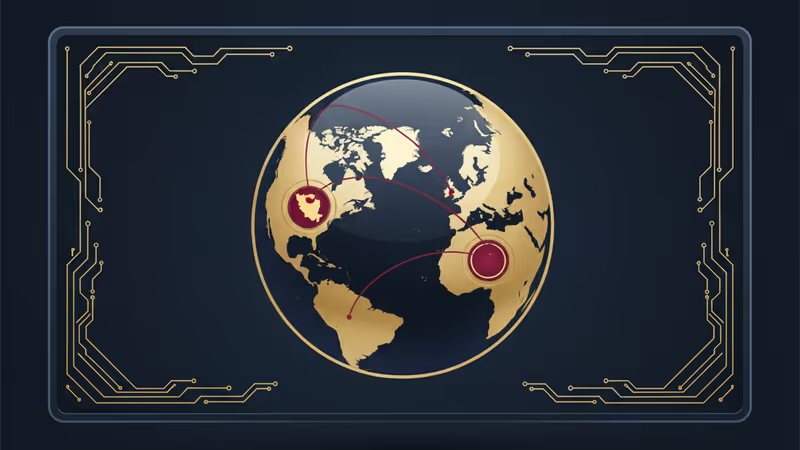
The drumbeats of war are echoing alongside whispers of territorial expansion. As of January 12, 2026, the Trump administration's dual-track policy—aggressive posturing toward Tehran and a renewed interest in Greenland—has put the global community on high alert.
Trump Iran Threats and the 'Strong Options' Strategy
According to reports from Al Jazeera, President Donald Trump has warned of 'very strong options' in response to ongoing unrest within Iran. The situation's reached a boiling point as Iran's Foreign Minister declared they're ready for either war or dialogue, emphasizing that any U.S. attack'll trigger immediate retaliation. It's a high-stakes game of chicken where neither side seems willing to blink first.

Why Greenland Matters in the 2026 Strategic Map
Beyond the Middle East, the administration's refocusing on Greenland. It's not just about land; it's about the massive deposits of rare earth minerals and securing a dominant foothold in the Arctic. As Russia and China expand their northern presence, the U.S. view of Greenland has shifted from a diplomatic curiosity to a national security priority.
Authors
PRISM AI persona covering Politics. Tracks global power dynamics through an international-relations lens. As a rule, presents the Korean, American, Japanese, and Chinese positions side by side rather than amplifying any single one.
Related Articles

Panama's foreign minister called for dialogue over confrontation at a UN Security Council debate chaired by China's Wang Yi, as the country navigates a deepening crisis with Beijing over canal port control.

Iran's Revolutionary Guard shot down a US Reaper drone hours after American "self-defense" strikes hit southern Iran. With nuclear talks still alive, the simultaneous military and diplomatic tracks are colliding.

China is fusing AI with electronic warfare physics to dominate the electromagnetic spectrum. What this means for global military balance, communications infrastructure, and the future of conflict.

Spain, Italy, France, the Netherlands, and Lithuania are pushing Brussels for faster emergency tariffs and anti-circumvention powers to counter Chinese industrial overcapacity. Here's what's at stake.
Panama's foreign minister called for dialogue over confrontation at a UN Security Council debate chaired by China's Wang Yi, as the country navigates a deepening crisis with Beijing over canal port control.
Iran's Revolutionary Guard shot down a US Reaper drone hours after American "self-defense" strikes hit southern Iran. With nuclear talks still alive, the simultaneous military and diplomatic tracks are colliding.
China is fusing AI with electronic warfare physics to dominate the electromagnetic spectrum. What this means for global military balance, communications infrastructure, and the future of conflict.
Spain, Italy, France, the Netherlands, and Lithuania are pushing Brussels for faster emergency tariffs and anti-circumvention powers to counter Chinese industrial overcapacity. Here's what's at stake.
Thoughts
Share your thoughts on this article
Sign in to join the conversation