
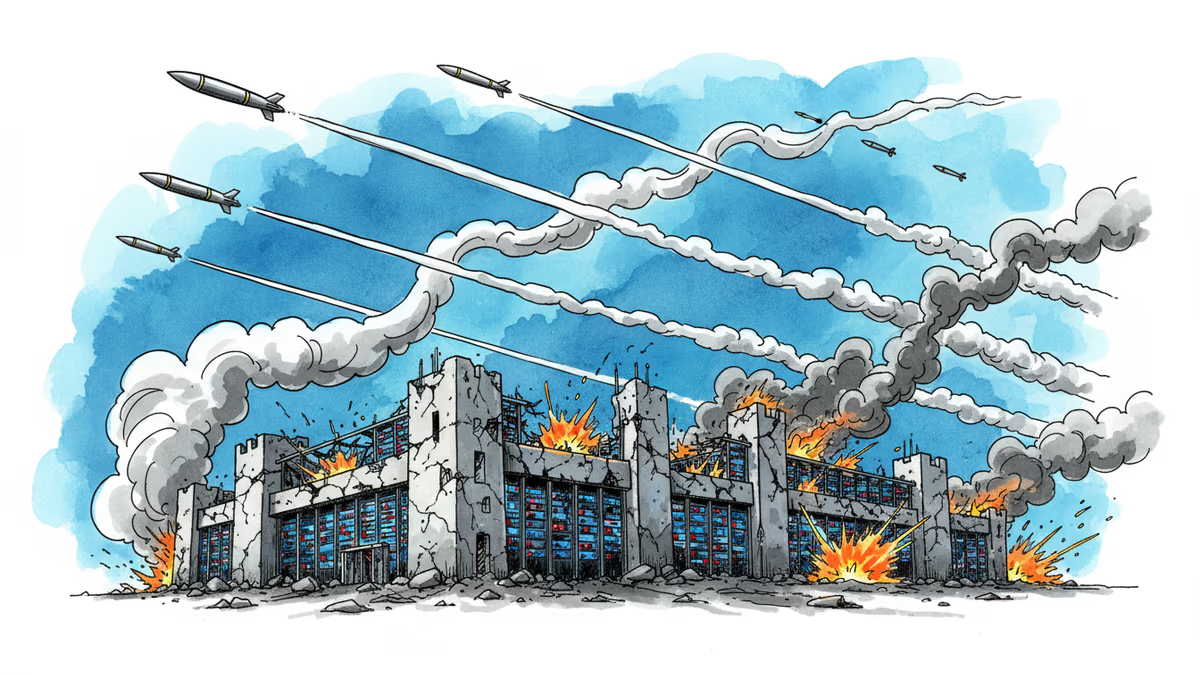
The $2 Trillion AI Promise Just Went Up in Flames
Iran's missile strike on Amazon's UAE data center exposes the fragility of Gulf AI investments worth **$5 trillion**. Physical security wasn't part of the deal.
When $5 Trillion in Promises Met Reality
For years, Gulf leaders made Silicon Valley a simple promise: bring your data, your models, and your chips, and we'll give you stability. On Sunday, that promise ended in flames.
Iran's retaliatory strikes set an Amazon data center in the UAE on fire, forcing power cuts that kept the facility offline for over 24 hours. The disruption spread across Amazon's entire UAE operation, affecting businesses from Africa to Southeast Asia.
This wasn't just any data center. It was part of a $5 trillion investment wave that was supposed to make the Gulf the world's third AI superpower, alongside the U.S. and China.
The Security Framework That Wasn't
"A theoretical scenario has become a concrete precedent," said Kristian Alexander, a senior fellow at Abu Dhabi's Rabdan Security & Defence Institute.
The security arrangements behind those massive AI deals were designed for completely different threats. The January 2026 Pax Silica initiative brought the UAE and Qatar into a U.S.-led effort to keep advanced chips away from China. The focus was on supply chain control and preventing technology leaks.
Not one agreement contemplated the possibility that a regional adversary would launch missiles at the physical buildings where those chips were meant to run.
"The security frameworks were built for supply chain control and political alignment, not for protecting buildings during a military attack," Ali Bakir, an assistant professor at Qatar University, told Rest of World.
The Asymmetry Problem
Data centers are massive, power-hungry industrial complexes. Protecting them against sustained missile and drone waves requires expensive, layered defenses that are difficult to maintain.
"It is cheaper to attack than to defend," Bakir observed.
Iran's assault proved that asymmetry. UAE forces intercepted 165 ballistic missiles, 2 cruise missiles, and 541 drones over two days. Still, 35 drones and 5 projectiles got through, striking airports, Jebel Ali Port, and the Burj Al Arab hotel. Three migrant workers died.

The Stakes Were Enormous
The numbers behind Trump's Gulf tour last May were staggering:
- Saudi Arabia: $600 billion pledged
- UAE: $1.4 trillion targeting AI and chips
- Qatar: $1.2 trillion in agreements
A consortium led by OpenAI and Nvidia announced Stargate UAE, envisioned as the largest AI facility outside the U.S. Amazon separately committed $5 billion to an AI hub in Riyadh.
To make it work, the Trump administration eased restrictions on advanced chip sales, approving up to 500,000 cutting-edge Nvidia processors annually for the UAE and Saudi Arabia. In return, Abu Dhabi's G42 cut ties with Huawei, effectively locking Beijing out of the region's AI expansion.
Global Ripple Effects
By Monday, the damage was spreading beyond the Gulf. UAE stock markets remained shut—the first unscheduled closure since President Sheikh Khalifa's death in 2022. Goldman Sachs, JPMorgan, and Citigroup all sent their UAE staff home.
The Gulf's cloud infrastructure doesn't just serve regional clients. Amazon, Microsoft, and Google's operations in the UAE are the digital backbone for fintech platforms across Africa, logistics networks in South Asia, and media services in emerging markets. OpenAI has said its planned UAE campus could eventually serve half the world's population.
From Cyber to Kinetic
"U.S. tech firms can no longer assume that running civilian services in the region will keep them out of the target set," Alexander warned.
Gulf data centers don't just store commercial information—they support government surveillance, intelligence work, and military communications, making them valuable targets.
For years, Gulf governments poured billions into defending against hackers and cyber-espionage. On Sunday, what brought the building down wasn't malicious code but heat, smoke, and a power cutoff.
The Path Forward
The investments in Gulf AI infrastructure are too large to unwind. Tech companies are unlikely to retreat, at least for now. Instead, Alexander believes they'll reinforce buildings, move operations underground, and push customers to spread data across multiple countries.
"I do not think it will reverse the broader strategic bet," he said. "But it will force a more openly militarized approach to protecting cloud infrastructure."
The conversation has shifted from political risk to war risk. In a missile and drone environment, concrete, distance, and dispersion matter just as much as firewalls.
Authors
Related Articles
Samsung Electronics' union branch revealed that 84% of survey respondents oppose the government's roughly $290 billion (₩400 trillion) semiconductor megaproject in Gwangju. Government, management, the union and shareholders are all reading the same national project in sharply different ways.
Nvidia shipped roughly a billion RISC-V cores in 2024, then announced it would run CUDA on the open standard. We break down how royalty-free instruction sets and open software stacks are trying to route around CUDA's lock-in. Part 2 of the Semiconductor Sovereignty series.
US AI-chip export controls split into three layers in the first half of 2026 — January easing, a May crackdown on circumvention, and a pending bill. Nvidia erased China from its guidance and still posted a record $81.6 billion quarter. A look at the export policy that both shields and cages it.
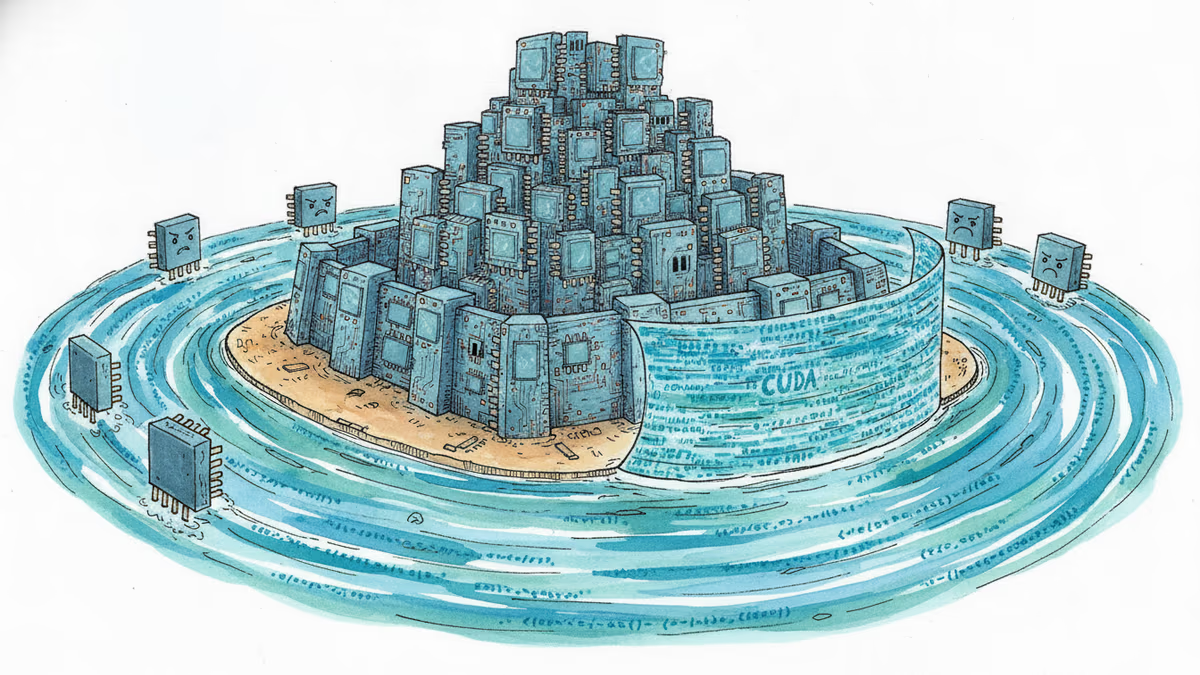
AMD's MI325X matches or beats Nvidia on memory and bandwidth — yet Nvidia's 86-92% share holds. The real moat is CUDA, 20 years in the making. Part 1 of 4.
Samsung Electronics' union branch revealed that 84% of survey respondents oppose the government's roughly $290 billion (₩400 trillion) semiconductor megaproject in Gwangju. Government, management, the union and shareholders are all reading the same national project in sharply different ways.
Nvidia shipped roughly a billion RISC-V cores in 2024, then announced it would run CUDA on the open standard. We break down how royalty-free instruction sets and open software stacks are trying to route around CUDA's lock-in. Part 2 of the Semiconductor Sovereignty series.
US AI-chip export controls split into three layers in the first half of 2026 — January easing, a May crackdown on circumvention, and a pending bill. Nvidia erased China from its guidance and still posted a record $81.6 billion quarter. A look at the export policy that both shields and cages it.
AMD's MI325X matches or beats Nvidia on memory and bandwidth — yet Nvidia's 86-92% share holds. The real moat is CUDA, 20 years in the making. Part 1 of 4.
Thoughts
Share your thoughts on this article
Sign in to join the conversation