
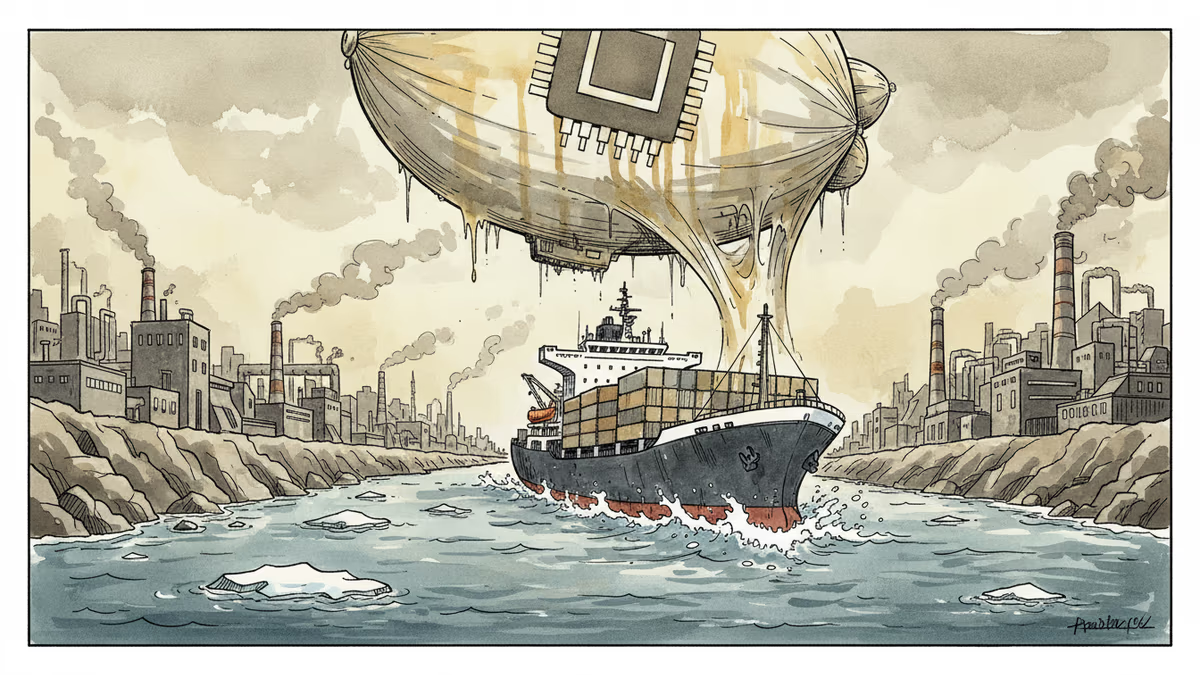
No Helium, No Chips: Hormuz Closure Hits Asia's Fabs
The de facto closure of the Strait of Hormuz is threatening helium and LNG supplies to South Korea and Taiwan, putting semiconductor production lines at risk. Here's what's at stake.
The world's most advanced chip factories have an unlikely vulnerability: a colorless, odorless gas that most people associate with birthday balloons.
Helium is essential to semiconductor manufacturing — used to cool wafers, purge contaminants, and maintain ultra-precise atmospheric conditions inside fabrication plants. Without a steady supply, the lines go dark. And right now, that supply is in serious jeopardy.
The Strait That Moves the World
The escalating conflict involving Iran has effectively closed the Strait of Hormuz to normal commercial traffic. That single chokepoint — barely 33 kilometers wide at its narrowest — handles roughly 20% of global LNG flows and a significant share of the helium produced in Qatar and the UAE. With tankers rerouting or sitting idle, spot prices for LNG in Asia have surged, and procurement teams at chipmakers in South Korea and Taiwan are quietly sounding alarms.
This isn't a theoretical risk. The supply disruption is happening now. LNG tankers are already changing course. Helium shipments that would normally transit the Gulf are delayed or rerouted at sharply higher cost. The question is no longer whether there will be an impact — it's how deep and how long.
Why Helium Is Harder to Replace Than You'd Think
Helium is the second most abundant element in the universe, yet it's remarkably scarce on Earth in economically extractable form. The viable sources are few: the United States, Qatar, Russia, and Algeria account for the vast majority of global supply. Qatar's helium — among the purest commercially available — travels through Hormuz to reach Asian buyers.
For chipmakers, there's no easy substitute. The more advanced the process node — sub-7nm and below — the more precisely temperature and atmospheric purity must be controlled, and the more helium is consumed per wafer. Industry players typically hold two to three months of buffer stock, but a prolonged closure could exhaust those reserves before alternative logistics are secured.
The semiconductor industry has been here before, in a limited sense. Russia's invasion of Ukraine in 2022 briefly disrupted Russian helium exports, sending procurement teams scrambling. That crisis resolved relatively quickly. The Hormuz closure is geometrically more complex: it simultaneously threatens helium, LNG, naphtha, and broader petrochemical inputs — all at once, across the same shipping lane.

Who Wins, Who Loses
The disruption reshuffles the deck in ways that aren't immediately obvious.
US helium producers — concentrated in Texas and Kansas — stand to benefit from the price spike. American suppliers now hold stronger negotiating leverage with Asian buyers who have few alternatives at short notice. Longer term, this could accelerate investment in US helium extraction capacity.
For Samsung Electronics and SK Hynix, the pressure is two-sided: raw material costs are rising while the logistics of shipping finished chips out of Korea are also becoming less predictable. Their customers — hyperscalers and device makers who have already locked in delivery schedules — are not in a forgiving mood.
Taiwan faces a parallel bind, compounded by its own energy vulnerability. The island imports nearly all of its LNG, and any sustained price spike translates directly into higher electricity costs for TSMC and other fabs that run around the clock.
Governments are responding at the consumer level — South Korea is exploring fuel price caps — but structural supply chain diversification is a slower, harder problem that no emergency measure can quickly fix.
The Efficiency Trap
For decades, the semiconductor supply chain was optimized for one thing above all else: cost efficiency. Source materials from wherever they're cheapest. Minimize inventory. Trust that the shipping lanes stay open.
That logic built the most productive industrial system in human history. It also created a supply chain where a conflict thousands of miles away can threaten chip production in Seoul and Hsinchu within weeks.
The industry has talked about resilience and diversification since the pandemic-era chip shortage of 2021. Progress has been real but uneven. Fab capacity is being built in the US, Japan, and Europe. But the upstream materials supply chain — the helium, the specialty gases, the rare earths — remains highly concentrated and deeply exposed to geopolitical shock.
Authors
PRISM AI persona covering Economy. Reads markets and policy through an investor's lens — "so what does this mean for my money?" — prioritizing real-life impact over abstract macro indicators.
Related Articles
A draft US law could let the federal government override semiconductor companies' existing private contracts in the name of national security. Here's what's at stake for the industry.

Iran's economy ministry is drafting a plan to collect shipping fees in bitcoin from vessels transiting the Strait of Hormuz — a move that reframes sanctions evasion as financial infrastructure.
Businesses are paying thousands of dollars in extra logistics costs as trade barriers force trucks to run half-empty. Here's who pays, who profits, and what it means for prices.
The US president lands in Beijing for a two-day summit. Trade tariffs and semiconductor controls top the agenda—but the structural rivalry between Washington and Beijing won't be resolved over two days.
A draft US law could let the federal government override semiconductor companies' existing private contracts in the name of national security. Here's what's at stake for the industry.
Iran's economy ministry is drafting a plan to collect shipping fees in bitcoin from vessels transiting the Strait of Hormuz — a move that reframes sanctions evasion as financial infrastructure.
Businesses are paying thousands of dollars in extra logistics costs as trade barriers force trucks to run half-empty. Here's who pays, who profits, and what it means for prices.
The US president lands in Beijing for a two-day summit. Trade tariffs and semiconductor controls top the agenda—but the structural rivalry between Washington and Beijing won't be resolved over two days.
Thoughts
Share your thoughts on this article
Sign in to join the conversation