
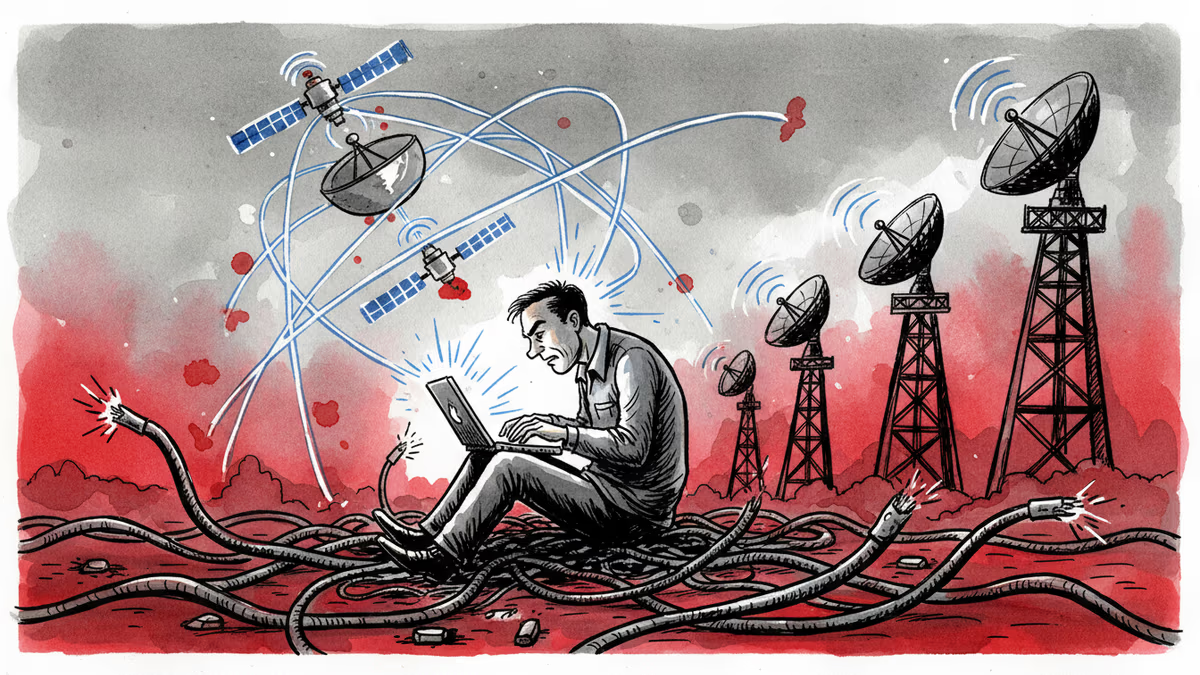
Iran's Internet Blackout Forces Journalists Into Life-or-Death Reporting
Iranian journalists risk execution charges to bypass government internet blackouts using satellite connections and encrypted tools, as connectivity drops to 4% of normal levels
4 percent. That's Iran's current internet connectivity level after the government imposed a near-total blackout following Saturday's strikes on Tehran. But some journalists are still getting the story out—at the risk of their lives.
When the Internet Dies, Journalists Adapt
Mostafa Zadeh, a Tehran-based international journalist, wasn't surprised when "the United States struck, nor when his phone's network died." Iran's government has made internet shutdowns routine during crises, from the 2022Mahsa Amini protests to the 12-day Iran-Israel war in 2025.
"The Iranian government's primary concern is preventing communication between Israeli intelligence operatives and contacts inside the country," Zadeh explains. "But journalists pay the heaviest price."
Those still reporting have developed a survival toolkit: encrypted messaging apps like Signal and Threema, international phone calls, SMS, and citizen-shot videos smuggled out in encrypted form. Some use Starlink satellite internet, but detection could mean execution on espionage charges.
Satellites Become Journalists' Eyes
Erfan Khorshidi runs a human rights organization from outside Iran but leads a large team inside Tehran. Before January's protests, his group smuggled Starlink terminals to dissidents. "It's the only means that allows rights organizations to relay accurate information to the outside world," he says.

But satellite internet comes with deadly risks. Teams must relocate Starlink devices continuously to avoid detection by Iranian intelligence, moving between cities while Basij paramilitary forces flood the streets.
Baqir Salehi, working with a European news outlet, relies heavily on satellite imagery from Maxar Technologies and Planet Labs. By comparing before-and-after images, he can spot damaged buildings and debris—but "never publish casualty estimates based on satellite imagery alone." The margin of error, he insists, is a line he won't cross.
The Death Penalty Looms
Iran significantly tightened its espionage laws in late 2025. Anyone accused of spying, particularly for Israel or the United States, now faces the death penalty and property confiscation. The stakes couldn't be higher.
Amnesty International reports Iran executed more than 1,000 people in 2025—double the previous year and the highest annual total in over a decade. Since hostilities with Israel began in June 2025, at least 15 people accused of spying for Israel have been executed.
"My biggest concern today is that a team member might be arrested while traveling to use Starlink devices," Khorshidi says. "But it's what we can do to maintain the flow of information."
Information as Resistance
With national connectivity at just 4 percent of normal levels, every byte counts. Journalists compress videos into still frames, send files in small segments to be reassembled outside the country, and generate cryptographic hashes to prove material hasn't been altered.
Salehi's newsroom coordinates dozens of informal correspondents, verifying accounts while ensuring speed and accuracy—a full-time operation layered on top of actual reporting. Teams outside the blackout zone continuously record official channels, dissecting footage frame by frame for visual markers that can be geolocated and cross-referenced with satellite imagery.
Authors
Related Articles
American Airlines just signed Starlink for 500+ aircraft. It's not just about faster inflight internet — it's a calculated move in the run-up to what could be the largest IPO in history.
A critical vulnerability in Starlette—downloaded 325 million times per week—puts millions of AI agent servers at risk, exposing stored credentials for email, databases, and third-party services.

GitHub confirmed hackers stole data from 3,800 internal repositories via a poisoned VS Code extension. Here's why developer tools are now the most dangerous attack surface in tech.
A Utah woman was sentenced to life in prison partly because of her Google searches and deleted texts. The Kouri Richins case reveals how digital footprints have become the courtroom's most reliable witness.
American Airlines just signed Starlink for 500+ aircraft. It's not just about faster inflight internet — it's a calculated move in the run-up to what could be the largest IPO in history.
A critical vulnerability in Starlette—downloaded 325 million times per week—puts millions of AI agent servers at risk, exposing stored credentials for email, databases, and third-party services.
GitHub confirmed hackers stole data from 3,800 internal repositories via a poisoned VS Code extension. Here's why developer tools are now the most dangerous attack surface in tech.
A Utah woman was sentenced to life in prison partly because of her Google searches and deleted texts. The Kouri Richins case reveals how digital footprints have become the courtroom's most reliable witness.
Thoughts
Share your thoughts on this article
Sign in to join the conversation