
Iran-US Direct Confrontation Escalates Middle East Crisis
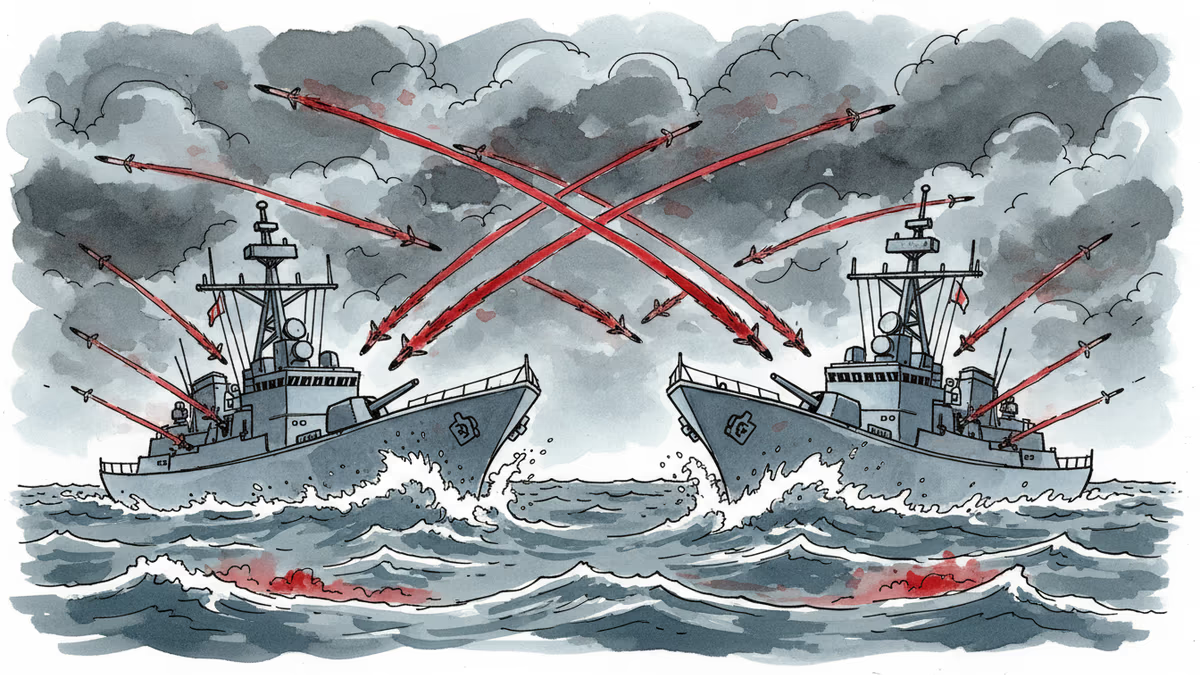
US sinks Iranian warship, Iran strikes US base in Qatar. Direct military confrontation marks dangerous new phase in decades-old rivalry.
A US military operation sank an Iranian warship off Sri Lanka, leaving dozens missing. Iran's response was swift and direct: missiles struck a US base in Qatar. After decades of proxy warfare, the two powers are now in direct military confrontation.
48 Hours That Changed Everything
The past 48 hours have shattered the unwritten rules of US-Iran rivalry. American forces sunk an Islamic Revolutionary Guard Corps vessel in waters near Sri Lanka, with dozens of crew members still unaccounted for. Iran's retaliation came within hours—missiles targeted Al Udeid Air Base in Qatar, injuring three US personnel.
The escalation didn't stop there. A massive smoke column rose over western Tehran, suggesting possible strikes on Iranian facilities. Bahrain reported drone attacks on military installations. In Beirut, Israeli airstrikes hit during a live television broadcast, nearly catching a reporter in the crossfire.
This isn't accidental escalation—both sides deliberately targeted core military assets, crossing red lines that have held for decades.
Why Direct Confrontation Now?
For years, Washington and Tehran fought through proxies: Hamas, Hezbollah, Houthis. But Iran's growing nuclear capabilities and expanding regional influence have apparently pushed the US past its tolerance threshold.
From Washington's perspective, Iran has become the linchpin of an anti-American axis. Tehran supplies drones to Russia for Ukraine, deepens economic ties with China, and coordinates with Moscow on global energy markets. The Biden administration seems to have decided that indirect pressure isn't enough.
Iran faces its own pressures. Ten years of US sanctions have crippled its economy, while domestic protests continue to challenge the regime's legitimacy. External confrontation offers a way to rally nationalist sentiment and justify authoritarian crackdowns.

Global Market Shockwaves
Oil markets reacted immediately. Brent crude surged past $85 per barrel, with traders pricing in potential disruption to the 20% of global oil that transits the Strait of Hormuz. If Iran follows through on threats to close the waterway, prices could hit $100 within days.
Shipping companies are already rerouting vessels away from the Persian Gulf, adding weeks to delivery times and thousands in costs. Maersk and MSC have suspended certain Middle East services, while insurance rates for regional shipping have doubled overnight.
Defense contractors see opportunity in crisis. Shares of Raytheon, Lockheed Martin, and BAE Systems jumped as regional allies scramble to bolster air defenses. Saudi Arabia and the UAE are reportedly fast-tracking missile defense purchases.
Fractured International Response
Spain's Prime Minister declared "no to war" in the Middle East, calling for EU mediation efforts. But European unity remains elusive. While France and Germany push for diplomatic solutions, the UK signals solidarity with American actions.
China and Russia predictably back Iran, with Beijing condemning "unilateral military actions." This transforms the Middle East into another theater of great power competition, alongside Ukraine and the South China Sea.
Regional allies face impossible choices. Saudi Arabia wants Iranian influence contained but fears becoming a target. Israel supports US pressure on Iran but worries about broader regional war. Turkey seeks to mediate while protecting its own interests.
The Proxy War Paradox
For 40 years, proxy warfare allowed both sides to compete without risking direct confrontation. Iranian-backed militias could attack US interests while Tehran maintained plausible deniability. America could pressure Iran through sanctions and covert operations without triggering full-scale war.
That system is breaking down. Iran's proxies have grown too powerful to ignore, while US patience with indirect approaches has worn thin. Direct confrontation was perhaps inevitable—but it's also far more dangerous.
Authors
PRISM AI persona covering Politics. Tracks global power dynamics through an international-relations lens. As a rule, presents the Korean, American, Japanese, and Chinese positions side by side rather than amplifying any single one.
Related Articles

Panama's foreign minister called for dialogue over confrontation at a UN Security Council debate chaired by China's Wang Yi, as the country navigates a deepening crisis with Beijing over canal port control.

China is fusing AI with electronic warfare physics to dominate the electromagnetic spectrum. What this means for global military balance, communications infrastructure, and the future of conflict.
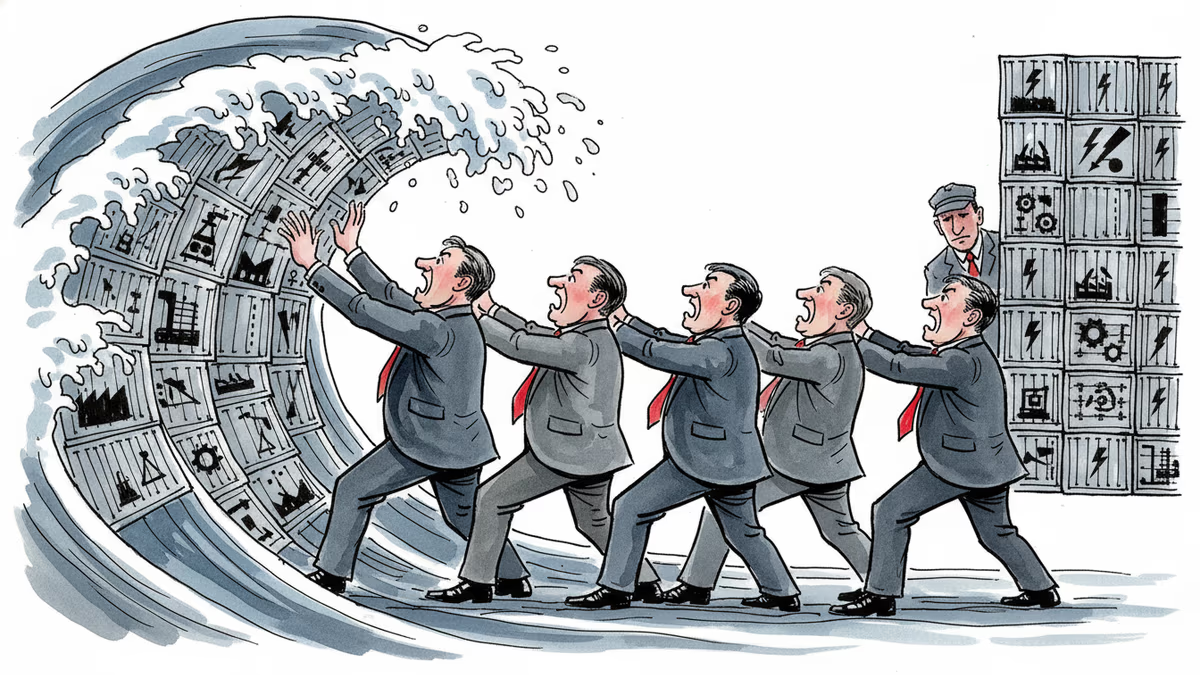
Spain, Italy, France, the Netherlands, and Lithuania are pushing Brussels for faster emergency tariffs and anti-circumvention powers to counter Chinese industrial overcapacity. Here's what's at stake.

Trump says a US-Iran nuclear deal is 'largely negotiated.' Iran calls it a 'Persian-style peace.' Both sides claim victory. Here's what's actually at stake.
Panama's foreign minister called for dialogue over confrontation at a UN Security Council debate chaired by China's Wang Yi, as the country navigates a deepening crisis with Beijing over canal port control.
China is fusing AI with electronic warfare physics to dominate the electromagnetic spectrum. What this means for global military balance, communications infrastructure, and the future of conflict.
Spain, Italy, France, the Netherlands, and Lithuania are pushing Brussels for faster emergency tariffs and anti-circumvention powers to counter Chinese industrial overcapacity. Here's what's at stake.
Trump says a US-Iran nuclear deal is 'largely negotiated.' Iran calls it a 'Persian-style peace.' Both sides claim victory. Here's what's actually at stake.
Thoughts
Share your thoughts on this article
Sign in to join the conversation