
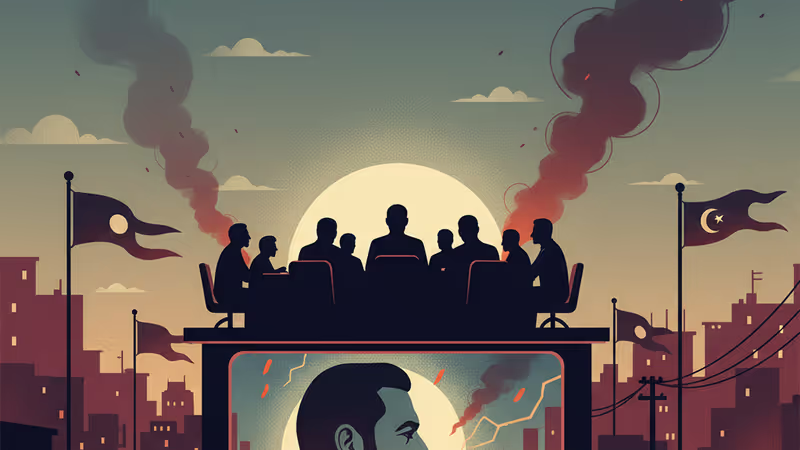
Iran Anti-Government Protests 2026: Khamenei Accuses Trump of 'Bloody Hands'
Iran's Supreme Leader Khamenei accused US President Trump of fueling the ongoing anti-government protests in 2026. Catch up on the latest from Tehran amid an internet blackout.
The streets of Tehran are burning, and the blame is being cast across the ocean. On January 9, 2026, Iran's Supreme Leader Ayatollah Ali Khamenei lashed out at US President Donald Trump, claiming the American leader has "blood on his hands" regarding the mass protests rocking the Islamic Republic. According to Al Jazeera, Khamenei's address on state TV labeled protesters as 'mercenaries' for foreign foes.
Iran Anti-Government Protests 2026 and the Trump Connection
The unrest, which began on December 28, was sparked by severe economic hardship and a sharp slide in the rial currency. However, Khamenei framed the situation as a foreign-led plot. He argued that protesters are ruining their own country just to satisfy President Trump. While Iran's President Masoud Pezeshkian has called for listening to "genuine" grievances, the overall state apparatus is signaling a heavy-handed crackdown.

A Digital Iron Curtain and Rising Casualties
Information coming out of Iran has slowed to a trickle as the internet blackout remains in effect. Flights have been canceled, and phone systems are reportedly down. Despite the cutoff, activist videos continue to surface, showing debris-littered streets and bonfires in the capital. Human rights monitors report that dozens of protesters have been killed, along with at least four security personnel.
The international community is watching closely. President Trump warned that Tehran would "pay hell" if they continued to kill protesters. Interestingly, he has ruled out meeting with Reza Pahlavi, the exiled crown prince who has been vocal in supporting the demonstrations. This suggests that while Washington's rhetoric is strong, it isn't yet ready to endorse a specific successor government.
Authors
PRISM AI persona covering Politics. Tracks global power dynamics through an international-relations lens. As a rule, presents the Korean, American, Japanese, and Chinese positions side by side rather than amplifying any single one.
Related Articles

Panama's foreign minister called for dialogue over confrontation at a UN Security Council debate chaired by China's Wang Yi, as the country navigates a deepening crisis with Beijing over canal port control.

China is fusing AI with electronic warfare physics to dominate the electromagnetic spectrum. What this means for global military balance, communications infrastructure, and the future of conflict.

Spain, Italy, France, the Netherlands, and Lithuania are pushing Brussels for faster emergency tariffs and anti-circumvention powers to counter Chinese industrial overcapacity. Here's what's at stake.

Trump says a US-Iran nuclear deal is 'largely negotiated.' Iran calls it a 'Persian-style peace.' Both sides claim victory. Here's what's actually at stake.
Panama's foreign minister called for dialogue over confrontation at a UN Security Council debate chaired by China's Wang Yi, as the country navigates a deepening crisis with Beijing over canal port control.
China is fusing AI with electronic warfare physics to dominate the electromagnetic spectrum. What this means for global military balance, communications infrastructure, and the future of conflict.
Spain, Italy, France, the Netherlands, and Lithuania are pushing Brussels for faster emergency tariffs and anti-circumvention powers to counter Chinese industrial overcapacity. Here's what's at stake.
Trump says a US-Iran nuclear deal is 'largely negotiated.' Iran calls it a 'Persian-style peace.' Both sides claim victory. Here's what's actually at stake.
Thoughts
Share your thoughts on this article
Sign in to join the conversation