
Sound Kills Fire. But Can It Scale?
A California startup demonstrated AI-driven acoustic fire suppression using infrasound waves. The science is real—but the gap between a kitchen demo and a certified product is wide.
The fire extinguisher hanging in your kitchen hasn't changed much since the 1950s. What if the next one made no sound you could hear—and used only sound to work?
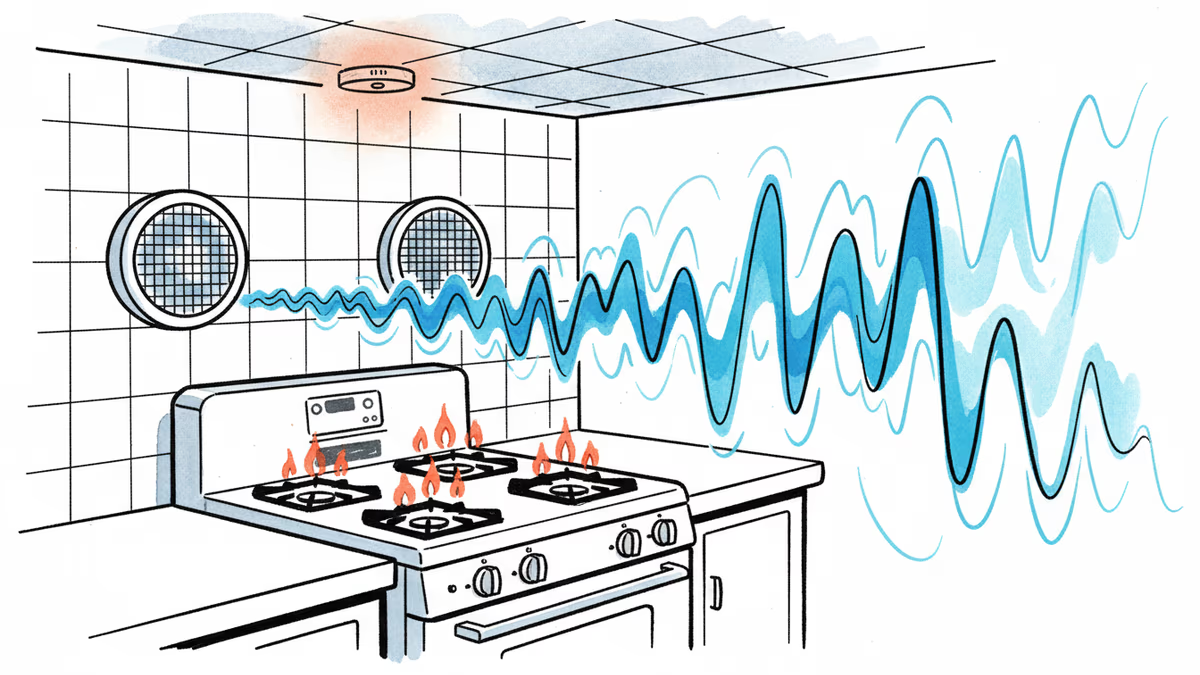
In a demonstration kitchen in Concord, California, cooking oil caught fire in an unattended pan on a gas stove. A smoke detector triggered. An AI-driven sensor identified the source. Within seconds, wall-mounted emitters directed infrasound waves at the flames. The fire went out.
The Physics Is Old. The Integration Is New.
Acoustic fire suppression isn't a new discovery. The mechanism is straightforward: low-frequency sound waves vibrate oxygen molecules away from a fuel source, cutting off the combustion triangle. DARPA demonstrated the concept publicly in 2012, and researchers at George Mason University published supporting work around the same period. The science has been sitting in journals for over a decade.
What's different here is the layer on top: AI-driven targeting. Rather than blasting infrasound indiscriminately, the system uses a sensor array to locate the fire's origin in real time and adjusts the frequency and direction of the acoustic output accordingly. The goal is autonomous response before a human can intervene—or before a sprinkler drenches everything in the room.
That distinction matters more than it might seem. The bottleneck in fire suppression technology hasn't been physics. It's been deployment: getting a system to respond correctly, fast enough, in conditions it wasn't explicitly trained on.
What Sprinklers Can't Do

The standard sprinkler system was invented in the 1870s. It works. But it works by flooding, which is catastrophic in server rooms, archives, museums, and anywhere electronics are present. Chemical suppressants have narrowed use cases due to toxicity concerns and tightening environmental regulations—the EU phased out several halon alternatives over the past decade, and the US EPA has restricted others.
Acoustic suppression uses no water, no chemicals. For data centers, where a single sprinkler misfire can destroy millions in hardware, or for heritage buildings where water damage rivals fire damage, a dry suppression method has obvious appeal. The addressable market isn't small: global fire protection systems were valued at roughly $65 billion in 2024 and are projected to keep growing as urbanization and data infrastructure expand.
But the Concord demo involved a small pan fire in a controlled environment. The honest question is whether the same physics scales—to a grease fire that's already spread, to a multi-room blaze, to the chaotic conditions of a real emergency.
Three Gaps Between Demo and Doorstep
Reliability under adversity. Fire safety equipment has zero tolerance for inconsistency. A sprinkler that fails 2% of the time is unacceptable. AI systems trained on controlled scenarios have a well-documented tendency to underperform when real-world conditions drift from training data. Regulators and insurers will need longitudinal failure data before this technology goes into occupied buildings.
Certification timelines. In the US, fire suppression products effectively require UL certification to reach commercial buildings. Novel technologies that don't fit existing test standards often spend years in regulatory limbo—not because they're unsafe, but because the frameworks to evaluate them don't yet exist. The EU's CE marking process faces similar structural delays for category-new products.
Cost parity. A commercial sprinkler system for a mid-size office building runs roughly $1–2 per square foot installed. AI sensor arrays and acoustic emitters carry higher unit costs at current production volumes. The economics may shift with scale, but the industry's purchasing decisions are made by facilities managers with fixed budgets, not early adopters.
This content is AI-generated based on source articles. While we strive for accuracy, errors may occur. We recommend verifying with the original source.
Related Articles

Samsung Electronics' union branch revealed that 84% of survey respondents oppose the government's roughly $290 billion (₩400 trillion) semiconductor megaproject in Gwangju. Government, management, the union and shareholders are all reading the same national project in sharply different ways.

Nvidia shipped roughly a billion RISC-V cores in 2024, then announced it would run CUDA on the open standard. We break down how royalty-free instruction sets and open software stacks are trying to route around CUDA's lock-in. Part 2 of the Semiconductor Sovereignty series.

US AI-chip export controls split into three layers in the first half of 2026 — January easing, a May crackdown on circumvention, and a pending bill. Nvidia erased China from its guidance and still posted a record $81.6 billion quarter. A look at the export policy that both shields and cages it.

AMD's MI325X matches or beats Nvidia on memory and bandwidth — yet Nvidia's 86-92% share holds. The real moat is CUDA, 20 years in the making. Part 1 of 4.
Samsung Electronics' union branch revealed that 84% of survey respondents oppose the government's roughly $290 billion (₩400 trillion) semiconductor megaproject in Gwangju. Government, management, the union and shareholders are all reading the same national project in sharply different ways.
Nvidia shipped roughly a billion RISC-V cores in 2024, then announced it would run CUDA on the open standard. We break down how royalty-free instruction sets and open software stacks are trying to route around CUDA's lock-in. Part 2 of the Semiconductor Sovereignty series.
US AI-chip export controls split into three layers in the first half of 2026 — January easing, a May crackdown on circumvention, and a pending bill. Nvidia erased China from its guidance and still posted a record $81.6 billion quarter. A look at the export policy that both shields and cages it.
AMD's MI325X matches or beats Nvidia on memory and bandwidth — yet Nvidia's 86-92% share holds. The real moat is CUDA, 20 years in the making. Part 1 of 4.
Thoughts
Share your thoughts on this article
Sign in to join the conversation