
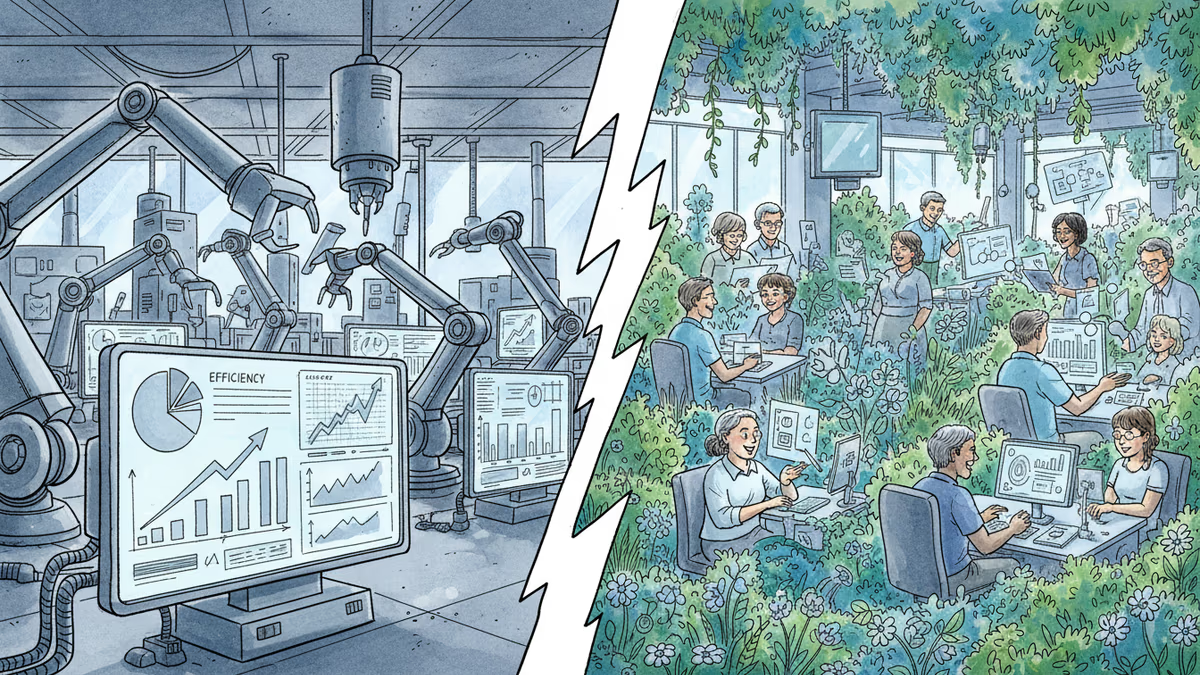
Industry 5.0's Human Promise vs. Corporate Reality Check
MIT survey of 250 industry leaders reveals most still focus on efficiency investments despite data showing human-centric and sustainable use cases deliver higher value but remain underfunded.
250 Leaders, One Uncomfortable Truth
Here's what MIT discovered when they surveyed 250 industry leaders worldwide: We're in the Industry 5.0 era, but most companies are still stuck in efficiency mode. The kicker? Their own data shows human-centric and sustainable use cases deliver higher value—yet these areas remain chronically underfunded.
While Industry 4.0 was about integrating emerging technologies like AI, cloud, IoT, robotics, and digital twins, Industry 5.0 represents a fundamental shift from integration to orchestration at scale. The purpose has evolved too: instead of just automating work, it's about augmenting human potential and enhancing environmental sustainability.
But there's a gap between promise and practice.
The Investment Paradox
"To realize the promise of Industry 5.0, companies must move beyond cost and efficiency to focus on growth, resilience, and human-centric outcomes," says Sachin Lulla, EY Americas industrials and energy transformation leader. "This requires not just new technologies, but new ways of working—where people and machines collaborate, and where value is measured not just in dollars saved, but in new opportunities created."
The MIT survey reveals a striking paradox: organizations know what works better, but they're not investing in it. Most industrial investments still target efficiency gains, even though the data clearly shows human-centric approaches deliver superior returns.
Why the Resistance to Human-Centric Investment?

The research identifies three critical barriers preventing organizations from realizing Industry 5.0's full value potential:
Culture, skills, and collaboration barriers: Companies install the technology but fail to transform how people work with it. It's like buying a Ferrari and driving it in first gear.
Tactical and misaligned technology investments: Departments operate in silos, creating redundant systems that don't talk to each other. The result? Expensive digital islands instead of integrated ecosystems.
Use-case prioritization focused on efficiency over growth: Short-term cost savings trump long-term value creation. It's the quarterly earnings trap applied to industrial transformation.
Beyond "Chasing Digital Fairies"
Rio Tinto's Chris Ware, general manager of iron ore digital, puts it bluntly: "We're not just doing digital work for work's sake, what I call 'chasing the digital fairies.' We have to be very clear on what pieces of work we go after and why. Every domain has a unique roadmap about how to deliver the best value."
This isn't just about technology implementation—it's about strategic discipline. The companies succeeding in Industry 5.0 aren't necessarily the ones with the most advanced tech; they're the ones with the clearest vision of how technology serves human and business outcomes.
The Oxford Connection
Research from EY and Oxford's Saïd Business School reinforces this point: the barrier to Industry 5.0 transformation isn't technical—it's human. Strategy, culture, and leadership matter more than algorithms and automation. Companies are investing heavily in digital transformation, but not always in ways that unlock the full human potential of Industry 5.0.
This creates a fascinating tension: as technology becomes more sophisticated, the human elements become more critical for success.
Authors
Related Articles
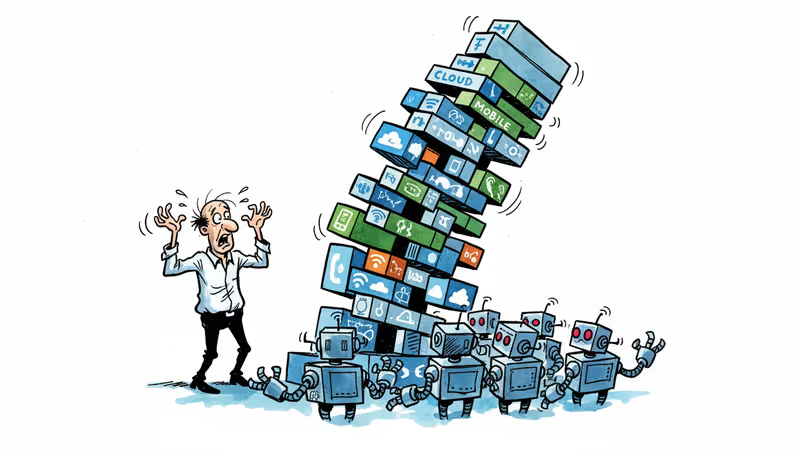
Enterprise IT systems built as stopgap solutions over decades are now hindering AI adoption. Only 48% of CIOs say their digital initiatives meet business targets.
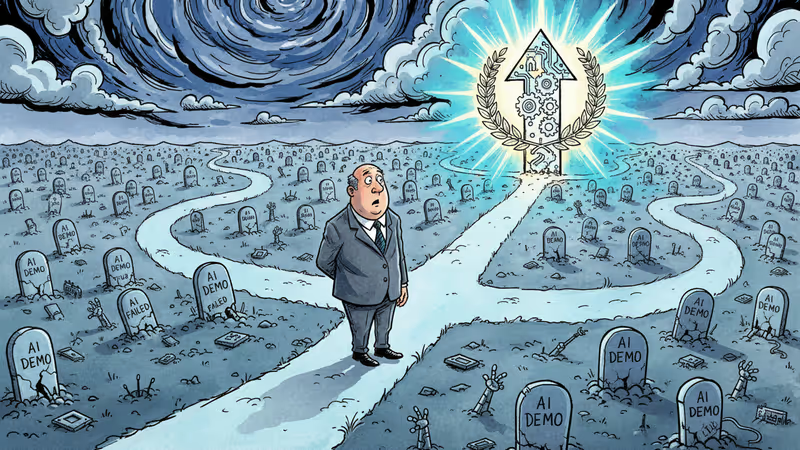
While companies rush into generative AI, most projects fail to deliver value. Mistral AI reveals the 4 criteria that separate successful AI transformations from expensive experiments.

New 2026 data shows only 7% of US car buyers complete their purchase entirely online, despite a push from Amazon and Ford. Physical touch and financing anxiety remain key barriers.

Explore the Kazakhstan AI Digitalization Strategy 2026. President Tokayev's 3-year plan involves supercomputers, AI education for 650k students, and a new AI ministry.
Enterprise IT systems built as stopgap solutions over decades are now hindering AI adoption. Only 48% of CIOs say their digital initiatives meet business targets.
While companies rush into generative AI, most projects fail to deliver value. Mistral AI reveals the 4 criteria that separate successful AI transformations from expensive experiments.
New 2026 data shows only 7% of US car buyers complete their purchase entirely online, despite a push from Amazon and Ford. Physical touch and financing anxiety remain key barriers.
Explore the Kazakhstan AI Digitalization Strategy 2026. President Tokayev's 3-year plan involves supercomputers, AI education for 650k students, and a new AI ministry.
Thoughts
Share your thoughts on this article
Sign in to join the conversation