
The Patchwork Problem: How Decades of IT Band-Aids Are Blocking AI
Enterprise IT systems built as stopgap solutions over decades are now hindering AI adoption. Only 48% of CIOs say their digital initiatives meet business targets.
48%. That's how many CIOs say their current digital initiatives are meeting or exceeding business targets. For a number that should represent success, it's remarkably close to a coin flip.
The Price of Quick Fixes
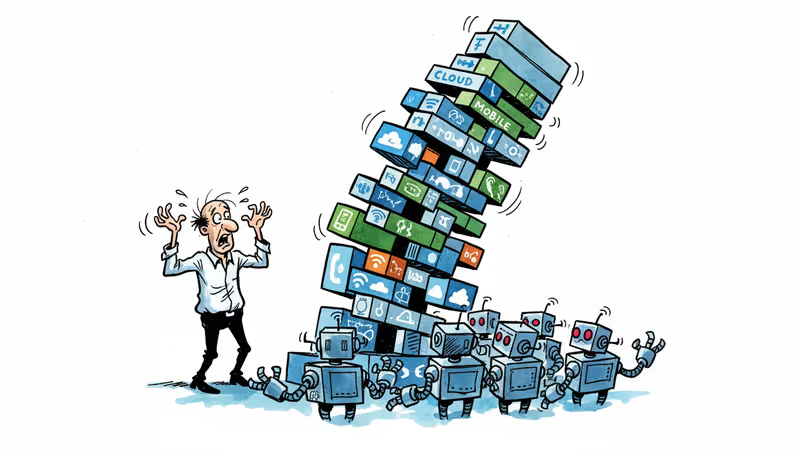
For decades, enterprises have played technological whack-a-mole. Rising infrastructure costs? Add cloud services. Customers going mobile? Layer on apps. Need real-time factory visibility? Bolt on IoT systems. Each solution promised better, more efficient operations—and many delivered, individually.
But as the solutions stacked up, IT teams found themselves managing less of an ecosystem and more of a Frankenstein's monster. Every new platform required custom connections, unique interfaces, and specialized maintenance. What started as targeted fixes became a tangled web of dependencies.
Achim Kraiss, chief product officer of SAP Integration Suite, puts it bluntly: "A fragmented landscape makes it difficult to see and control end-to-end business processes. Monitoring, troubleshooting, and governance all suffer. Costs go up because of all the complex mappings and multi-application connectivity you have to maintain."
AI Exposes the Cracks

These architectural sins might have remained manageable in a simpler era. But AI changes everything. As artificial intelligence embeds itself into everyday workflows, systems suddenly need to move far larger volumes of data, at higher speeds, with tighter coordination than yesterday's patchwork architectures were ever designed to handle.
Whether it's generative AI, machine learning, or agentic AI, companies are realizing that how data moves through their business matters just as much as the insights it generates. A 2025 survey found that operations leaders point to integration complexity and data quality issues as the top culprits for why their AI investments haven't delivered expected returns.
The math is unforgiving. AI systems need clean, accessible data flowing seamlessly between applications. But when your customer data lives in one system, your inventory in another, and your analytics in a third—with each requiring custom APIs to communicate—even the smartest AI can't work miracles.
The Great Consolidation
Smart enterprises are responding by abandoning the band-aid approach. Instead of adding yet another integration tool to the pile, they're moving toward consolidated, end-to-end platforms that restore order and streamline how systems interact.
This isn't just about technology—it's about competitive survival. Companies that can move data efficiently will deploy AI faster, adapt to market changes quicker, and ultimately outmaneuver competitors still wrestling with their digital Jenga towers.
Authors
Related Articles
MIT survey of 250 industry leaders reveals most still focus on efficiency investments despite data showing human-centric and sustainable use cases deliver higher value but remain underfunded.

While companies rush into generative AI, most projects fail to deliver value. Mistral AI reveals the 4 criteria that separate successful AI transformations from expensive experiments.

New 2026 data shows only 7% of US car buyers complete their purchase entirely online, despite a push from Amazon and Ford. Physical touch and financing anxiety remain key barriers.

Explore the Kazakhstan AI Digitalization Strategy 2026. President Tokayev's 3-year plan involves supercomputers, AI education for 650k students, and a new AI ministry.
MIT survey of 250 industry leaders reveals most still focus on efficiency investments despite data showing human-centric and sustainable use cases deliver higher value but remain underfunded.
While companies rush into generative AI, most projects fail to deliver value. Mistral AI reveals the 4 criteria that separate successful AI transformations from expensive experiments.
New 2026 data shows only 7% of US car buyers complete their purchase entirely online, despite a push from Amazon and Ford. Physical touch and financing anxiety remain key barriers.
Explore the Kazakhstan AI Digitalization Strategy 2026. President Tokayev's 3-year plan involves supercomputers, AI education for 650k students, and a new AI ministry.
Thoughts
Share your thoughts on this article
Sign in to join the conversation