

Kazakhstan AI Digitalization Strategy 2026: A Vision to Leapfrog into the Tech Elite
Explore the Kazakhstan AI Digitalization Strategy 2026. President Tokayev's 3-year plan involves supercomputers, AI education for 650k students, and a new AI ministry.
Can a resource-rich giant pivot to a digital-first economy in just three years? President Kassym-Jomart Tokayev thinks so. As of January 14, 2026, Kazakhstan has officially entered its 'Year of Development of Digitalization and AI,' a bold initiative to transform the Central Asian nation into a digital power by the end of the decade.
The Kazakhstan AI Digitalization Strategy 2026 Roadmap
The administration isn't just talking; they're building. Last year, the government established the Ministry of Artificial Intelligence and Digital Development and signed a landmark AI law. On the hardware side, Astana has secured two powerful supercomputers, Alem.Cloud and Al-Farabium, to fuel domestic innovation.
Educational initiatives are also scaling fast. More than 650,000 students have already completed the 'AI-Sana' program. The goal is to ensure the next generation is 'AI-ready' as the technology reshapes public administration, medicine, and the economy.

Challenges on the Path to 'Full Digitization'
Despite the momentum, global rankings suggest a steep climb ahead. In the 2025 IMD World Digital Competitiveness Ranking, Kazakhstan sits at 39th place. To match the top 25 nations, Astana must address significant infrastructure gaps.
- Connectivity: While internet access is at 93%, rural areas still lag behind the 100% target.
- Urban-Rural Divide: Ensuring digital services reach small towns in West Kazakhstan and Kyzylorda.
- Middle-Class Stagnation: A recent World Bank report warns that stagnating growth could threaten long-term innovation hubs like Alatau City.
Authors
Related Articles

Indian venture capital has quietly displaced Silicon Valley in its own backyard. Only one American VC made India's top 10 investor list last year. Here's why that matters beyond India.
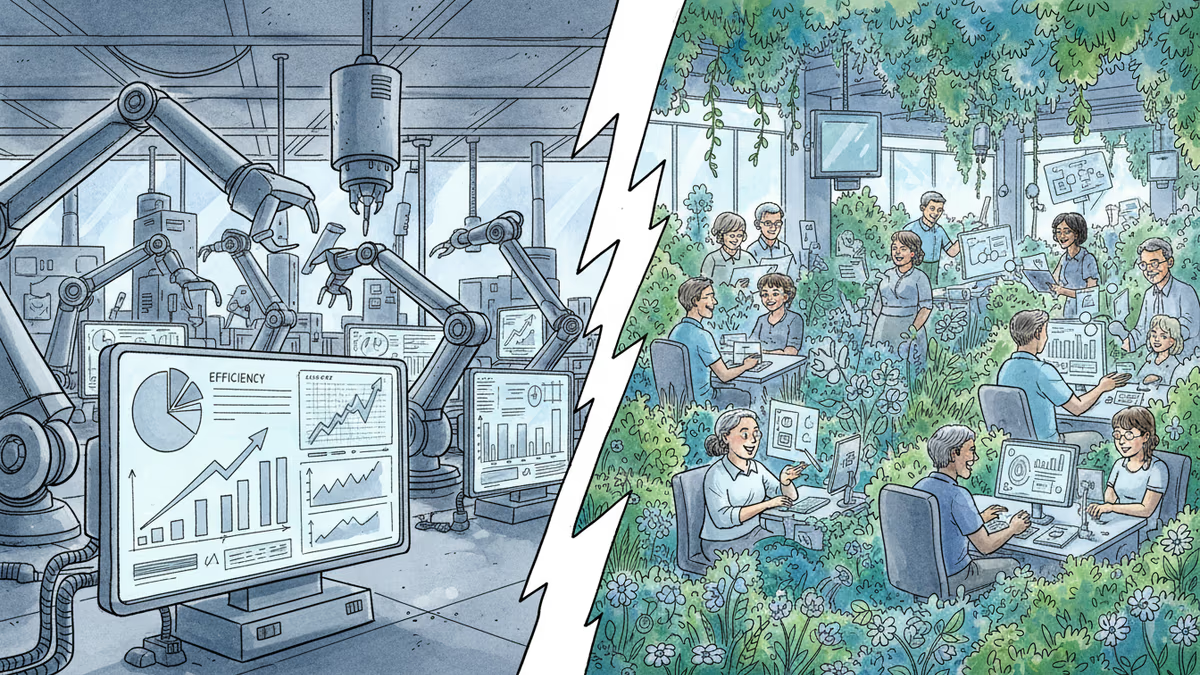
MIT survey of 250 industry leaders reveals most still focus on efficiency investments despite data showing human-centric and sustainable use cases deliver higher value but remain underfunded.

Sarvam AI deploys edge models on Nokia feature phones and smart glasses, challenging the cloud-first AI paradigm with offline-capable intelligence for emerging markets.

Enterprise IT systems built as stopgap solutions over decades are now hindering AI adoption. Only 48% of CIOs say their digital initiatives meet business targets.
Indian venture capital has quietly displaced Silicon Valley in its own backyard. Only one American VC made India's top 10 investor list last year. Here's why that matters beyond India.
MIT survey of 250 industry leaders reveals most still focus on efficiency investments despite data showing human-centric and sustainable use cases deliver higher value but remain underfunded.
Sarvam AI deploys edge models on Nokia feature phones and smart glasses, challenging the cloud-first AI paradigm with offline-capable intelligence for emerging markets.
Enterprise IT systems built as stopgap solutions over decades are now hindering AI adoption. Only 48% of CIOs say their digital initiatives meet business targets.
Thoughts
Share your thoughts on this article
Sign in to join the conversation