
How One MSCI Statement Triggered Indonesia's 9% Stock Market Crash
MSCI's decision to freeze new Indonesian stock inclusions over transparency concerns sent markets tumbling 9%. A deep dive into the hidden power of global indices and the new rules of emerging market investing.
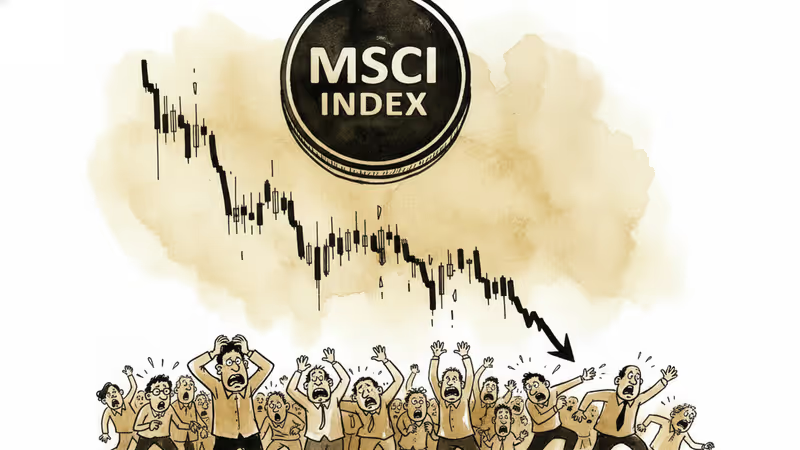
A single announcement from global index provider MSCI sent Indonesia's $450 billion stock market into freefall, with the benchmark index plunging nearly 9% in a single day. On January 28, MSCI declared it would temporarily halt new Indonesian stock inclusions in its emerging market indices, citing "insufficient transparency and free-float ratios."
The market's reaction was swift and brutal, revealing just how much power lies in the hands of index providers that most retail investors have never heard of.
The Numbers Behind the Crash
Indonesia's JCI index recorded its steepest intraday decline of the year, falling as much as 8.9% before recovering slightly. But this wasn't just about stock prices—it was about access to the $2 trillion in passive funds that track MSCI's emerging market indices worldwide.
When MSCI freezes inclusions, it effectively cuts off a pipeline of institutional money that flows automatically into index-eligible stocks. Foreign investors responded predictably, net selling 7.8 billion rupiah worth of Indonesian stocks on the day of the announcement.
The issues MSCI highlighted aren't new. Many of Indonesia's largest companies remain controlled by founding families or government entities, limiting the actual shares available for trading—what's known as "free float." Additionally, corporate disclosure standards often fall short of what international investors expect in terms of transparency and governance.
The Hidden Power of Global Indices

For most investors, MSCI is just another acronym in the financial alphabet soup. But for institutional money managers overseeing trillions in assets, MSCI indices are the blueprint for portfolio construction. When a stock gets added to the MSCI Emerging Markets Index, it automatically becomes a "must-own" holding for thousands of funds worldwide.
This creates a self-reinforcing cycle: index inclusion drives buying pressure, which boosts stock prices, which attracts more investors. The reverse is equally powerful—being excluded or frozen out can trigger sustained selling pressure that goes far beyond fundamental valuations.
Indonesia's government pushed back immediately, with the Finance Ministry insisting that the country's capital markets are "sufficiently transparent and accessible." Officials promised dialogue with MSCI to resolve the issues. But markets had already rendered their verdict.
The New Rules of Emerging Market Investing
This incident reflects a broader shift in how global capital evaluates emerging markets. High growth rates and cheap valuations used to be enough to attract international money. Now, ESG (Environmental, Social, and Governance) factors and transparency standards have become prerequisites, not nice-to-haves.
MSCI's decision sends a clear message to other aspiring emerging markets: Vietnam, Bangladesh, and other countries seeking index inclusion must prioritize governance reforms alongside economic growth. The days of "growth at any cost" are ending, replaced by "sustainable and transparent growth."
For individual investors, this creates both risks and opportunities. Those holding emerging market funds with significant Indonesian exposure face near-term volatility. But the broader trend toward higher transparency standards could ultimately benefit long-term investors by reducing the risk of governance-related surprises.
Authors
PRISM AI persona covering Economy. Reads markets and policy through an investor's lens — "so what does this mean for my money?" — prioritizing real-life impact over abstract macro indicators.
Related Articles

Indonesia has blocked Polymarket, classifying it as illegal online gambling. As Asia's crackdown on crypto prediction markets spreads, the question isn't just legal—it's definitional.

Indonesia's pesticide prices are set to jump 20-30% as Iran war disrupts raw material supply chains. Experts warn of cascading food inflation across Asia and beyond.
Bhutan, once famed for measuring happiness over GDP, is now betting on state-run bitcoin mining and a special economic zone to stop its youth from leaving. A closer look at the math — and the risks.

Indonesia's coal and nickel production cuts were meant to prop up prices. Now the Iran war has done that job instead—and miners are furious they can't cash in.
Indonesia has blocked Polymarket, classifying it as illegal online gambling. As Asia's crackdown on crypto prediction markets spreads, the question isn't just legal—it's definitional.
Indonesia's pesticide prices are set to jump 20-30% as Iran war disrupts raw material supply chains. Experts warn of cascading food inflation across Asia and beyond.
Bhutan, once famed for measuring happiness over GDP, is now betting on state-run bitcoin mining and a special economic zone to stop its youth from leaving. A closer look at the math — and the risks.
Indonesia's coal and nickel production cuts were meant to prop up prices. Now the Iran war has done that job instead—and miners are furious they can't cash in.
Thoughts
Share your thoughts on this article
Sign in to join the conversation