
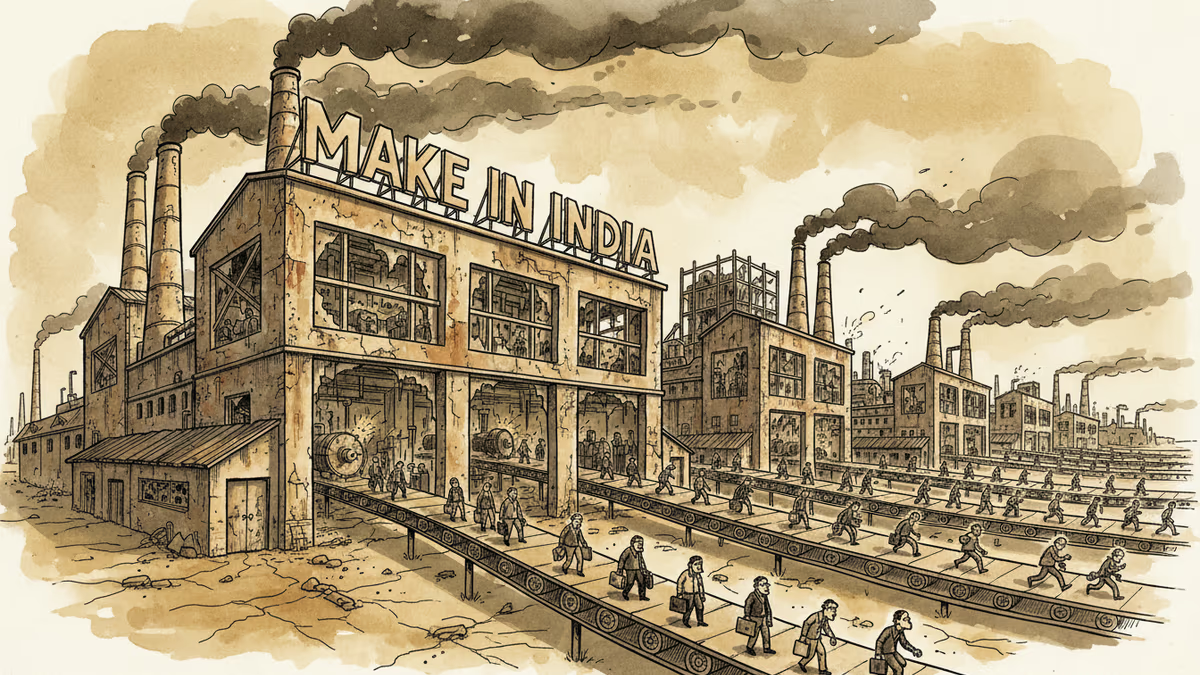
How India's 70-Year Tech Independence Dream Became a Dependency Trap
India's pursuit of technological sovereignty has paradoxically deepened its dependence. What does this mean for other emerging economies seeking tech autonomy?
When $85 Billion Bought Nothing
That's how much foreign direct investment flowed into India annually by 2022 under the "Make in India" initiative. Yet manufacturing's share of GDP collapsed to 14.7% — its lowest since 1968. How does a country attract record investment while watching its industrial base crumble?
India's seven-decade quest for technological independence has produced a cruel irony: the more aggressively it pursued self-reliance, the deeper its dependency became.
The Spectacular Failure of Make in India
When Prime Minister Narendra Modi launched Make in India in 2014, the targets were audacious: 12-14% annual industrial growth, 100 million new manufacturing jobs by 2022, and manufacturing's share rising to 25% of GDP. The rhetoric promised nothing less than India displacing China as "the world's new factory."
A decade later, the results read like an industrial obituary. Manufacturing hemorrhaged nearly one million workers between 2016-17 and 2022-23. Of the $80 billion in foreign investment by 2020-21, barely $21 billion translated into actual manufacturing capability.
Where did the money go? Nine sectors, dominated by IT services, absorbed the majority of FDI flows. Manufacturing was spread thin across 53 sectors, receiving just 30% of total foreign investment. A program named for self-reliance had become a service sector subsidy.
The R&D Collapse That Explains Everything
The most damning statistic isn't about factories or jobs — it's about innovation. India's R&D spending withered from 0.83% of GDP in 2009-10 to 0.64% in 2020-21. While India's share of global R&D spending stagnated at 2.9%, China surged to 22.8% by 2017.

The private sector, once imagined as the engine of technological development, retreated from R&D entirely. Its share dropped from 45.2% to 40.8%. India became one of the few major economies where public institutions account for more than half of domestic R&D — not because of strong state capacity, but because of private sector abdication.
Silicon Valley's Perfect Colony
India's trajectory reveals something profound about how technological dependency operates in the 21st century. Silicon Valley doesn't need to own Indian companies — it simply needs to structure the relationship correctly. It draws talent from India's skilled labor pool while treating the country as a captive market, cloaking this arrangement in the noble language of digital progress.
The software-hardware split exemplifies this dynamic. India celebrates its "comparative advantage" in software services while accepting permanent subordination in hardware manufacturing. Early computing initiatives understood hardware development as the foundation for genuine industrial growth. Today's orthodoxy treats this separation as natural and inevitable.
The Global South's Shared Predicament
India's experience isn't unique — it's a template. Lagos's thriving startup ecosystem risks becoming another talent pool for multinational corporations. Semiconductor fabrication remains concentrated in wealthy economies, while renewable energy transitions reproduce colonial extraction patterns despite sourcing lithium and copper from Africa and Latin America.
The capital requirements are staggering: a single semiconductor fabrication facility costs billions of dollars. But successful late industrializers elsewhere managed to construct robust national innovation systems. What makes the difference isn't just capital or skilled labor — it's institutional arrangements that India failed to develop.
The Nationalism That Deepens Dependence
The 2020 rebranding of Make in India as "Atmanirbhar Bharat Abhiyan" (Self-Reliant India) only highlighted the farcical nature of contemporary technological nationalism. Government ministers celebrated rising FDI numbers as proof of growing technological prowess while carefully obscuring where this investment actually went.
This isn't incompetence — it's the logical outcome of technocratic thinking that imagines technological advancement can bypass the need for deeper social transformation. By treating technology as politically neutral, India's elite reproduced the very dependency relationships they claimed to oppose.
Authors
Related Articles

SolarSquare is raising $55-60M at a $450-500M valuation, more than doubling its worth in 18 months. Here's what's driving investor conviction in India's residential solar market.

Indian venture capital has quietly displaced Silicon Valley in its own backyard. Only one American VC made India's top 10 investor list last year. Here's why that matters beyond India.
India's biggest digital payments platform PhonePe has shelved its IPO amid geopolitical tensions and a 9% market drop—but a quietly revised valuation tells a more complicated story.
Apple has hit 25% iPhone production in India, a milestone years in the making. What it means for supply chains, consumers, and the geopolitics of where things get made.
SolarSquare is raising $55-60M at a $450-500M valuation, more than doubling its worth in 18 months. Here's what's driving investor conviction in India's residential solar market.
Indian venture capital has quietly displaced Silicon Valley in its own backyard. Only one American VC made India's top 10 investor list last year. Here's why that matters beyond India.
India's biggest digital payments platform PhonePe has shelved its IPO amid geopolitical tensions and a 9% market drop—but a quietly revised valuation tells a more complicated story.
Apple has hit 25% iPhone production in India, a milestone years in the making. What it means for supply chains, consumers, and the geopolitics of where things get made.
Thoughts
Share your thoughts on this article
Sign in to join the conversation