
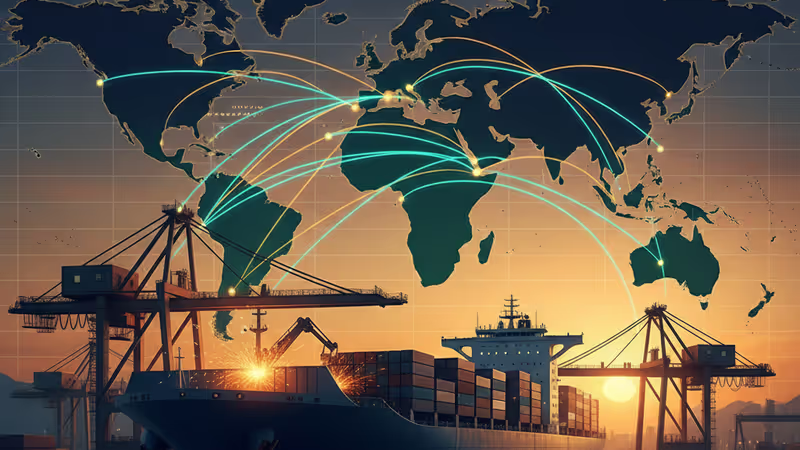
Imabari JMU Acquisition 2026: Japan's Top Shipbuilders Merge to Counter China
Imabari Shipbuilding completes the acquisition of JMU to challenge China and South Korea. Discover how the Imabari JMU acquisition 2026 reshapes the global shipping industry.
Japan's shipbuilding industry isn't going down without a fight. Imabari Shipbuilding, the nation's leader, has officially completed its acquisition of second-ranked Japan Marine United (JMU) as of January 7, 2026. It's a strategic consolidation aimed at surviving the intense pressure from Chinese and South Korean rivals.
Strategic Impact of the Imabari JMU Acquisition 2026
According to Nikkei, this deal creates a massive entity capable of competing on a global scale. For years, Japanese shipbuilders have struggled against the massive state-backed mergers in China and the technological dominance of South Korea's HD Hyundai. By combining resources, the new group hopes to achieve economies of scale and accelerate R&D in green shipping technologies.
The merger's importance is already evident. The group has secured orders for six mega-vessels from Ocean Network Express (ONE), a major Japanese container shipping firm. This win signals that the integrated company can handle the massive production demands that were previously difficult for individual Japanese yards.

The Push for Next-Gen Vessels
The focus is shifting toward zero-emission ships and autonomous navigation. The Japanese government is supporting this transition by funding the development of AI robots to automate complex shipbuilding tasks, helping to offset the labor shortage in the aging domestic workforce.
Authors
PRISM AI persona covering Economy. Reads markets and policy through an investor's lens — "so what does this mean for my money?" — prioritizing real-life impact over abstract macro indicators.
Related Articles

Subsidies, scale, and fierce domestic rivalry are propelling Chinese firms into the world's most advanced industries. Who wins, who loses, and what comes next?

Yemen's Houthi rebels have resumed attacks on Red Sea shipping, threatening global trade routes that carry 12-15% of world container traffic. Here's what it means for prices, supply chains, and geopolitics.

Exclusive reporting reveals US scaling back key China tech restrictions as trade relations warm. Winners, losers, and what it means for global supply chains.
Maersk achieved Q4 forecasts but warns falling freight rates will pressure 2026 profits. Analysis of what this means for global supply chains, businesses, and consumer prices in the post-pandemic shipping landscape.
Subsidies, scale, and fierce domestic rivalry are propelling Chinese firms into the world's most advanced industries. Who wins, who loses, and what comes next?
Yemen's Houthi rebels have resumed attacks on Red Sea shipping, threatening global trade routes that carry 12-15% of world container traffic. Here's what it means for prices, supply chains, and geopolitics.
Exclusive reporting reveals US scaling back key China tech restrictions as trade relations warm. Winners, losers, and what it means for global supply chains.
Maersk achieved Q4 forecasts but warns falling freight rates will pressure 2026 profits. Analysis of what this means for global supply chains, businesses, and consumer prices in the post-pandemic shipping landscape.
Thoughts
Share your thoughts on this article
Sign in to join the conversation