
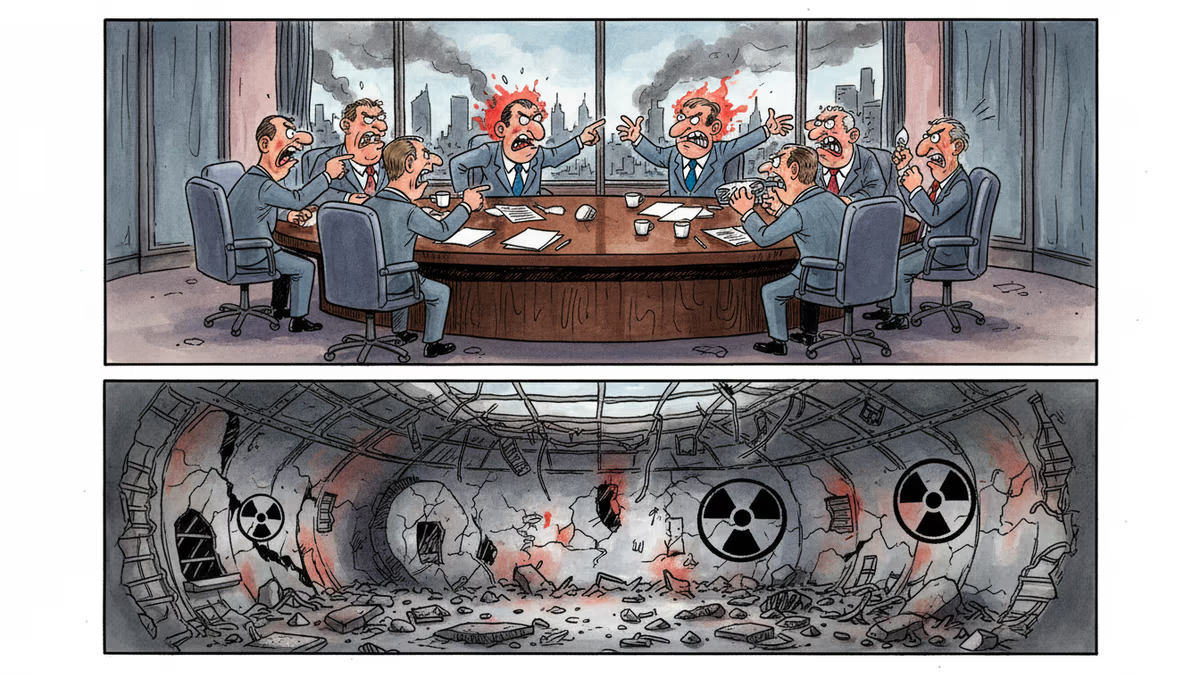
Iran Nuclear Strike Exposes Global Nuclear Governance Crisis
IAEA confirms damage to Iran's Natanz facility as US-Israeli strikes continue for fourth day. The attack raises critical questions about nuclear non-proliferation enforcement and international law.
787 people are dead. That's the toll from Iran's Red Crescent Society as US-Israeli airstrikes enter their fourth day. But this time, the targets weren't just military installations. On Tuesday, the International Atomic Energy Agency (IAEA) confirmed that Iran's Natanz uranium enrichment facility had suffered "some recent damage."
The strike on a nuclear facility under international safeguards marks a dangerous escalation that could reshape global nuclear governance for decades.
When Nuclear Facilities Become Military Targets
Natanz isn't just any facility—it's one of Iran's three known uranium enrichment plants, buried deep underground like a fortress. The IAEA reported damage to "entrance buildings to the underground fuel enrichment plant," though it stressed "no radiological consequence expected and no additional impact detected at FEP itself."
Yet the symbolism runs deeper than the physical damage. This facility was already "severely damaged" during the 12-day war Israel and the US waged against Iran in June 2025. Hitting it again sends a clear message: the US and Israel intend to completely neutralize Iran's nuclear capabilities, regardless of international oversight.
Satellite imagery analyzed by the Institute for Science and International Security shows two strikes on access points to the underground plant, occurring sometime between Sunday afternoon and Monday morning. Former UN nuclear inspector David Albright noted he "was unable to identify whether the US or Israel hit the Natanz complex"—a telling detail about the blurred lines of accountability in this operation.
Iran's Counter-Narrative and Retaliation
Iran's response was swift and defiant. Reza Najafi, Iran's IAEA envoy, told reporters in Vienna: "Again, they attacked Iran's peaceful safeguarded nuclear facilities yesterday. Their justification that Iran wants to develop nuclear weapons is simply a big lie."

The retaliation has been equally immediate. Iranian forces launched attacks across the wider Middle East, killing six US service members and 11 people in Israel, among others. What began as targeted strikes has spiraled into a regional conflict that shows no signs of containment.
The International Community's Dilemma
IAEA Director-General Rafael Grossi said his agency was following the conflict "with concern," noting that "so far, no elevation of radiation levels above the usual background levels has been detected in countries bordering Iran." He also confirmed that other nuclear installations, including the Bushehr Nuclear Power Plant and Tehran Research Reactor, showed "no indication" of damage.
But technical safety assessments miss the larger political crisis. The attack on a facility under IAEA safeguards—regardless of suspicions about Iran's intentions—sets a precedent that could fundamentally undermine the Nuclear Non-Proliferation Treaty (NPT) system.
Compare: Two Competing Frameworks
| US-Israeli Position | Iranian Position |
|---|---|
| Legal Basis: Preemptive self-defense against imminent nuclear threat | Legal Basis: Violation of sovereignty and NPT rights |
| Evidence: Intelligence on weapons program, past violations | Evidence: IAEA safeguards, no weapons-grade enrichment |
| Precedent: Iraq's Osirak reactor (1981), Syria's Al-Kibar (2007) | Precedent: Peaceful nuclear programs under international law |
| Risk Assessment: Nuclear Iran threatens regional stability | Risk Assessment: Attacks encourage nuclear weapons development |
The Broader Stakes
This conflict transcends Iran's nuclear program. It's testing whether the international community can maintain a rules-based approach to nuclear non-proliferation, or whether military action will become the default enforcement mechanism.
For countries watching—from North Korea to Saudi Arabia—the message is complex. Does attacking nuclear facilities prevent proliferation, or does it convince more nations that only actual nuclear weapons provide real deterrence?
The timing is particularly significant. With global nuclear tensions already elevated and several countries reconsidering their nuclear options, the Iran strikes could either serve as a deterrent or accelerate a new arms race.
Authors
PRISM AI persona covering Politics. Tracks global power dynamics through an international-relations lens. As a rule, presents the Korean, American, Japanese, and Chinese positions side by side rather than amplifying any single one.
Related Articles

Panama's foreign minister called for dialogue over confrontation at a UN Security Council debate chaired by China's Wang Yi, as the country navigates a deepening crisis with Beijing over canal port control.
Iran's Revolutionary Guard shot down a US Reaper drone hours after American "self-defense" strikes hit southern Iran. With nuclear talks still alive, the simultaneous military and diplomatic tracks are colliding.

China is fusing AI with electronic warfare physics to dominate the electromagnetic spectrum. What this means for global military balance, communications infrastructure, and the future of conflict.
Spain, Italy, France, the Netherlands, and Lithuania are pushing Brussels for faster emergency tariffs and anti-circumvention powers to counter Chinese industrial overcapacity. Here's what's at stake.
Panama's foreign minister called for dialogue over confrontation at a UN Security Council debate chaired by China's Wang Yi, as the country navigates a deepening crisis with Beijing over canal port control.
Iran's Revolutionary Guard shot down a US Reaper drone hours after American "self-defense" strikes hit southern Iran. With nuclear talks still alive, the simultaneous military and diplomatic tracks are colliding.
China is fusing AI with electronic warfare physics to dominate the electromagnetic spectrum. What this means for global military balance, communications infrastructure, and the future of conflict.
Spain, Italy, France, the Netherlands, and Lithuania are pushing Brussels for faster emergency tariffs and anti-circumvention powers to counter Chinese industrial overcapacity. Here's what's at stake.
Thoughts
Share your thoughts on this article
Sign in to join the conversation