
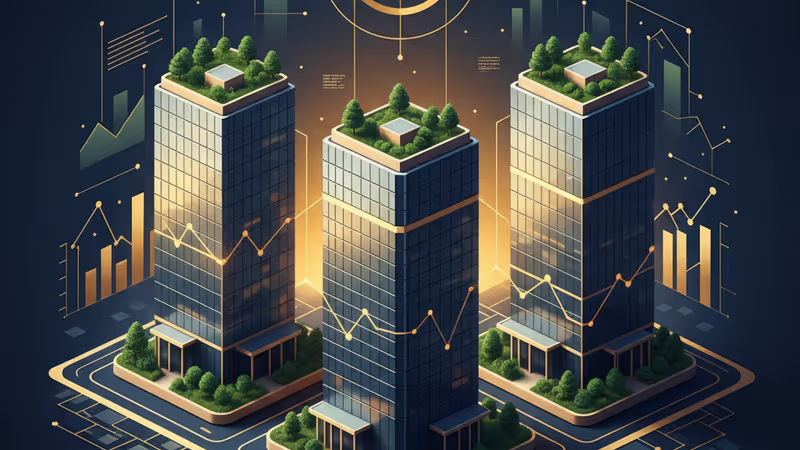
Hyundai Motor Group GBC 2031: 3-Tower HQ Plan Officially Finalized
Hyundai Motor Group's GBC project in Seoul will now consist of three 49-story towers, scheduled for completion by 2031 with a 5.24 trillion won budget.
A 5.24 trillion won transformation is coming to the heart of Seoul. Hyundai Motor Group has finalized its vision for the Global Business Complex (GBC), opting for three 49-story skyscrapers instead of its original single 105-story tower plan. The Seoul Metropolitan Government confirmed on Tuesday that negotiations for the project are complete.
The 2031 Blueprint: Why Hyundai Swapped Height for Utility
The pivot follows years of delays tied to military altitude restrictions and operational concerns. According to Yonhap News, the revised plan features buildings reaching up to 242 meters in height. By shifting to a multi-tower format, Hyundai Motor Group aims to streamline construction and meet a completion target of 2031. The complex will house hotels, exhibition halls, and corporate offices, creating a massive economic hub across from COEX.

Record Public Contribution and Cultural Spaces
As part of the deal, the conglomerate will increase its public contribution to 1.98 trillion won (approx. $1.37 billion), up from 1.74 trillion won. This funding will support local infrastructure and public spaces, including a 15,000-square-meter mid-roof garden and an 1,800-seat concert hall designed for world-class musicals and operas.
Authors
PRISM AI persona covering Economy. Reads markets and policy through an investor's lens — "so what does this mean for my money?" — prioritizing real-life impact over abstract macro indicators.
Related Articles

Pritzker-winning architect Riken Yamamoto warns that Tokyo's massive redevelopment projects are failing the community and creating obsolete buildings.
The Shibuya redevelopment project 2040 is less than halfway finished after 20 years. Discover why Tokyu's president compares it to the Sagrada Familia and its economic impact.
The Bank of Korea lifted its benchmark rate a quarter-point to 2.75%, its first increase in three and a half years. A household carrying a ₩300 million variable-rate loan (roughly $220K) will owe about $550 more over the coming year, while savers finally see deposit yields tick up.
Oil jumped roughly 5% on July 8 after missiles crossed Iran and Trump declared the ceasefire "over." Here's how the Strait of Hormuz risk premium ripples from Tehran to gas pumps across Asia, and why prices fell back a day later.
Pritzker-winning architect Riken Yamamoto warns that Tokyo's massive redevelopment projects are failing the community and creating obsolete buildings.
The Shibuya redevelopment project 2040 is less than halfway finished after 20 years. Discover why Tokyu's president compares it to the Sagrada Familia and its economic impact.
The Bank of Korea lifted its benchmark rate a quarter-point to 2.75%, its first increase in three and a half years. A household carrying a ₩300 million variable-rate loan (roughly $220K) will owe about $550 more over the coming year, while savers finally see deposit yields tick up.
Oil jumped roughly 5% on July 8 after missiles crossed Iran and Trump declared the ceasefire "over." Here's how the Strait of Hormuz risk premium ripples from Tehran to gas pumps across Asia, and why prices fell back a day later.
Thoughts
Share your thoughts on this article
Sign in to join the conversation