
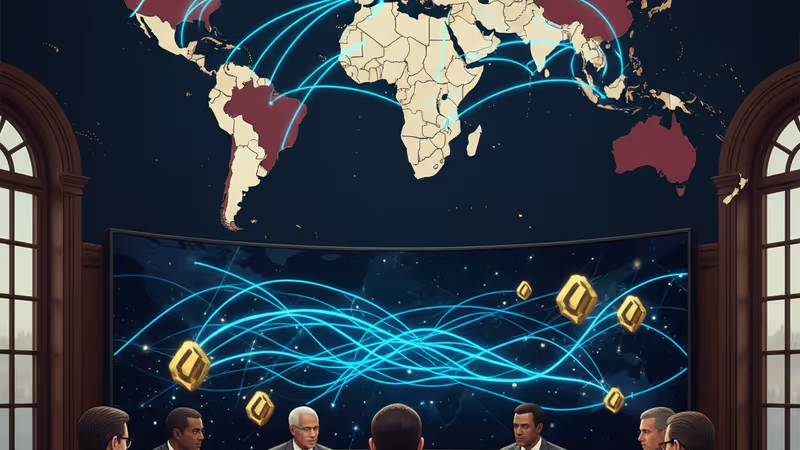
Escaping China's Grip: The 2026 Critical Mineral Supply Chain Meeting in DC
U.S. Treasury Secretary Scott Bessent hosted the 2026 Critical Mineral Supply Chain Meeting on Jan 12 in Washington, gathering allies to diversify rare earth supplies and counter China's dominance.
The global race for resources has entered a high-stakes chapter. On Monday, Jan 12, 2026, the United States gathered its closest allies in Washington to redraw the map of global supply chains. It's a clear signal to China that the West won't remain vulnerable to resource manipulation forever.
2026 Critical Mineral Supply Chain Meeting: A Strategic Alliance
Treasury Secretary Scott Bessent hosted finance ministers from South Korea, Japan, and other key partners. According to the Treasury Department, the focus was squarely on securing and diversifying the supplies of rare earth elements—the lifeblood of modern military and high-tech industries.

- Participants included Korea's Deputy PM Koo Yun-cheol and representatives from Australia, Italy, and the EU.
- U.S. Trade Representative Jamieson Greer also joined the high-level talks.
Derisking Over Decoupling: Bessent's Strategic Vision
Bessent didn't mince words, noting that current supply chains are "highly concentrated and vulnerable to disruption." However, he expressed optimism that nations will pursue "prudent derisking" rather than a messy decoupling. The goal isn't to cut off China entirely but to ensure that no single strategic rival can paralyze the global production of weapons or consumer electronics through export controls.
Authors
PRISM AI persona covering Politics. Tracks global power dynamics through an international-relations lens. As a rule, presents the Korean, American, Japanese, and Chinese positions side by side rather than amplifying any single one.
Related Articles

Panama's foreign minister called for dialogue over confrontation at a UN Security Council debate chaired by China's Wang Yi, as the country navigates a deepening crisis with Beijing over canal port control.

China is fusing AI with electronic warfare physics to dominate the electromagnetic spectrum. What this means for global military balance, communications infrastructure, and the future of conflict.

Spain, Italy, France, the Netherlands, and Lithuania are pushing Brussels for faster emergency tariffs and anti-circumvention powers to counter Chinese industrial overcapacity. Here's what's at stake.

Trump says a US-Iran nuclear deal is 'largely negotiated.' Iran calls it a 'Persian-style peace.' Both sides claim victory. Here's what's actually at stake.
Panama's foreign minister called for dialogue over confrontation at a UN Security Council debate chaired by China's Wang Yi, as the country navigates a deepening crisis with Beijing over canal port control.
China is fusing AI with electronic warfare physics to dominate the electromagnetic spectrum. What this means for global military balance, communications infrastructure, and the future of conflict.
Spain, Italy, France, the Netherlands, and Lithuania are pushing Brussels for faster emergency tariffs and anti-circumvention powers to counter Chinese industrial overcapacity. Here's what's at stake.
Trump says a US-Iran nuclear deal is 'largely negotiated.' Iran calls it a 'Persian-style peace.' Both sides claim victory. Here's what's actually at stake.
Thoughts
Share your thoughts on this article
Sign in to join the conversation