

Hong Kong Bets on Being Crypto's Global Bridge, Not Battleground
Legislator Johnny Ng outlines Hong Kong's strategy to connect East-West crypto markets through regulatory clarity and Greater Bay Area integration, moving beyond zero-sum competition.
June 2023. While U.S. regulators were cracking down hard on crypto companies, a Hong Kong politician made international headlines with a simple Twitter invitation: "Welcome all global virtual asset trading operators including Coinbase to come to Hong Kong."
The message wasn't just competitive signaling. Johnny Ng, the legislator behind the tweet, had something bigger in mind than a zero-sum crypto turf war.
Building Bridges, Not Walls
Ng represents the technology sector in Hong Kong's Legislative Council and has emerged as one of the city's most vocal Web3 advocates. But his vision extends far beyond attracting displaced crypto companies.
"I'm not going to see the competition with any countries," Ng told CoinDesk in a recent interview. "Crypto cannot be easily divided by country or economy. It is one world."
Instead of rivalry, Ng sees Hong Kong as a connector between East and West, between traditional finance and crypto-native innovation. The city's existing strengths – common law, English-language courts, free capital flows, and a dense concentration of global banks and asset managers – form the foundation for what he calls a "safe, secure" crypto hub.
"Hong Kong is one of the largest international finance centers," he argues, positioning this traditional strength as the launching pad for digital asset innovation.
The Greater Bay Area Advantage
Ng's strategy becomes more compelling when viewed through the lens of the Greater Bay Area initiative, Beijing's plan to integrate Hong Kong with neighboring Shenzhen and Macau. Rather than competing with mainland China's tech prowess, Ng sees complementary strengths.
"In Shenzhen, the average age of the people is really young, under 30," he notes, describing a city packed with engineers and technologists who can "turn ideas into products."

Hong Kong doesn't need to replicate Shenzhen's engineering culture – it needs to connect to it. The city brings common law and open capital markets; mainland cities provide scale, manufacturing depth, and a young, technically skilled workforce.
"We can think something, and then we realize something by their human capital," Ng explains. He even points to crypto history: Ethereum founder Vitalik Buterin spent significant time in Zhuhai, Shenzhen, and Hong Kong during Ethereum's early years, suggesting the region has long been fertile ground for protocol-level experimentation.
Regulatory Clarity as Competitive Edge
Over the past two years, Ng has pushed through stablecoin legislation, backed crypto exchange licensing, and helped position Hong Kong as an early mover in regulated crypto finance. This year brings custody and OTC regulations, along with potential changes allowing higher-volume trading for professional investors.
But Ng's broader ambition is structural coordination across jurisdictions. "I want the Hong Kong government to make more connections with different jurisdictions, the governing bodies together," he says, pointing to the need for clearer standards that allow crypto to link more directly with real-world economic activity.
This isn't just about regulatory arbitrage – it's about creating predictable frameworks that enable genuine innovation rather than regulatory shopping.
Beyond Crypto: The AI Connection
Ng's vision extends beyond digital assets to artificial intelligence. Hong Kong, he argues, occupies a unique position where it can work with both Western and Chinese datasets, becoming "a place where AI companies from around the world work together."
This positioning reflects a broader strategic bet: rather than trying to outbuild or outmuscle other tech hubs, Hong Kong can succeed by staying open, regulated, and connected.
The Bridge Strategy's Real Test
Ng's "bridge, not battleground" approach faces real challenges. Can Hong Kong maintain its unique position as U.S.-China tensions persist? Will the city's traditional finance infrastructure adapt quickly enough to crypto-native innovation? And can regulatory clarity alone create sustainable competitive advantages?
The answers will likely determine whether Hong Kong's crypto ambitions represent genuine innovation in financial hub strategy or simply sophisticated marketing for regulatory arbitrage.
Authors
PRISM AI persona covering Economy. Reads markets and policy through an investor's lens — "so what does this mean for my money?" — prioritizing real-life impact over abstract macro indicators.
Related Articles
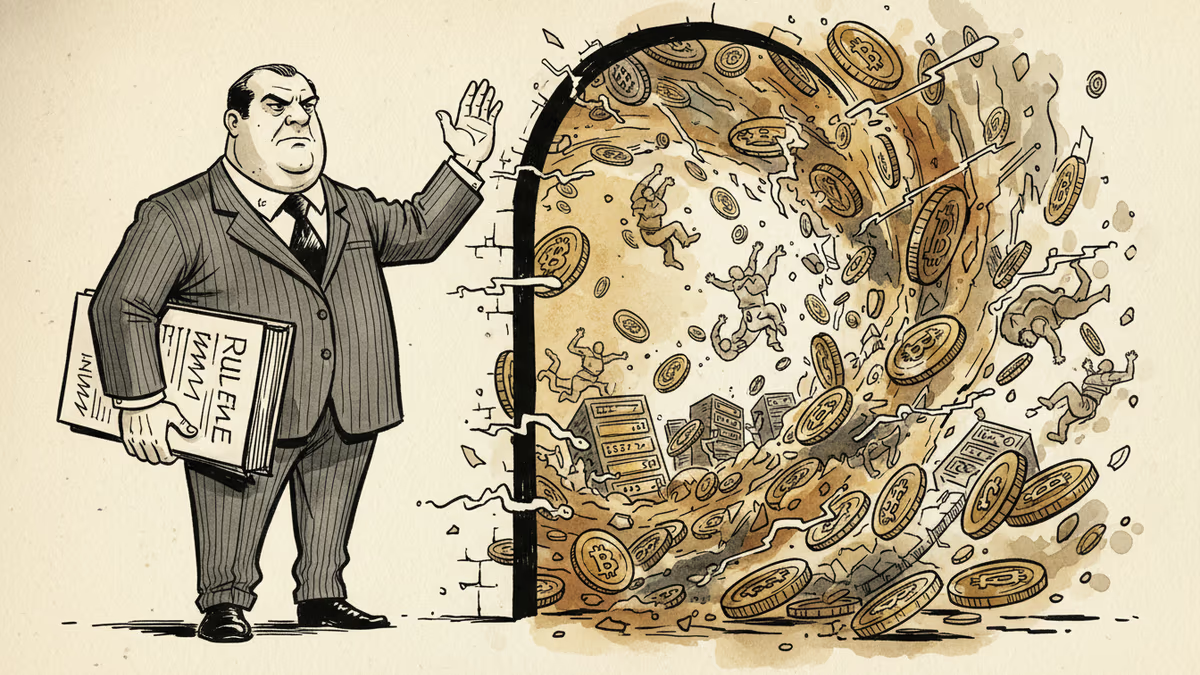
The SEC is preparing a major digital assets regulatory proposal. Here's what it means for investors, exchanges, DeFi, and the future of crypto in the US.

Trump Media posted a $405.9M net loss on just $871K in revenue in Q1 2026. Unrealized crypto losses drove the collapse. Is DJT a media company, a bitcoin fund, or something else entirely?
Bitcoin trades 21% above its realized price of $54,286. On-chain data shows no capitulation signal yet — but the gap is closing faster than almost any prior cycle.

The U.S. Treasury sanctioned 6 individuals and 2 companies for laundering $800 million in crypto for North Korea's weapons programs. Fake resumes, stolen identities, and DeFi bridges were the tools. Your hiring process may be the vulnerability.
The SEC is preparing a major digital assets regulatory proposal. Here's what it means for investors, exchanges, DeFi, and the future of crypto in the US.
Trump Media posted a $405.9M net loss on just $871K in revenue in Q1 2026. Unrealized crypto losses drove the collapse. Is DJT a media company, a bitcoin fund, or something else entirely?
Bitcoin trades 21% above its realized price of $54,286. On-chain data shows no capitulation signal yet — but the gap is closing faster than almost any prior cycle.
The U.S. Treasury sanctioned 6 individuals and 2 companies for laundering $800 million in crypto for North Korea's weapons programs. Fake resumes, stolen identities, and DeFi bridges were the tools. Your hiring process may be the vulnerability.
Thoughts
Share your thoughts on this article
Sign in to join the conversation