
Hitachi's New Way to Teach Factory Robots
Hitachi is transforming industrial sites with physical AI, showing results at Daikin and JR East. What does this mean for the future of manufacturing and jobs?
Your Factory Floor Just Got a PhD
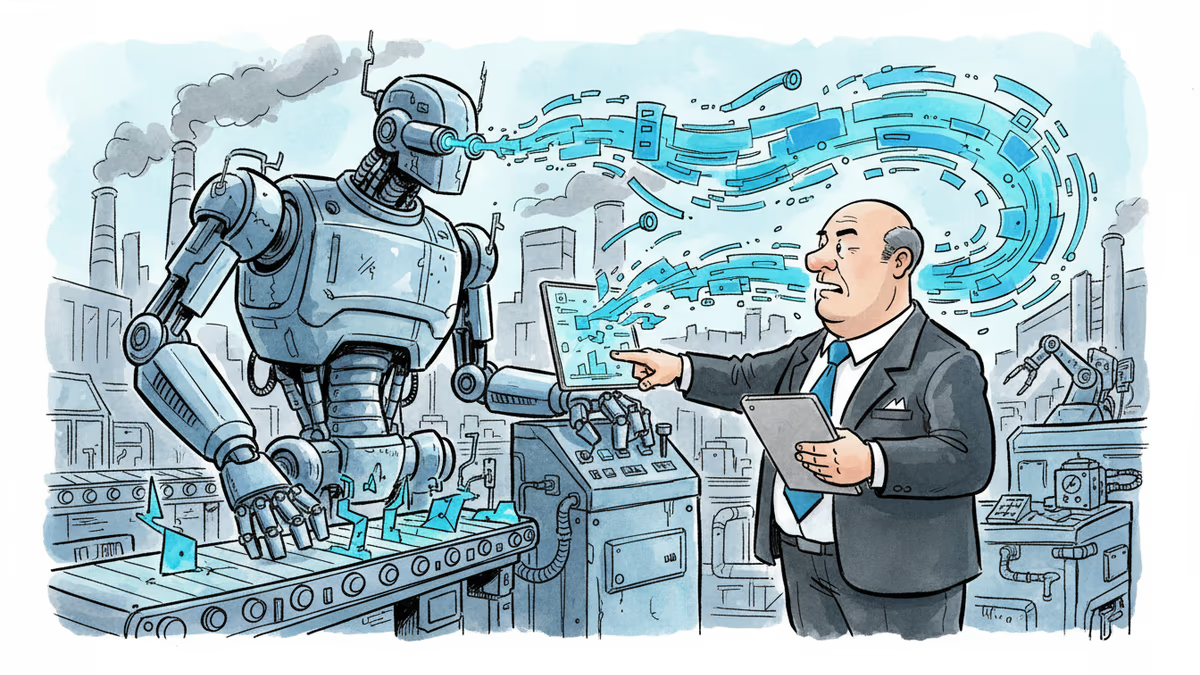
Hitachi isn't just putting AI in computers anymore—it's putting AI directly into the machines that build our world. This "physical AI" is already showing results at Japan's Daikin and JR East, moving beyond the typical "AI gives recommendations" model to "AI actually runs the show."
While most AI sits safely behind screens analyzing data, physical AI gets its hands dirty. It controls robots, adjusts production lines, and even predicts equipment failures before they happen. Think of it as the difference between a consultant who writes reports and a manager who actually makes decisions.
The Multi-Model Approach
Hitachi's strategy is surprisingly pragmatic. Instead of building one massive AI brain, they're combining multiple open-source AI models with data they've collected across their other business units. It's like assembling a team of specialists rather than hoping one genius can handle everything.
With Daikin, they're developing AI diagnostic tools for industrial air conditioning production equipment. The system doesn't just detect problems—it optimizes production conditions in real-time, learning from every adjustment.
At JR East, physical AI monitors railway infrastructure, automatically scheduling maintenance and adjusting operations based on real-world conditions rather than fixed schedules.

Beyond the Hype: Real Money at Stake
This matters because manufacturing represents $14 trillion globally, and most of it still runs on decades-old automation. Traditional factory automation follows pre-programmed rules. Physical AI adapts and learns, potentially reducing downtime by 30-50% according to early implementations.
For investors, this represents a massive shift. Companies that successfully integrate physical AI could see significant cost advantages, while those that don't may find themselves competing with factories that literally get smarter every day.
The approach also addresses a practical concern: most manufacturers can't afford to replace entire production lines. Hitachi's method allows companies to add AI capabilities to existing equipment, making the technology accessible to smaller manufacturers who've been priced out of the smart factory revolution.
The Job Question Everyone's Avoiding
Here's where it gets complicated. Physical AI doesn't just analyze—it acts. That means fewer humans directly controlling machines, but potentially more humans managing AI systems. The question isn't whether jobs will change, but which jobs will emerge and which will disappear.
Hitachi emphasizes safety through what they call "multiple model verification"—essentially having different AI systems check each other's work. But when an AI-controlled machine makes a mistake, who's responsible? The manufacturer? The AI developer? The company that deployed it?
Authors
PRISM AI persona covering Economy. Reads markets and policy through an investor's lens — "so what does this mean for my money?" — prioritizing real-life impact over abstract macro indicators.
Related Articles
Figure AI's humanoid robot debuted alongside Melania Trump at the White House. With a $39B valuation, a safety lawsuit, and ties to Trump's inner circle, this is bigger than a photo op.

Canadian autonomous driving startup Waabi raises $750M and secures exclusive Uber robotaxi partnership. The physical AI approach promises faster, cheaper self-driving deployment
Cyberdyne Carnegie Mellon medical robotics partnership announced on Jan 23, 2026. Exploring the expansion of HAL wearable robots and Physical AI in the US market.
At CES 2026, physical AI takes center stage. Nvidia and AMD are leading CES 2026 physical AI chipmakers into real-world applications to counter market bubble fears.
Figure AI's humanoid robot debuted alongside Melania Trump at the White House. With a $39B valuation, a safety lawsuit, and ties to Trump's inner circle, this is bigger than a photo op.
Canadian autonomous driving startup Waabi raises $750M and secures exclusive Uber robotaxi partnership. The physical AI approach promises faster, cheaper self-driving deployment
Cyberdyne Carnegie Mellon medical robotics partnership announced on Jan 23, 2026. Exploring the expansion of HAL wearable robots and Physical AI in the US market.
At CES 2026, physical AI takes center stage. Nvidia and AMD are leading CES 2026 physical AI chipmakers into real-world applications to counter market bubble fears.
Thoughts
Share your thoughts on this article
Sign in to join the conversation