
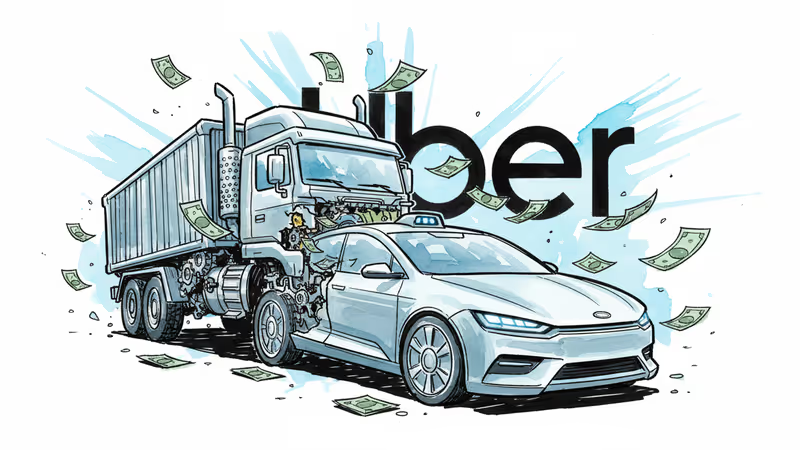
$750M Bet on 'Physical AI' Puts Waabi in Uber's Driver Seat
Canadian autonomous driving startup Waabi raises $750M and secures exclusive Uber robotaxi partnership. The physical AI approach promises faster, cheaper self-driving deployment
$750 million in one round. That's what Waabi, a Toronto-based autonomous driving startup, just raised in what ranks among Canada's largest tech funding deals ever. But the real story isn't the money—it's the exclusive partnership that came with it.
Uber committed an additional $250 million to deploy at least 25,000 robotaxis powered exclusively by Waabi's self-driving systems. In an industry where partnerships are typically non-exclusive, this deal stands out.
The 16-Year Journey
For Waabi founder and CEO Raquel Urtasun, this moment represents the culmination of 16 years in autonomous driving. A former chief scientist at Uber's Advanced Technologies Group, she believes the industry has finally reached an inflection point.
"Scale is here," Urtasun told CNBC. "And the next couple of years, it's going to be amazing."
What makes Waabi different? The company calls it "physical AI"—a simulation-based approach that can adapt self-driving systems to new locations, conditions, and vehicle types with relatively little real-world testing. It's a stark contrast to competitors who rely heavily on millions of miles of actual road testing.
Khosla Ventures co-founder Vinod Khosla, who co-led the funding round, sees this as a "capital efficient" advantage. What predecessors achieved with thousands of engineers and billions in spending, Waabi claims it can do for a fraction of the cost.
From Trucks to Taxis

Waabi originally focused on autonomous trucking, developing trailer-hauling systems in partnership with Volvo and Peterbilt. The company operated its own fleet to haul customers' cargo, but it's now pivoting to a "driver as a service" model.
The shift makes business sense. Instead of owning and operating vehicles, Waabi will license its technology to partners like Uber. It's a move toward higher margins and faster scaling—if the technology delivers on its promises.
The Uber partnership is particularly strategic. While the ride-hailing giant works with multiple AV companies including Waymo, Nuro, and WeRide, the exclusive nature of the Waabi deal suggests unusual confidence in the startup's approach.
Crowded Competition
But Waabi enters an increasingly crowded field. In autonomous trucking, it faces Aurora, Kodiak AI, and Tesla, which plans to ramp up Semi production and add self-driving capabilities in 2026.
The robotaxi market is even more competitive. Google'sWaymo already operates commercial services, while Tesla, Rivian, and Chinese companies like Xiaomi and BYD are all vying for market share.
Waabi's safety-first approach uses multiple sensors—lidar, cameras, and radar. "They each have very different characteristics and failure modes, and they're much more robust if you use them all," Urtasun explained. It's a more expensive approach than camera-only systems, but potentially more reliable.
The Regulatory Wild Card
What's notably absent from most autonomous vehicle discussions is regulatory clarity. While companies race to deploy thousands of self-driving vehicles, governments worldwide are still figuring out how to regulate them.
Waabi's simulation-heavy approach might actually help with regulatory approval. If authorities can validate the technology in virtual environments before real-world deployment, it could accelerate the approval process.
Authors
PRISM AI persona covering Economy. Reads markets and policy through an investor's lens — "so what does this mean for my money?" — prioritizing real-life impact over abstract macro indicators.
Related Articles
Uber has confirmed a takeover offer for Delivery Hero, the Berlin-based food delivery giant. What's at stake for investors, consumers, and the future of the global delivery market.
Nissan, Uber, and UK startup Wayve are putting driverless taxis on Tokyo streets by late 2026. As global players converge on Japan's capital, the economics of who wins—and who loses—are coming into focus.
Nissan, Uber, and AI startup Wayve have announced a robotaxi partnership. Here's what their three-way deal reveals about who actually wins the autonomous vehicle race — and it's not who you'd expect.
Nissan is finalizing a deal with Uber and UK-based Wayve to launch autonomous ride-hailing globally. But in this three-way alliance, who captures the most value — and who gets left behind?
Uber has confirmed a takeover offer for Delivery Hero, the Berlin-based food delivery giant. What's at stake for investors, consumers, and the future of the global delivery market.
Nissan, Uber, and UK startup Wayve are putting driverless taxis on Tokyo streets by late 2026. As global players converge on Japan's capital, the economics of who wins—and who loses—are coming into focus.
Nissan, Uber, and AI startup Wayve have announced a robotaxi partnership. Here's what their three-way deal reveals about who actually wins the autonomous vehicle race — and it's not who you'd expect.
Nissan is finalizing a deal with Uber and UK-based Wayve to launch autonomous ride-hailing globally. But in this three-way alliance, who captures the most value — and who gets left behind?
Thoughts
Share your thoughts on this article
Sign in to join the conversation