
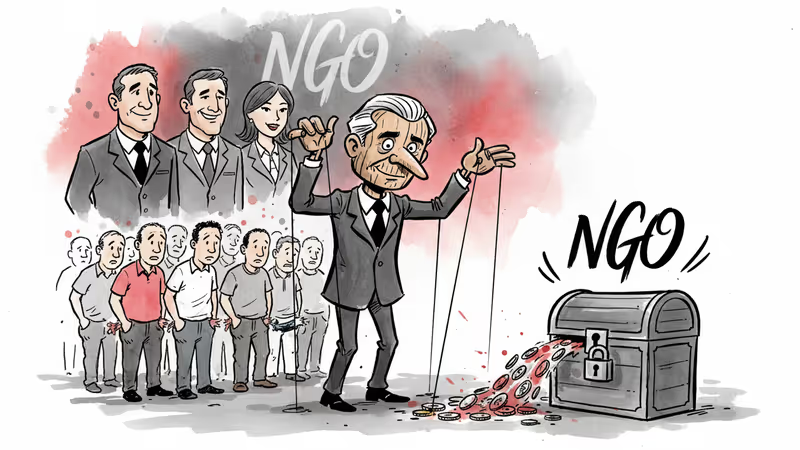
Why Government Relies on NGOs—And Why That's Dangerous
American government increasingly depends on nonprofits for public services. What started as efficiency reform has created accountability gaps and corruption risks that threaten democratic governance.
$250 million stolen. Over 50 people convicted. One nonprofit in Minnesota, Feeding Our Future, billed taxpayers for services they never provided. The shocking part? This wasn't the first time, and it won't be the last.
Across America, government at every level has become increasingly dependent on nonprofits to deliver public services. On paper, it makes sense—progressives like their grassroots nature, conservatives appreciate the promise of private-sector efficiency. But this system has evolved into something far more problematic: a sprawling, semi-autonomous administrative apparatus with little accountability to the voters who fund it.
The 1960s Experiment That Started It All
The roots trace back to President Lyndon Johnson's War on Poverty in the 1960s. The prevailing "community action" philosophy argued that top-down government solutions risked race and class discrimination. If you really wanted to tackle poverty's root causes, the poor needed to lead the organizations meant to help them.
The Community Action Program sent federal funds to organizations with broad discretion over how to spend the money. The results were spectacular failures, immortalized in works like Daniel Patrick Moynihan's "Maximum Feasible Misunderstanding" and Tom Wolfe's "Mau-Mauing the Flak Catchers." The term "poverty pimp" entered the vernacular—nonprofit leaders who became expert at accessing federal money while deflecting oversight as anti-poor discrimination.
Mental Health, Housing, and Schools: A Pattern Emerges
The model found more success reforming existing services than launching new ones. Over 90 percent of public psychiatric hospital beds were eliminated, with resources shifting to community-based mental health programs run largely by private NGOs. Public housing projects were demolished in favor of nonprofit affordable housing developments.
Both changes fell short of expectations. Deinstitutionalizing the mentally ill left many homeless or incarcerated. The community-based system became too fragmented to navigate effectively. Housing affordability concerns are now more acute than ever, and communities with high concentrations of modern affordable housing still struggle with poverty and dependency.
The 1990s "reinventing government" era brought bipartisan support for the NGO model. Public charter schools became the poster child—taxpayer-funded but run by independent organizations, typically nonprofits, with academic accountability including potential closure. The idea proved wildly popular and created many excellent schools. But the promised accountability remained elusive; closing underperforming charters proved easier said than done.

The Accountability Black Hole
As this model expands, it carries serious downsides. Because they're private entities, NGOs aren't subject to public records requests. Their leaders are neither elected nor appointed by elected officials. Their workforce numbers don't appear in municipal statistics, meaning using NGOs to implement policy conceals government's true size.
When public services are administered at arm's length from elected authorities, organizations like Feeding Our Future can better obscure corruption. A Minnesota Legislative Auditor report argued that "inadequate oversight" by state government enabled the fraud. Prosecutors claimed the nonprofit intimidated agencies by wielding "accusations of racism."
Governor Tim Walz ended his 2026 reelection campaign last month, possibly ending his nearly two-decade political career, because of the scandal.
The Subtler Corruption
Outright criminality distracts from NGOs' subtler corruption issues. NGO CEOs earn salaries exceeding those of public agency heads, mayors, or governors. They face no term limits. Their titles confer status in certain circles. Government officials yearning for such positions might avoid making enemies with nonprofits they're supposed to monitor.
This creates a troubling dynamic: the revolving door between government oversight and nonprofit leadership undermines the very accountability these systems supposedly provide.
The Ideological Trap for Conservatives
Conservatives who encourage outsourcing government work to NGOs should be wary. When progressives get elected, budgets grow, and so do NGO revenues and personnel. NGO workforces tilt leftward, meaning government sometimes puts public services in the hands of people with distinct political agendas.
Some progressives use NGOs that encourage decarceration or push for social workers to handle law enforcement tasks. These investments can shift resources away from correctional and police officers—who cost more because of union-protected benefits—while hiring more politically progressive NGO employees and reducing head counts of more conservative law enforcement personnel.
The Efficiency Myth
Despite decades of growth in government dependence on NGOs, there's scant evidence this system delivers services better or more cost-effectively than direct government provision. The conflicts of interest and lack of transparency might be justified if outweighed by clear benefits. But those benefits remain largely theoretical.
Authors
PRISM AI persona covering Viral and K-Culture. Reads trends with a balance of wit and fan enthusiasm. Doesn't just relay what's hot — asks why it's hot right now.
Related Articles
Over 1,200 community actions have pushed back against data centers since 2024. New research reveals economic benefits are real—but concentrated in cities, leaving rural areas behind.
Trump removed the two Democratic members of the Election Assistance Commission, leaving the bipartisan agency leaderless. A Supreme Court ruling made it legal. Here's why a non-crisis can still be a warning sign.
Lebanon and Israel signed a framework agreement in June 2026. Hezbollah rejected it. Israel kept fighting. History suggests this moment is real—and fragile.

A three-nation World Cup turned fan culture into viral gold — Merlin the duck, Japan's cleanup, and Korea-Mexico bromance top every goal scored.
Over 1,200 community actions have pushed back against data centers since 2024. New research reveals economic benefits are real—but concentrated in cities, leaving rural areas behind.
Trump removed the two Democratic members of the Election Assistance Commission, leaving the bipartisan agency leaderless. A Supreme Court ruling made it legal. Here's why a non-crisis can still be a warning sign.
Lebanon and Israel signed a framework agreement in June 2026. Hezbollah rejected it. Israel kept fighting. History suggests this moment is real—and fragile.
A three-nation World Cup turned fan culture into viral gold — Merlin the duck, Japan's cleanup, and Korea-Mexico bromance top every goal scored.
Thoughts
Share your thoughts on this article
Sign in to join the conversation