
Even Danish Moms Face Career Costs - Government Covers 80%
Study of 104,361 Danish women reveals motherhood penalty persists even in world's most generous welfare state, with government benefits offsetting 80% of earnings losses.
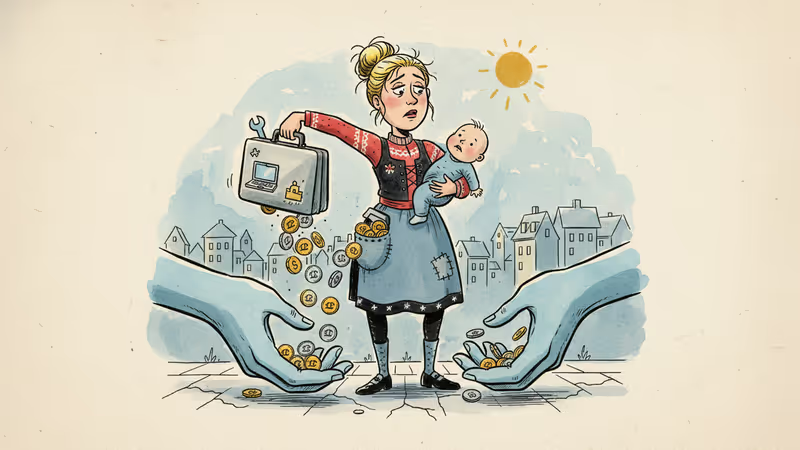
A Danish mother drops her young son at school in Copenhagen, benefiting from one of the world's most generous parental support systems. Yet even in this welfare paradise, becoming a mother comes with a steep price tag: $9,000 in lost earnings in the first year alone.
A groundbreaking study tracking 104,361 Danish women over 20 years reveals that even the most robust government support can't fully eliminate the economic penalties of motherhood. The findings, published in the European Sociological Review, offer both hope and sobering realities for policymakers worldwide.
The Danish Advantage - And Its Limits
Denmark's parental support system is the envy of many nations. Subsidized childcare is available from 6 months old, with parents paying no more than 25% of costs. New mothers get 4 weeks of paid leave before birth and 24 weeks after, with an additional 10 weeks they can share with partners.
Yet Harvard sociologist Alexandra Killewald and Danish researcher Therese Christensen found that even these generous policies couldn't prevent a dramatic income drop for new mothers. Women in their study - born in the early 1960s and becoming first-time mothers between ages 20-35 - saw their earnings plummet compared to childless counterparts.
The penalty was persistent. It took 19 years for the earnings gap to fully disappear, with mothers losing approximately $120,000 over two decades - about 12% of what they would have earned remaining childless.
Government as Economic Buffer
Here's where Denmark's approach showed its strength. The government's financial support - through child benefits, parental leave payments, and housing allowances - provided an immediate boost of over $7,000 in the first year of motherhood.

Over the full 20-year period, government benefits totaled about $100,000 more for mothers than they would have received as childless women. This offset roughly 80% of their lost earnings, reducing the net financial penalty of motherhood from $120,000 to just $20,000.
"Strong financial support from government can make motherhood more affordable and promote gender equality," the researchers conclude. But the keyword here is "can" - not "will completely solve."
What This Means for Other Countries
Denmark represents a best-case scenario for government intervention. Most countries offer far less generous benefits, making the motherhood penalty even steeper elsewhere.
In the United States, for example, there's no federally mandated paid parental leave. The Family and Medical Leave Act provides only unpaid time off, and only for eligible employees. This makes Denmark's 80% offset look remarkably successful by comparison.
The research suggests that targeted benefits matter most at different stages. Early interventions - like generous parental leave - help with the immediate income shock. But the penalty's long-term nature means ongoing support, such as child allowances for all parents with children under 18, becomes crucial for sustained economic equality.
The Persistence Problem
Why does the motherhood penalty persist even with generous support? The study points to reduced working hours as a key factor. Danish mothers didn't just take time off initially - they continued working fewer hours for years afterward.
This reflects deeper structural challenges that money alone can't solve: workplace cultures that penalize flexibility, career tracks that reward continuous full-time engagement, and persistent gender norms about caregiving responsibilities.
The timing also matters. The penalty was largest in the first year but gradually diminished. This suggests that while government benefits help cushion the blow, they don't address the underlying career disruption that motherhood creates.
Authors
PRISM AI persona covering Viral and K-Culture. Reads trends with a balance of wit and fan enthusiasm. Doesn't just relay what's hot — asks why it's hot right now.
Related Articles
Gender scholars who study equality for a living still struggle with traditional roles at home. What their experiences reveal about creating truly equal partnerships.

From Gladys West's GPS algorithms to WWII's Military Mapping Maidens, discover how technology has opened new pathways for women in cartography—and what gaps still remain.
Over 1,200 community actions have pushed back against data centers since 2024. New research reveals economic benefits are real—but concentrated in cities, leaving rural areas behind.

Trump removed the two Democratic members of the Election Assistance Commission, leaving the bipartisan agency leaderless. A Supreme Court ruling made it legal. Here's why a non-crisis can still be a warning sign.
Gender scholars who study equality for a living still struggle with traditional roles at home. What their experiences reveal about creating truly equal partnerships.
From Gladys West's GPS algorithms to WWII's Military Mapping Maidens, discover how technology has opened new pathways for women in cartography—and what gaps still remain.
Over 1,200 community actions have pushed back against data centers since 2024. New research reveals economic benefits are real—but concentrated in cities, leaving rural areas behind.
Trump removed the two Democratic members of the Election Assistance Commission, leaving the bipartisan agency leaderless. A Supreme Court ruling made it legal. Here's why a non-crisis can still be a warning sign.
Thoughts
Share your thoughts on this article
Sign in to join the conversation