
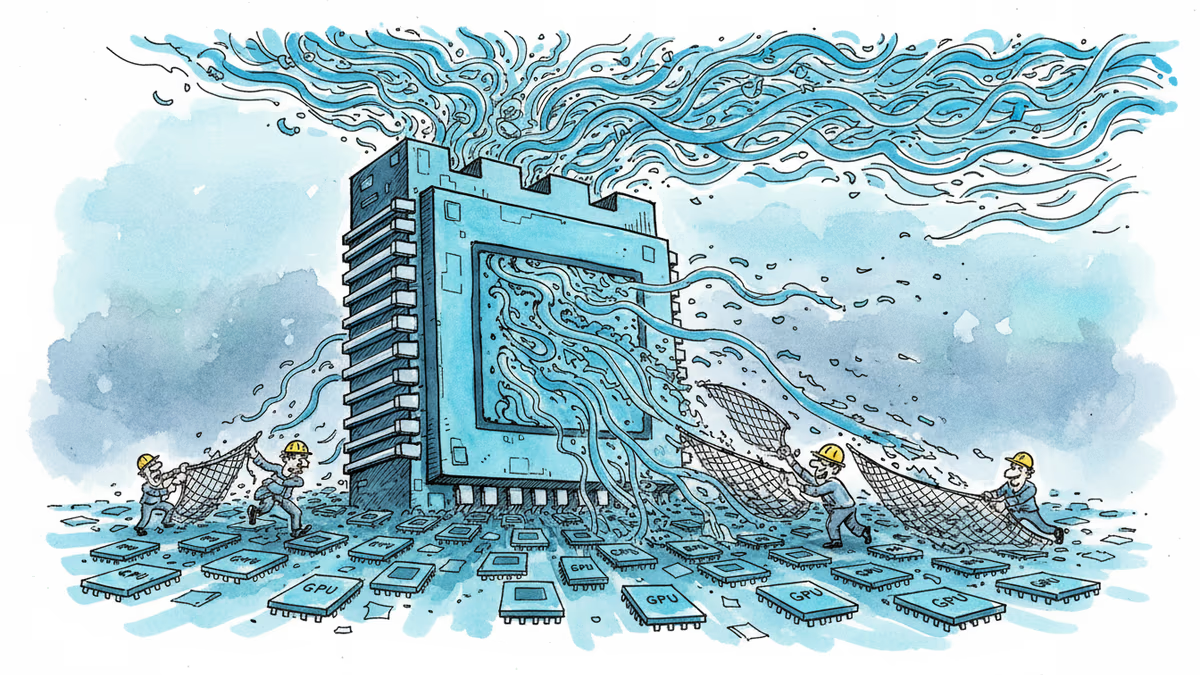
The Hidden AI Infrastructure Crisis: Why Memory Costs Jumped 7x
While everyone focuses on GPUs, DRAM prices have surged 7x in a year. Memory orchestration is becoming the make-or-break skill for AI companies as inference costs spiral.
The $10 Billion Oversight Everyone's Missing
While the tech world obsesses over Nvidia and GPU shortages, a quieter crisis has been building. DRAM chip prices have jumped roughly 7x in the past year as hyperscalers race to build billions of dollars worth of new data centers. But the real story isn't the price surge—it's how memory management has become the difference between AI companies that thrive and those that fold.
The companies mastering memory orchestration can run the same queries with fewer tokens. In a world where inference costs can make or break a business model, that's everything.
When Simple Pricing Becomes an Encyclopedia
Semiconductor analyst Dan O'Laughlin recently highlighted a telling example: Anthropic's prompt caching pricing page. Six months ago, it was elegantly simple—"use caching, it's cheaper." Today? It reads like a complex financial instrument prospectus.
You've got 5-minute cache tiers, 1-hour windows, pre-purchase requirements, and arbitrage opportunities based on cache reads versus writes. The complexity reflects a fundamental shift: memory management has evolved from a backend concern to a core business strategy.
Every new bit of data you add to a query might bump something else out of the cache window. Get it wrong, and your costs spiral. Get it right, and you can save massive amounts on inference.
The Stack Nobody's Talking About

While venture capital flows toward flashy AI models, a quieter ecosystem is emerging around memory optimization. Startups like TensorMesh are carving out niches in cache optimization—just one layer in an increasingly complex stack.
Lower in the stack, data centers are wrestling with when to use DRAM chips versus HBM (High Bandwidth Memory). Higher up, end users are learning to structure their model swarms to take advantage of shared cache. Each optimization compounds, creating dramatic cost differences between companies that master these techniques and those that don't.
The math is compelling: as memory orchestration improves, companies use fewer tokens. As models get more efficient at processing each token, costs drop further. This double dividend could push many AI applications from unprofitable experiments to viable businesses.
The Semiconductor Winners and Losers
For memory manufacturers, this shift creates both opportunity and pressure. The traditional model of selling more capacity is giving way to selling smarter architecture. Companies that can optimize for AI workloads—understanding the specific patterns of how AI models access memory—will command premium pricing.
But there's a catch: as software gets better at memory management, the pressure on hardware margins increases. The most successful semiconductor companies will need to stay ahead of software optimization, continuously pushing the boundaries of what's possible at the silicon level.
The Enterprise Reality Check
For enterprise AI buyers, this complexity creates a new evaluation criteria. It's no longer enough to compare model accuracy or even raw inference costs. You need to understand:
- How does this provider manage memory allocation?
- What cache optimization techniques do they use?
- How do their pricing tiers align with your usage patterns?
- Can you structure your queries to take advantage of their memory architecture?
The companies that figure this out will have a sustainable cost advantage. Those that don't may find themselves priced out of the market, even with superior models.
Authors
Related Articles

Snowflake's new $6 billion AWS contract is about more than cloud spending. It signals a shift in AI infrastructure—away from Nvidia GPUs and toward cheaper, homegrown chips for the agent era.
At Milken 2026, five AI insiders—from the CEO of ASML to a quantum physicist challenging LLMs—laid out the physical, energy, and geopolitical limits the AI boom is running into.

Palantir co-founder Peter Thiel and other Silicon Valley investors have poured $140 million into Panthalassa, a startup building wave-powered floating AI data centers in the open ocean. Here's what that actually means.
40,000 Samsung union workers rallied at its Pyeongtaek chip plant, threatening an 18-day strike over wages. With AI-driven RAM shortages already lifting consumer prices, the timing couldn't be worse.
Snowflake's new $6 billion AWS contract is about more than cloud spending. It signals a shift in AI infrastructure—away from Nvidia GPUs and toward cheaper, homegrown chips for the agent era.
At Milken 2026, five AI insiders—from the CEO of ASML to a quantum physicist challenging LLMs—laid out the physical, energy, and geopolitical limits the AI boom is running into.
Palantir co-founder Peter Thiel and other Silicon Valley investors have poured $140 million into Panthalassa, a startup building wave-powered floating AI data centers in the open ocean. Here's what that actually means.
40,000 Samsung union workers rallied at its Pyeongtaek chip plant, threatening an 18-day strike over wages. With AI-driven RAM shortages already lifting consumer prices, the timing couldn't be worse.
Thoughts
Share your thoughts on this article
Sign in to join the conversation