
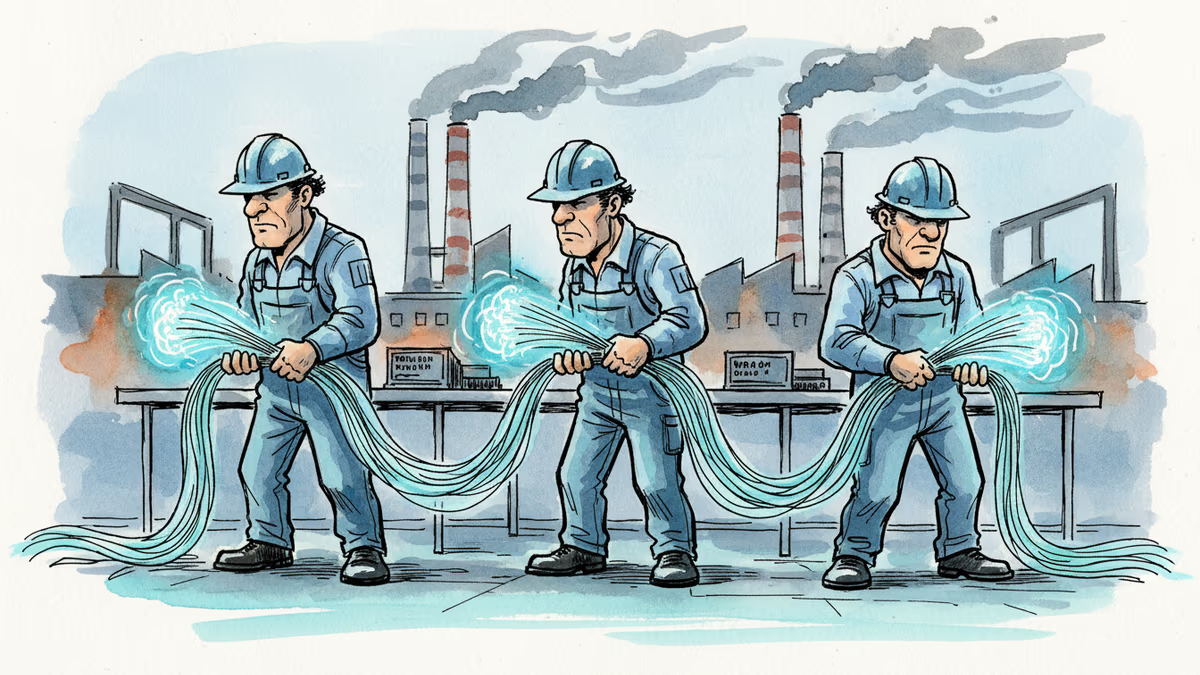
The $50M Bet on America's AI Supply Chain Independence
Ex-SpaceX engineers raise $50M to challenge China's dominance in optical transceivers, the hidden hardware powering AI data centers. National security meets silicon strategy.
The Hidden Bottleneck in Every AI Supercomputer
When OpenAI brags about training on a million-GPU cluster, there's a number they don't mention: four to five million optical transceivers humming away in the background. These thumb-sized devices convert light signals into electrical data, letting thousands of AI chips work as one massive brain. And 90% of them come from China.
Three former SpaceX engineers think that's a problem worth $50 million to solve.
Travis Brashears, Cameron Ramos, and Serena Grown-Haeberli announced Tuesday that their Los Angeles startup Mesh Optical Technologies has raised a Series A led by Thrive Capital. Their mission: mass-produce the optical transceivers that keep AI data centers running—but build them in America.
From Starlink to Silicon Valley
The trio discovered this opportunity while designing SpaceX's next-generation satellites. As they assessed the optical transceiver market for space applications, they realized the same components bottlenecking satellite communications were becoming critical for AI infrastructure.
"Someone will brag about a million GPU cluster; you have to multiply by four to five for the number of transceivers in that cluster," CEO Brashears explained. The math is stark: every AI training run depends on these devices to shuttle data between processors at light speed.
The market opportunity is massive. Established supplier AOI won a $4 billion contract with AWS last year alone. But the supply chain tells a concerning story for American tech companies betting their futures on AI dominance.

The China Dependency Dilemma
Chinese firms dominate optical transceiver manufacturing so thoroughly that even European equipment suppliers assume Chinese customers—one German company's standard intake form asks for a Chinese company registration number by default.
Thrive Capital partner Philip Clark frames the stakes bluntly: "If AI is the most important technology in several generations, to have critical parts of AI data center capex run through misaligned/competitive countries is a problem."
While trade restrictions haven't impacted this market yet, Mesh's founders and backers see themselves getting ahead of an inevitable national security reckoning. The company plans to manufacture 1,000 units per day within a year, positioning for bulk orders in 2027 and 2028.
Beyond Manufacturing: The Innovation Edge
Mesh isn't just reshoring production—they're redesigning the hardware. Their current prototype eliminates one power-hungry component, potentially reducing GPU cluster energy consumption by 3% to 5%. In an industry where hyperscalers obsess over efficiency gains, those percentage points translate to millions in operational savings.
The founders believe co-locating design and manufacturing will yield better, cheaper components than the traditional model of American design with Chinese production. But executing "lights-out" automated manufacturing in the U.S. presents its own challenges, given how much expertise has migrated overseas.
The Photonics Future
Data centers are just the beginning. Brashears envisions optical communications replacing radio frequencies across industries: "We want to interconnect everything, and not just computers, but that's where we're starting."
It's an ambitious vision that echoes broader industry trends. As AI models demand ever-faster data movement, photonics—using light instead of electricity for communication—offers speed and efficiency advantages that traditional copper and radio can't match.
Authors
Related Articles
Snowflake's new $6 billion AWS contract is about more than cloud spending. It signals a shift in AI infrastructure—away from Nvidia GPUs and toward cheaper, homegrown chips for the agent era.
At Milken 2026, five AI insiders—from the CEO of ASML to a quantum physicist challenging LLMs—laid out the physical, energy, and geopolitical limits the AI boom is running into.
Palantir co-founder Peter Thiel and other Silicon Valley investors have poured $140 million into Panthalassa, a startup building wave-powered floating AI data centers in the open ocean. Here's what that actually means.
40,000 Samsung union workers rallied at its Pyeongtaek chip plant, threatening an 18-day strike over wages. With AI-driven RAM shortages already lifting consumer prices, the timing couldn't be worse.
Snowflake's new $6 billion AWS contract is about more than cloud spending. It signals a shift in AI infrastructure—away from Nvidia GPUs and toward cheaper, homegrown chips for the agent era.
At Milken 2026, five AI insiders—from the CEO of ASML to a quantum physicist challenging LLMs—laid out the physical, energy, and geopolitical limits the AI boom is running into.
Palantir co-founder Peter Thiel and other Silicon Valley investors have poured $140 million into Panthalassa, a startup building wave-powered floating AI data centers in the open ocean. Here's what that actually means.
40,000 Samsung union workers rallied at its Pyeongtaek chip plant, threatening an 18-day strike over wages. With AI-driven RAM shortages already lifting consumer prices, the timing couldn't be worse.
Thoughts
Share your thoughts on this article
Sign in to join the conversation