
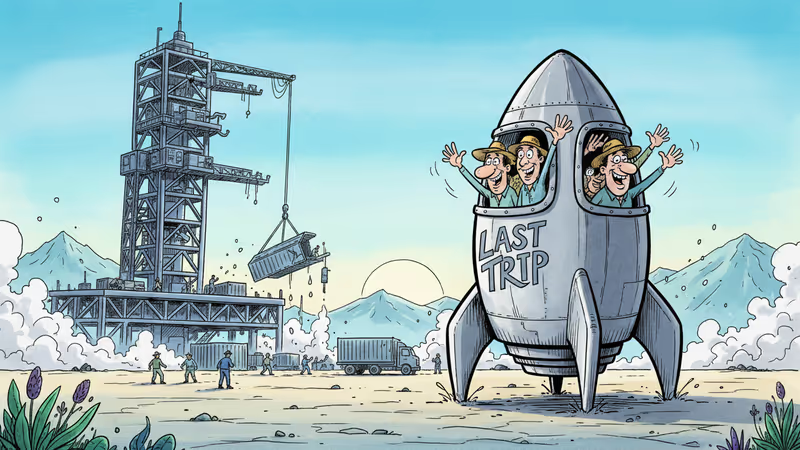
Blue Origin Ends Space Tourism Dream After Flying 98 People
Jeff Bezos' Blue Origin pauses New Shepard space tourism program for two years, marking likely end of 25-year-old company's longest-running initiative
After 98 passengers and 25 years of dreams, the curtain falls. Jeff Bezos'Blue Origin announced it's "pausing" its New Shepard space tourism program for the next two years – industry speak for what's likely a permanent goodbye to suborbital joy rides.
The Numbers Tell a Story
Since April 2015, New Shepard compiled impressive stats: 38 launches with only one failure, 36 successful landings, and 200+ scientific payloads delivered to microgravity. For a company that started as Bezos' side project, those numbers represent genuine engineering achievement.
But impressive engineering doesn't always equal sustainable business. Despite the technical success, New Shepard's 10-minute space hops at hundreds of thousands of dollars per seat never found their market sweet spot. The wealthy adventure seekers willing to pay premium prices for brief weightlessness turned out to be a smaller club than anticipated.
Market Reality Bites

The space tourism landscape became increasingly crowded and stratified. SpaceX captured headlines with multi-day orbital missions to the International Space Station. Virgin Galactic positioned itself as the more accessible option. New Shepard found itself stuck in the middle – more expensive than Virgin's offering, less ambitious than SpaceX's orbital adventures.
Blue Origin is now redirecting resources toward its New Glenn orbital rocket and lunar lander programs. The shift signals a strategic pivot from consumer entertainment to infrastructure development – arguably where the real money in space lies.
What This Means for Space Commerce
The New Shepard pause reveals uncomfortable truths about space tourism's current economics. The market for brief suborbital flights appears limited to a few hundred ultra-wealthy individuals globally. Meanwhile, the costs of maintaining safety standards, regulatory compliance, and operational readiness remain substantial regardless of flight frequency.
This doesn't spell doom for space tourism entirely. SpaceX continues flying private missions, and Virgin Galactic recently resumed operations. But it suggests the industry needs either dramatically lower costs or significantly enhanced experiences to achieve scale.
The timing also matters. As economic uncertainty grows and environmental concerns intensify, spending hundreds of thousands on 10-minute space rides becomes harder to justify – even for the ultra-wealthy.
Authors
Related Articles
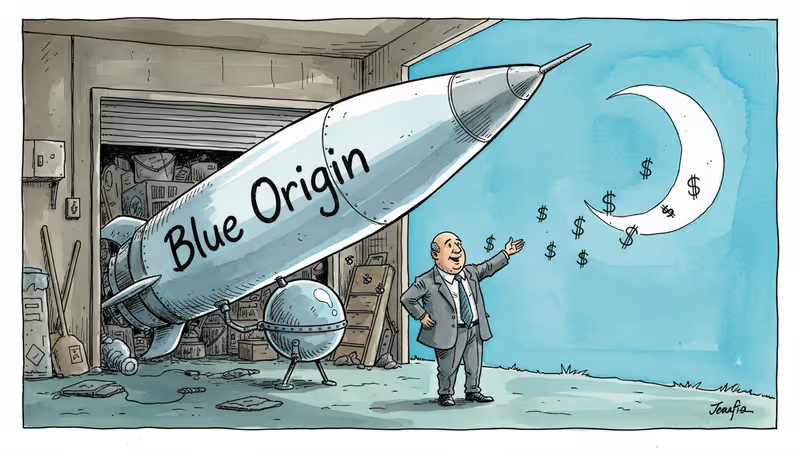
Blue Origin halts space tourism for two years to focus on moon missions. Can Bezos catch up to SpaceX in the new space race? What this shift means for the industry.

Five stories from late September, traced to where the paper trail stops: Korea's export record, Nvidia's Hugging Face 8-K, a US-China AI channel, the UN on AI, and rising births.

Huawei's CANN is open source under a license barring software for non-Ascend chips. Inside China's second CUDA, and the two links still outside it: pre-training compute and 5nm capacity.
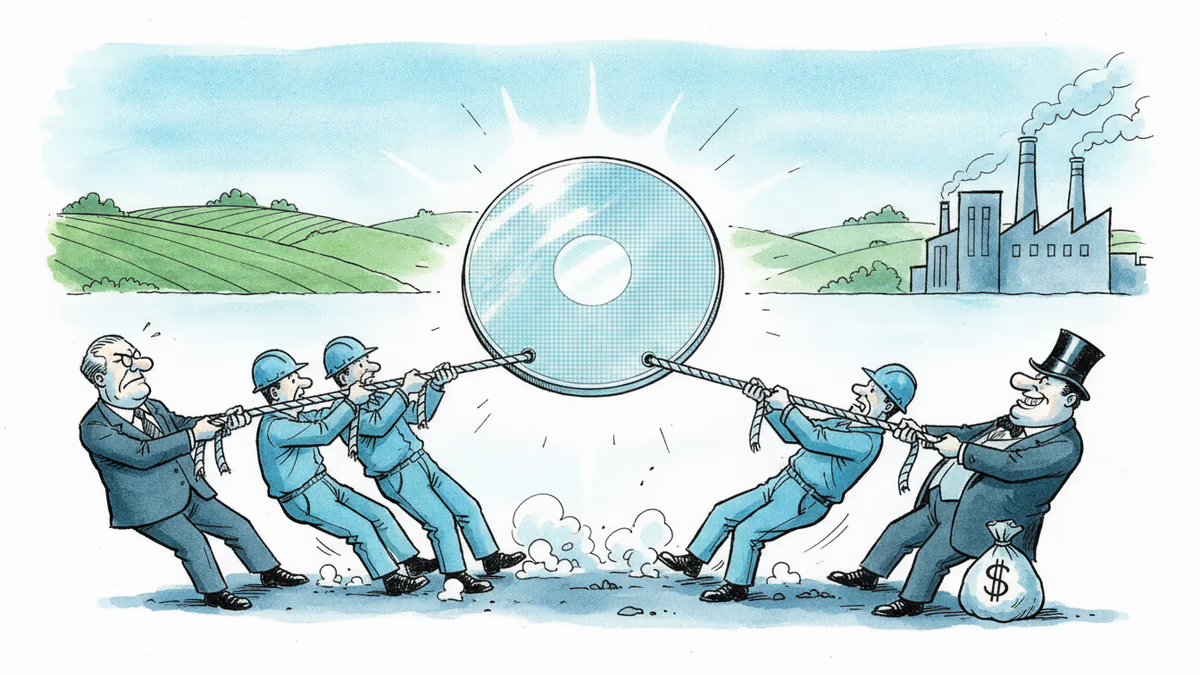
Samsung Electronics' union branch revealed that 84% of survey respondents oppose the government's roughly $290 billion (₩400 trillion) semiconductor megaproject in Gwangju. Government, management, the union and shareholders are all reading the same national project in sharply different ways.
Blue Origin halts space tourism for two years to focus on moon missions. Can Bezos catch up to SpaceX in the new space race? What this shift means for the industry.
Five stories from late September, traced to where the paper trail stops: Korea's export record, Nvidia's Hugging Face 8-K, a US-China AI channel, the UN on AI, and rising births.
Huawei's CANN is open source under a license barring software for non-Ascend chips. Inside China's second CUDA, and the two links still outside it: pre-training compute and 5nm capacity.
Samsung Electronics' union branch revealed that 84% of survey respondents oppose the government's roughly $290 billion (₩400 trillion) semiconductor megaproject in Gwangju. Government, management, the union and shareholders are all reading the same national project in sharply different ways.
Thoughts
Share your thoughts on this article
Sign in to join the conversation