

Your Space Heater Could Mine Bitcoin. Should It?
The Heatbit Maxi Pro heats your room, filters your air, and mines bitcoin simultaneously. At $1,499, it's an ingenious idea with a brutal payback math. Here's the full breakdown.
Electricity bills in the US have climbed 40% since 2020. Bitcoin mining at home is barely profitable for most people. And the air in your house is, statistically, worse than you think. Heatbit looked at these three anxieties and asked: what if one device fixed all of them?
The result is the Heatbit Maxi Pro—a $1,499 space heater that doubles as a bitcoin miner and HEPA air purifier. It's the kind of idea that spreads through office Slack channels with a mix of eye-rolls and genuine curiosity. WIRED's reviewer Matthew Korfhage spent weeks running one in his Portland, Oregon home, doing the math so you don't have to. The verdict: clever concept, brutal economics.
What It Actually Does
The Heatbit Maxi Pro runs at roughly 1,200 watts, putting out heat comparable to a standard space heater for a small room. Simultaneously, it mines bitcoin at close to its advertised rate of 60 terahashes per second (TH/s)—a measure of how many times per second the device attempts to solve the cryptographic puzzle that earns bitcoin.
At March 2026 bitcoin prices, that translated to $1–$2 per day in mined bitcoin when running continuously. The HEPA filter runs constantly alongside the miner, pushing air through filtration the entire time the device is active. Setup is genuinely simple: download the app, pair the device, and Heatbit tracks your mining earnings even before you have a bitcoin wallet. Once you accumulate 100,000 satoshis (about $66 at April 2026 prices), you can transfer to Coinbase, Binance, or other major exchanges via the Lightning Network.
Safety credentials are real: the device passed formal heater safety certification, shuts down instantly if blocked, and its exterior stays cool to the touch. These aren't trivial distinctions—most crypto miners repurposed as heaters carry no such certification.
The Math That Doesn't Work
Here's where the cocktail-napkin elegance collides with reality. That $1–$2 daily bitcoin haul sounds appealing until you account for the electricity cost to run the device. At Portland's rate of 17 cents per kilowatt-hour—close to the US national average—the mining revenue covers only about one-third of the energy cost. You're not making money. You're losing it more slowly.

Heatbit's counter-framing is clever: don't think of it as a miner that loses money. Think of it as a heater that gives you a 33% rebate on your heating bill. If you'd be running heat anyway, the bitcoin is a bonus. At full tilt, that's roughly $70–$100 in bitcoin every two months.
But the upfront cost demolishes this logic for most buyers. The Heatbit Maxi Pro costs $1,499 at its current discounted price—approximately $1,350 more than a quality space heater and $900–$1,000 more than a comparable Dyson purifier-heater combo. Running it 24/7 for four months a year, assuming stable bitcoin prices and electricity rates, Korfhage calculated a payback period of five to eight years. The warranty lasts one year.
The Inconvenient Physics
There's a deeper problem that Heatbit's marketing glosses over: every crypto miner is already a space heater.
This isn't a metaphor. All electrical energy consumed by a mining device eventually converts to heat—100% efficiency, every time, no exceptions. Which means the best combined bitcoin miner and space heater is simply whichever device mines bitcoin most efficiently. By that logic, a Canaan Avalon Q at $1,900 delivers roughly 50% more hash rate than the Heatbit and produces equivalent heat—it just looks like industrial equipment, sounds like a server rack, and lacks safety certification.
What Heatbit is actually selling, beyond the mining hardware, is design, safety certification, ease of use, and the emotional experience of owning something that looks good next to your couch. Those are real values. Whether they're worth a $1,300+ premium over alternatives is the question every potential buyer has to answer for themselves.
Who This Actually Makes Sense For
The economics shift meaningfully under specific conditions. If you live somewhere with cheap electricity—say, certain Pacific Northwest regions with hydroelectric power, or states with favorable rate structures—the payback timeline compresses. If bitcoin prices recover significantly from their current levels, mining revenue improves. If you're already committed to crypto mining and want a device that's safe, legal, and doesn't look like a fire hazard, Heatbit solves real problems that raw mining hardware doesn't.
For crypto-curious consumers who want low-friction entry into mining without managing wallets, ASIC firmware, or industrial cooling—and who happen to need a heater—the Heatbit removes genuine friction. The app works. The onboarding is painless. The device doesn't look embarrassing.
But for anyone running the numbers purely on financial return, the honest answer is: not yet. Maybe not for years.
Authors
Related Articles
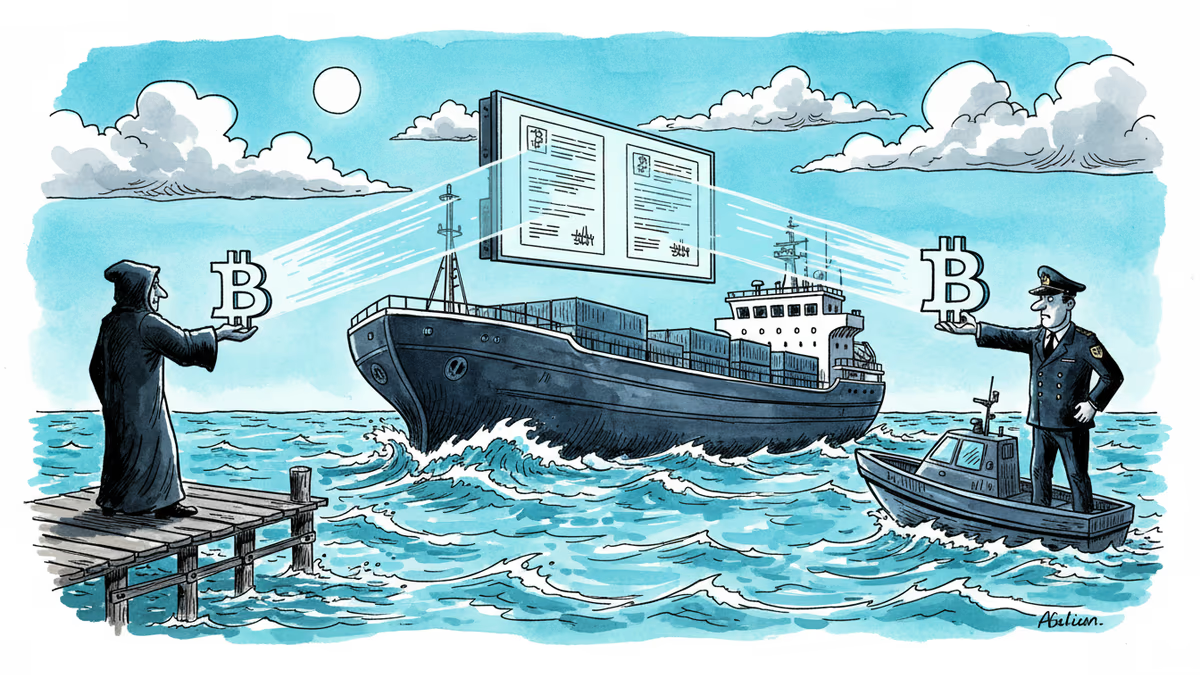
Scammers posing as Iranian authorities are demanding bitcoin and tether from ships near the Strait of Hormuz—exploiting the fact that Iran already does exactly this.

Nosh One is an AI kitchen appliance that cooks autonomously—load ingredients, pick a recipe, walk away. But does automating the kitchen solve a problem, or create new ones?
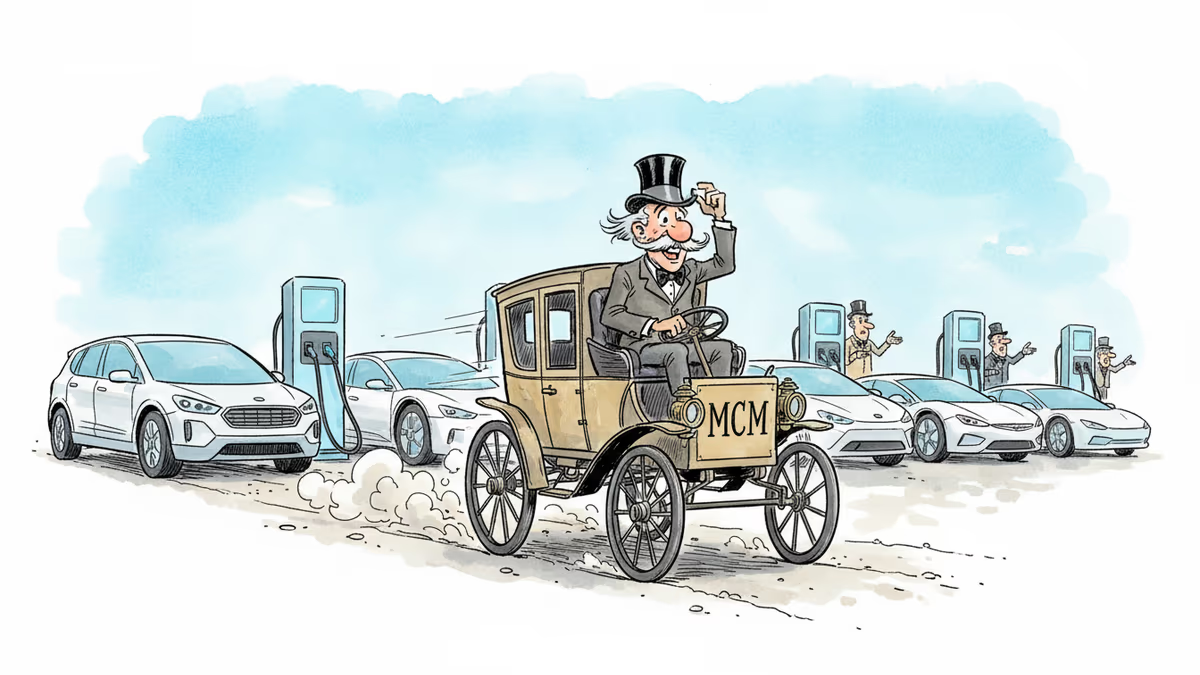
Ferdinand Porsche built the first hybrid vehicle in 1900. Over a century later, as EV adoption stalls, hybrids are surging. What does this mean for consumers, automakers, and the green transition?

Bitcoin plunged 10% in a single day to $64,000, its lowest since the 2024 election. After peaking at $122,000, what does this 50% decline really mean for crypto's future?
Scammers posing as Iranian authorities are demanding bitcoin and tether from ships near the Strait of Hormuz—exploiting the fact that Iran already does exactly this.
Nosh One is an AI kitchen appliance that cooks autonomously—load ingredients, pick a recipe, walk away. But does automating the kitchen solve a problem, or create new ones?
Ferdinand Porsche built the first hybrid vehicle in 1900. Over a century later, as EV adoption stalls, hybrids are surging. What does this mean for consumers, automakers, and the green transition?
Bitcoin plunged 10% in a single day to $64,000, its lowest since the 2024 election. After peaking at $122,000, what does this 50% decline really mean for crypto's future?
Thoughts
Share your thoughts on this article
Sign in to join the conversation