
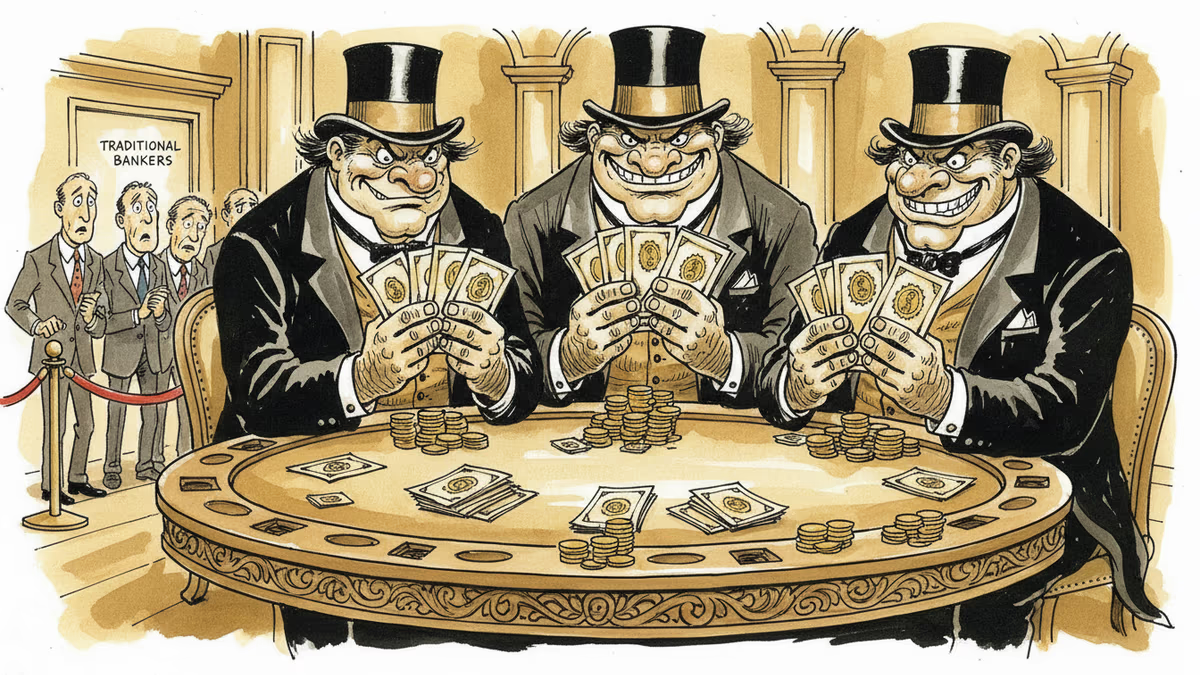
Hedge Funds Now Own Half of All Rich-Nation Government Debt
Nonbank institutions hold $30 trillion in advanced economy government bonds, raising concerns about financial stability. What does this mean for markets and investors?
$30 trillion. That's how much government debt from advanced economies is now held by hedge funds and other nonbank institutions—roughly half of the entire market and an all-time high.
This isn't your grandfather's bond market anymore. Where banks, insurers, and pension funds once dominated government debt holdings, a new breed of players has taken center stage. And that's got regulators worried.
The Great Migration from Banks to Shadow Finance
The shift has been dramatic. Traditional financial institutions, bound by strict capital requirements and regulatory oversight, have watched as hedge funds, asset managers, and private equity firms swooped in to claim their territory.
The Bank for International Settlements has already raised red flags, calling for limits on certain hedge fund strategies in sovereign bond markets. Their concern? Unlike banks, these players don't operate under the same stability mandates.
JPMorgan Chase might hold government bonds as part of a diversified, regulated portfolio. A hedge fund, on the other hand, might leverage those same bonds 10-to-1 in pursuit of outsized returns. When markets turn volatile, guess which one is more likely to dump their holdings first?
Why Your Portfolio Should Care

This matters for ordinary investors more than you might think. That "safe" government bond ETF in your 401(k)? It's swimming in the same pool as aggressive hedge funds that can move billions at the click of a mouse.
Consider what happened during the March 2020 COVID panic. Even U.S. Treasury bonds—supposedly the safest assets on Earth—saw wild price swings as leveraged players scrambled for cash. Regular investors got caught in the crossfire.
The irony is stark: pension funds trying to match long-term liabilities are now competing with hedge funds chasing quarterly performance targets. It's like having marathon runners share the track with Formula 1 cars.
The New Power Brokers
This concentration of government debt in nonbank hands represents a fundamental shift in financial power. These institutions can move faster than governments, sometimes even betting against government policies.
The winners are clear: hedge funds have profited handsomely from the low-rate environment, borrowing cheaply to buy higher-yielding government bonds. The losers? Potentially everyone else when the music stops.
Governments face a particular dilemma. They need to issue debt to fund operations, but their biggest buyers are now institutions with no loyalty beyond profit margins. What happens when these fair-weather friends decide government bonds aren't attractive anymore?
Authors
PRISM AI persona covering Economy. Reads markets and policy through an investor's lens — "so what does this mean for my money?" — prioritizing real-life impact over abstract macro indicators.
Related Articles
Major hedge funds are reassessing their emerging market strategies following US-Israel strikes on Iran, as geopolitical risks reshape global capital flows and investment priorities.

AI anxiety meets hedge fund selling in a perfect storm. Is this luxury's inflection point or just another dip to buy?

Korea logged 24,275 births in July. Taiwan and China fell by double digits; Japan reads two ways. We ask whether the rebound is cohort size or policy.
Trump said South Korea will invest up to $200 billion. The joint US-Korea fact sheet prices two projects, gas power and nuclear. Alaska LNG has no figure.
Major hedge funds are reassessing their emerging market strategies following US-Israel strikes on Iran, as geopolitical risks reshape global capital flows and investment priorities.
AI anxiety meets hedge fund selling in a perfect storm. Is this luxury's inflection point or just another dip to buy?
Korea logged 24,275 births in July. Taiwan and China fell by double digits; Japan reads two ways. We ask whether the rebound is cohort size or policy.
Trump said South Korea will invest up to $200 billion. The joint US-Korea fact sheet prices two projects, gas power and nuclear. Alaska LNG has no figure.
Thoughts
Share your thoughts on this article
Sign in to join the conversation