

Computer Science Is Dying. AI Majors Are Taking Over.
UC campuses see 6% drop in CS enrollment while AI-specific programs explode. What students are choosing reveals the future of tech education.
The 6% That Changed Everything
Something unprecedented happened at University of California campuses this fall. For the first time since the dot-com crash, computer science enrollment dropped—6% this year, following a 3% decline in 2024. This happened while overall college enrollment climbed 2% nationally.
One campus bucked the trend: UC San Diego, the only UC school that launched a dedicated AI major this fall. Coincidence? Hardly.
China Already Has the Answer
While American universities debate, Chinese institutions have made their choice. They treat AI not as a threat but as essential infrastructure. Nearly 60% of Chinese students and faculty use AI tools multiple times daily. Zhejiang University made AI coursework mandatory. Tsinghua created entirely new interdisciplinary AI colleges.
In China, AI fluency isn't optional—it's table stakes.
The American Scramble
U.S. universities are racing to catch up. MIT's "AI and decision-making" major is now the second-largest on campus. The University of South Florida enrolled over 3,000 students in its new AI and cybersecurity college this fall. The University at Buffalo's "AI and Society" department received 200+ applications before opening its doors.

But the transition isn't smooth everywhere.
Faculty Resistance Meets Reality
UNC Chapel Hill Chancellor Lee Roberts doesn't mince words. Some faculty are "leaning forward" with AI, while others have "their heads in the sand." The former finance executive is pushing AI integration despite faculty pushback.
"No one's going to tell students after graduation, 'Do your best, but if you use AI, you'll be in trouble,'" Roberts told me. "Yet we have faculty members effectively saying that right now."
Parents Play Defense, Students Play Offense
David Reynaldo from College Zoom consultancy notices a fascinating split. Parents who once pushed kids toward CS are now steering them toward majors that seem more resistant to AI automation—mechanical and electrical engineering.
But students are voting with their feet differently. A Computing Research Association survey found 62% of computing programs saw undergraduate enrollment declines. Yet AI programs are exploding.
USC, Columbia, Pace, New Mexico State—the list of universities launching AI degrees this fall keeps growing.
Migration, Not Exodus
This isn't students abandoning tech. It's a calculated migration toward programs focused on AI instead of traditional computer science. The numbers tell the story: while CS shrinks, AI-specific majors balloon.
Authors
Related Articles

Samsung Electronics' union branch revealed that 84% of survey respondents oppose the government's roughly $290 billion (₩400 trillion) semiconductor megaproject in Gwangju. Government, management, the union and shareholders are all reading the same national project in sharply different ways.
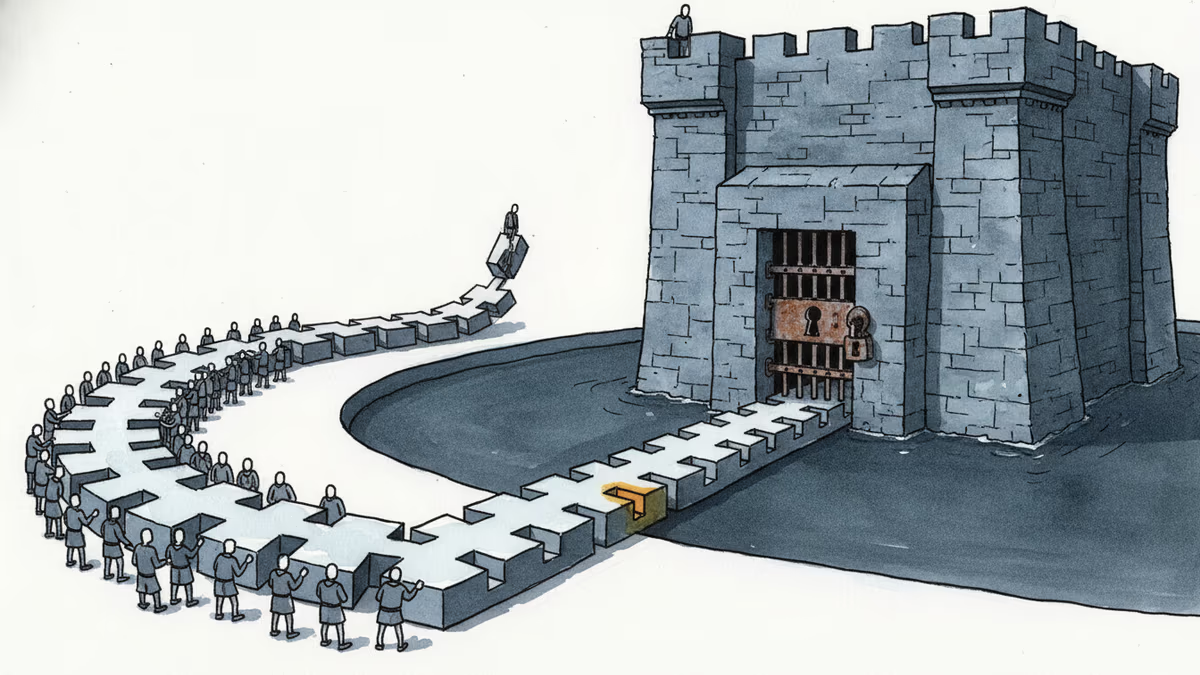
Nvidia shipped roughly a billion RISC-V cores in 2024, then announced it would run CUDA on the open standard. We break down how royalty-free instruction sets and open software stacks are trying to route around CUDA's lock-in. Part 2 of the Semiconductor Sovereignty series.
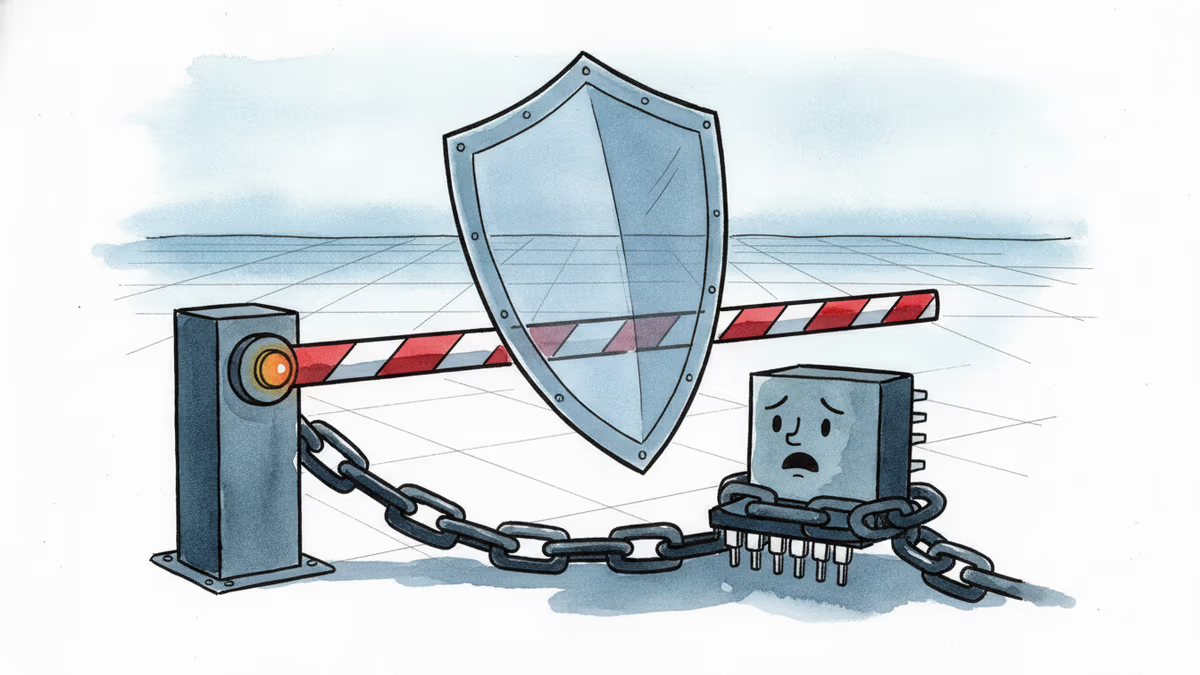
US AI-chip export controls split into three layers in the first half of 2026 — January easing, a May crackdown on circumvention, and a pending bill. Nvidia erased China from its guidance and still posted a record $81.6 billion quarter. A look at the export policy that both shields and cages it.

AMD's MI325X matches or beats Nvidia on memory and bandwidth — yet Nvidia's 86-92% share holds. The real moat is CUDA, 20 years in the making. Part 1 of 4.
Samsung Electronics' union branch revealed that 84% of survey respondents oppose the government's roughly $290 billion (₩400 trillion) semiconductor megaproject in Gwangju. Government, management, the union and shareholders are all reading the same national project in sharply different ways.
Nvidia shipped roughly a billion RISC-V cores in 2024, then announced it would run CUDA on the open standard. We break down how royalty-free instruction sets and open software stacks are trying to route around CUDA's lock-in. Part 2 of the Semiconductor Sovereignty series.
US AI-chip export controls split into three layers in the first half of 2026 — January easing, a May crackdown on circumvention, and a pending bill. Nvidia erased China from its guidance and still posted a record $81.6 billion quarter. A look at the export policy that both shields and cages it.
AMD's MI325X matches or beats Nvidia on memory and bandwidth — yet Nvidia's 86-92% share holds. The real moat is CUDA, 20 years in the making. Part 1 of 4.
Thoughts
Share your thoughts on this article
Sign in to join the conversation