
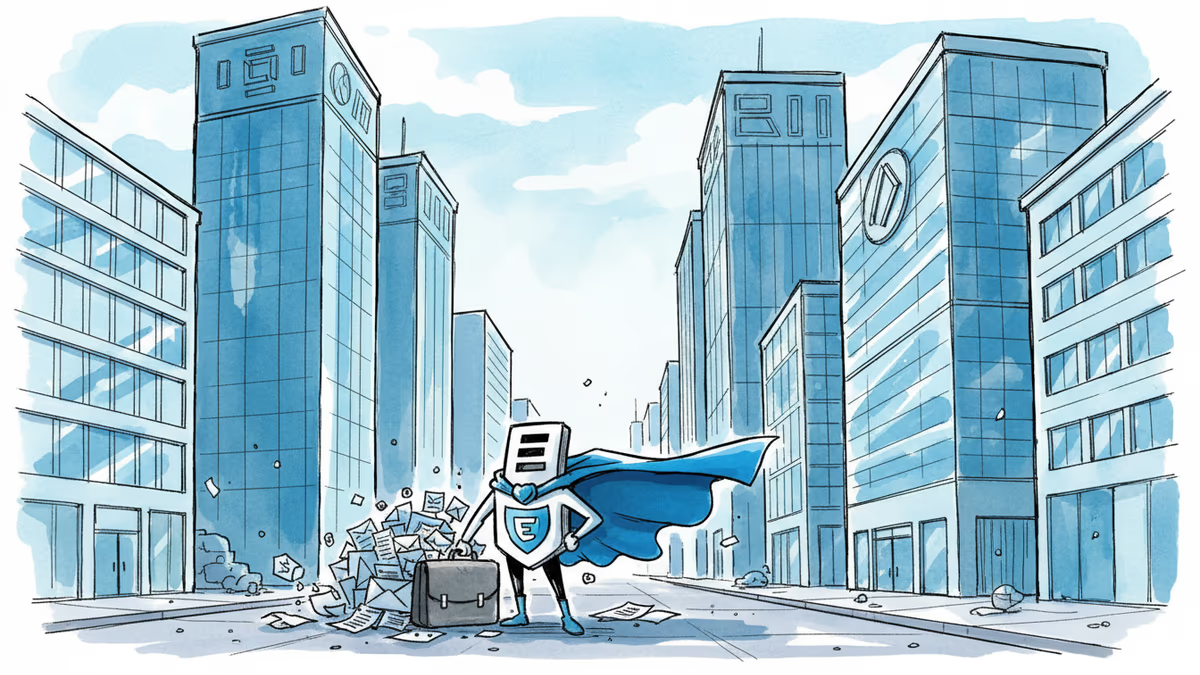
Grammarly Wants to Be Your AI Chief of Staff
Grammarly rebranded as Superhuman, betting it can evolve from a spell-checker into a full AI productivity platform. But in a market dominated by Microsoft and Google, is there room for an independent player?
For most people, Grammarly was the app they forgot they had installed—until a red underline appeared under a typo in an email. That invisibility was, for a long time, the product's greatest asset. Now the company is betting it's also its biggest liability.
In October, Grammarly announced it was rebranding as Superhuman—absorbing Superhuman Mail, an AI email platform it acquired, and adopting its name wholesale. The message was unambiguous: the company that built its reputation on quiet, unobtrusive spell-checking wants to become the AI platform that sits at the center of your entire workday.
From the Margins to the Middle
The strategic logic isn't hard to follow. Grammarly built an enormous user base—tens of millions of daily active users—on the back of a single, simple promise: we'll catch your mistakes. But that promise has a ceiling. As AI writing assistance became table stakes, embedded directly into Google Docs, Microsoft Word, and every major email client, the standalone spell-checker began to look like a category in decline.
The pivot to Superhuman is an attempt to escape that ceiling. The new identity positions the company not as a writing assistant but as an AI productivity layer—handling email drafting, scheduling, document summarization, and workflow automation all in one place. It's a direct play for the market that Microsoft Copilot and Google Gemini are already carving up.
The timing matters. 2025 has been the year that Big Tech stopped treating AI as a premium add-on and started bundling it into existing subscriptions. Copilot is now included in Microsoft 365. Gemini is woven into Google Workspace. The window for independent AI productivity tools to establish themselves before being squeezed out is narrowing fast.

Three Stakeholders, Three Very Different Reactions
For everyday users, the rebrand is a mixed signal. The people who loved Grammarly loved it precisely because it was lightweight and unobtrusive. A full-featured AI platform—with the complexity, the learning curve, and almost certainly the higher price tag that comes with it—is a different product category entirely. When tools try to do everything, they often stop doing the one thing well that made users trust them in the first place.
For enterprise customers, the calculus is more favorable. Teams in sales, marketing, and HR spend enormous amounts of time on email and documents. An integrated AI platform that handles all of that has real value. The harder question is whether companies already locked into Microsoft or Google ecosystems will pay for a third-party subscription to do what those platforms already offer—even if Superhuman does it better.
For investors and competitors, the rebrand is a signal worth watching. Superhuman Mail had cultivated a cult following among productivity-obsessed professionals—a premium, invite-only email client with a reputation for speed. Merging that brand identity with Grammarly's mass-market reach is either a brilliant synthesis or an identity crisis waiting to happen.
The Brand Bet
There's a harder truth underneath the strategy. Grammarly is a name that took over a decade to build into something users trusted instinctively. Superhuman is a name that carries enormous expectations—and enormous risk. A brand that promises superhuman productivity had better deliver. In a market where AI tools are improving every few months, the gap between a product's marketing and its actual performance has never been more visible—or more punishing.
There's also the question of independent survival. The AI productivity space has been a graveyard for standalone tools. Slack got absorbed by Salesforce. Dozens of AI writing startups have been acqui-hired by larger platforms. Superhuman's rebrand could be the opening move of a genuine independent play—or it could be a valuation exercise ahead of an acquisition. Both readings are plausible.
Authors
Related Articles
Samsung and SK unveiled a chip and AI investment package worth thousands of trillions of won on June 29. The headline number swings wildly by outlet, but the real contest isn't capital — it's water and power.
Viral videos show 2026 graduates jeering executives who praise AI at commencement ceremonies. It's not just rudeness — it's a signal about who pays for technological optimism.
Google's Gmail Live lets you ask your inbox questions out loud. Announced at I/O 2026, it's AI's pitch to skeptics — and a reminder of how much Google already knows about you.
Filipino virtual assistants using AI to ghost-manage LinkedIn profiles for executives is now a structured industry. 30 comments a day, fake engagement rings, and a platform struggling to tell real from fabricated.
Samsung and SK unveiled a chip and AI investment package worth thousands of trillions of won on June 29. The headline number swings wildly by outlet, but the real contest isn't capital — it's water and power.
Viral videos show 2026 graduates jeering executives who praise AI at commencement ceremonies. It's not just rudeness — it's a signal about who pays for technological optimism.
Google's Gmail Live lets you ask your inbox questions out loud. Announced at I/O 2026, it's AI's pitch to skeptics — and a reminder of how much Google already knows about you.
Filipino virtual assistants using AI to ghost-manage LinkedIn profiles for executives is now a structured industry. 30 comments a day, fake engagement rings, and a platform struggling to tell real from fabricated.
Thoughts
Share your thoughts on this article
Sign in to join the conversation