
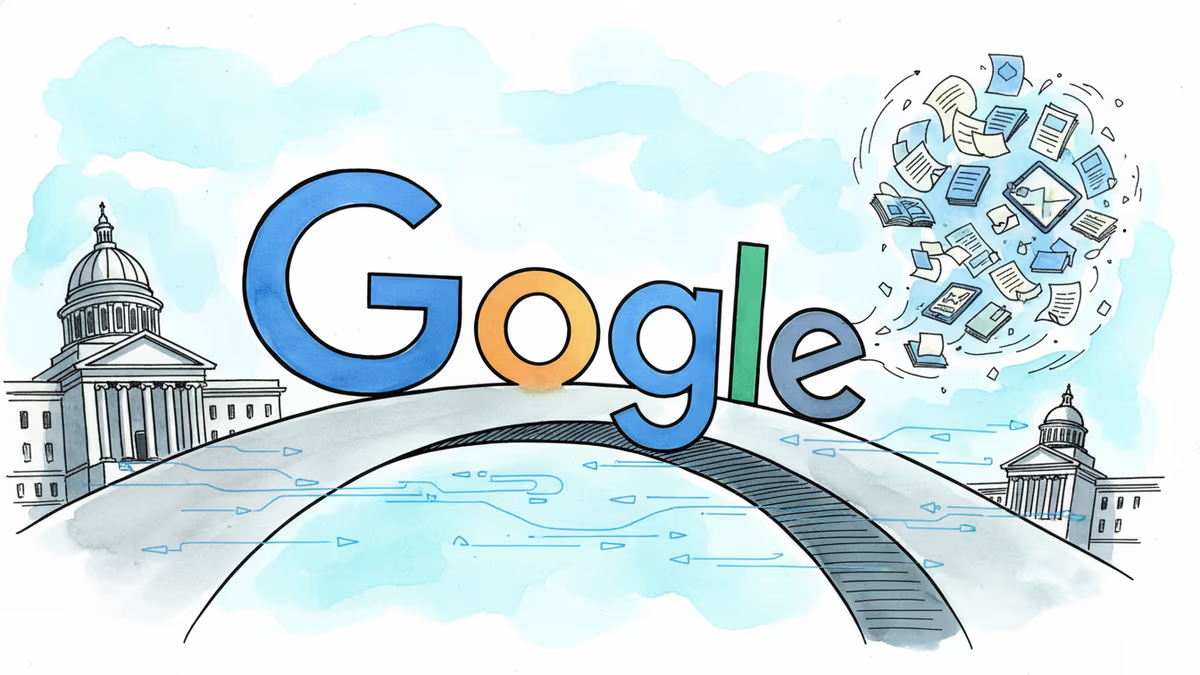
When Google Became ICE's Data Broker
Google handed over a student's personal data to ICE without judicial approval, raising questions about Big Tech's role in government surveillance and user protection.
Two hours. That's how long it took between Cornell University notifying Amandla Thomas-Johnson that his student visa was revoked and ICE demanding his Google account data.
Google complied with an administrative subpoena—issued without judicial approval—and handed over everything: usernames, physical addresses, IP addresses, phone numbers, and even credit card and bank account numbers. Thomas-Johnson's crime? Briefly attending a pro-Palestinian protest in 2024.
The Subpoena That Courts Never Saw
Administrative subpoenas are legal demands federal agencies issue directly, bypassing judges entirely. While they can't compel companies to hand over email contents, search histories, or location data, they can request metadata—enough to de-anonymize account owners.
Here's the catch: companies can say no. Unlike court orders, administrative subpoenas carry no enforcement power. Yet Google complied without question.
Last week, the Electronic Frontier Foundation sent letters to Amazon, Apple, Google, Meta, Microsoft, and Reddit, demanding they stop handing over user data to the Department of Homeland Security in response to these subpoenas. "We are deeply concerned your companies are failing to challenge unlawful surveillance," the letter read.
Silicon Valley's Split Personality
Tech companies are caught between competing pressures. Privacy advocates argue that automatic compliance with government requests betrays user trust. Law enforcement supporters counter that legitimate requests deserve cooperation.

But this case reveals a troubling pattern. ICE has been systematically targeting critics of the Trump administration—anonymous Instagram accounts sharing ICE raid information, protesters opposing Trump policies, and now student journalists attending demonstrations.
Thomas-Johnson told The Intercept: "We need to think very hard about what resistance looks like under these conditions...where government and Big Tech know so much about us, can track us, can imprison, can destroy us in a variety of ways."
The Compliance Machine
Why do companies comply so readily? Legal teams often default to cooperation to avoid potential conflicts with federal agencies. It's easier to hand over data than fight each request, especially when users rarely know about the demands due to accompanying gag orders.
This creates a surveillance infrastructure where private companies become extensions of government intelligence gathering. Your Gmail account, Facebook profile, and Amazon purchases aren't just corporate assets—they're potential government files.
Beyond the Valley
The implications stretch far beyond one student's data. If major tech platforms can be compelled to share user information through administrative requests, what happens to journalists' sources, activists' networks, or dissidents' communications?
European regulators are watching closely. The EU's GDPR provides stronger protections, but American users remain vulnerable to this judicial bypass.
The answer may determine whether the internet remains a space for free expression or becomes a panopticon where every click is a potential government record.
Authors
Related Articles
In a post-Google I/O interview, Sundar Pichai acknowledged flawed search results, real AI anxiety, and an AGI timeline that makes the label irrelevant. Here's what he said — and what it means.
The FTC fined Cox Media and two ad firms $930,000 — not for actually eavesdropping on users, but for falsely claiming they could. The case raises uncomfortable questions about surveillance capitalism.
Google is building AI agents that search the web proactively, without user prompting. That's not just a product update — it's a fundamental shift in who controls the information you receive.
A Utah woman was sentenced to life in prison partly because of her Google searches and deleted texts. The Kouri Richins case reveals how digital footprints have become the courtroom's most reliable witness.
In a post-Google I/O interview, Sundar Pichai acknowledged flawed search results, real AI anxiety, and an AGI timeline that makes the label irrelevant. Here's what he said — and what it means.
The FTC fined Cox Media and two ad firms $930,000 — not for actually eavesdropping on users, but for falsely claiming they could. The case raises uncomfortable questions about surveillance capitalism.
Google is building AI agents that search the web proactively, without user prompting. That's not just a product update — it's a fundamental shift in who controls the information you receive.
A Utah woman was sentenced to life in prison partly because of her Google searches and deleted texts. The Kouri Richins case reveals how digital footprints have become the courtroom's most reliable witness.
Thoughts
Share your thoughts on this article
Sign in to join the conversation