
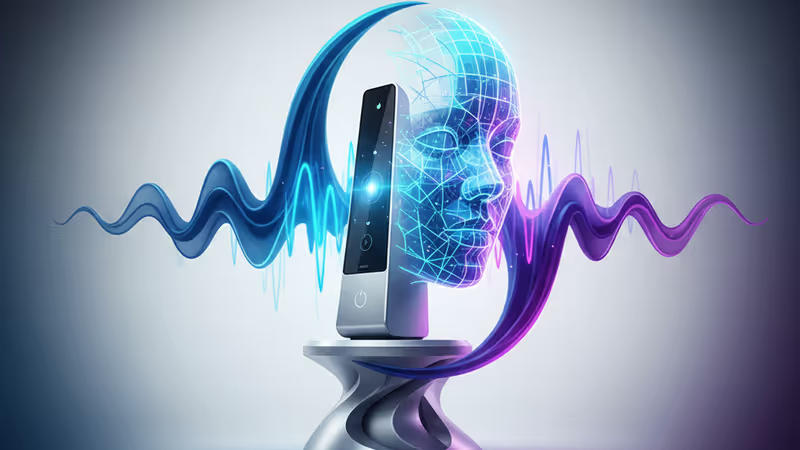
Google DeepMind Hume AI Acquihire 2026: The Quest for Emotional Gemini
Google DeepMind has hired the CEO and core engineers from Hume AI. Explore how this 'acquihire' affects Gemini's emotional intelligence and the 2026 AI voice war.
Big Tech is gobbling up AI talent without buying the companies. In a move that signals the next phase of the AI arms race, Google DeepMind has brought on Alan Cowen, the CEO of Hume AI, and about seven top engineers, according to Wired.
The Google DeepMind Hume AI Acquihire Strategy
This deal is the latest example of an "acquihire," a tactic used by tech giants like Google and OpenAI to bypass regulatory scrutiny. By hiring the leadership and licensing the technology instead of an outright acquisition, firms can sidestep the Federal Trade Commission (FTC). Hume AI will continue as a separate entity, but its brain trust has effectively moved to DeepMind to integrate its "secret sauce"—emotional intelligence—into Gemini Live.

Hume AI’s Empathetic Voice Interface (EVI) has been a standout, capable of detecting subtle emotional shifts in a user's voice. This is a massive play for Google, as Hume had raised nearly $80 million and was on track to generate $100 million in revenue this year.
Voice: The New Battlefield for AI Domination
The industry consensus is clear: voice is the only acceptable input for the next generation of wearables. OpenAI is rumored to be prepping an audio-first device with Jony Ive, while ElevenLabs recently crossed $330 million in annual recurring revenue. Google's move ensures Gemini won't just hear you; it will understand how you feel.
Authors
Related Articles

In a post-Google I/O interview, Sundar Pichai acknowledged flawed search results, real AI anxiety, and an AGI timeline that makes the label irrelevant. Here's what he said — and what it means.
Behind every congressional hearing on Big Tech, there's a quieter room where the real rules get negotiated. As AI regulation, antitrust battles, and privacy law converge on Capitol Hill in 2026, the stakes have never been higher.

Google is replacing Assistant with Gemini in cars with Google built-in, starting in the U.S. GM's 4 million vehicles are first. But the real story is what happens when your car becomes a Google device.
Google launched Google AI Edge Eloquent, an offline-first AI dictation app for iOS. Built on Gemma, it strips filler words and polishes speech in real time — and it's free.
In a post-Google I/O interview, Sundar Pichai acknowledged flawed search results, real AI anxiety, and an AGI timeline that makes the label irrelevant. Here's what he said — and what it means.
Behind every congressional hearing on Big Tech, there's a quieter room where the real rules get negotiated. As AI regulation, antitrust battles, and privacy law converge on Capitol Hill in 2026, the stakes have never been higher.
Google is replacing Assistant with Gemini in cars with Google built-in, starting in the U.S. GM's 4 million vehicles are first. But the real story is what happens when your car becomes a Google device.
Google launched Google AI Edge Eloquent, an offline-first AI dictation app for iOS. Built on Gemma, it strips filler words and polishes speech in real time — and it's free.
Thoughts
Share your thoughts on this article
Sign in to join the conversation