
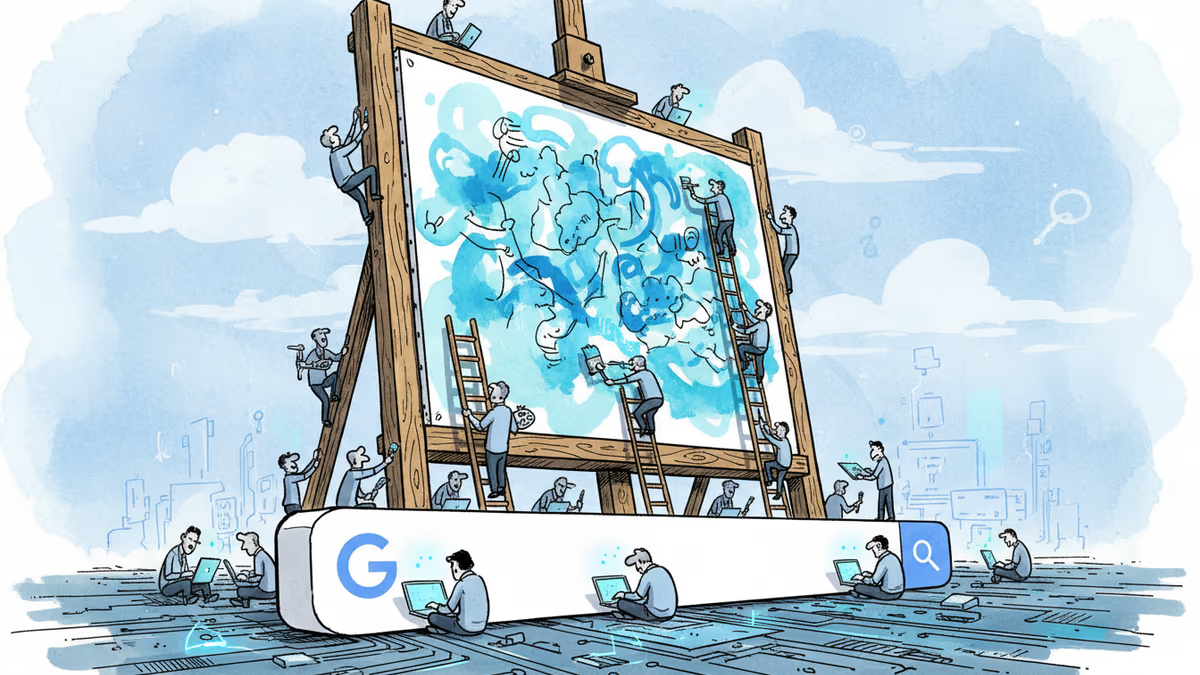
Google Just Put AI Tools in Front of Billions - Here's Why That Changes Everything
Google expands Canvas in AI Mode to all US users, integrating AI productivity tools directly into search. How this move reshapes the AI competition with ChatGPT and Claude.
The Billion-User Advantage Just Got Real
Google has quietly made its biggest AI move yet. Canvas in AI Mode is now available to all US users through Google Search, not just the premium Gemini subscribers who had exclusive access since last year's Google Labs experiment. This isn't just a feature rollout—it's Google leveraging its most powerful asset in the AI race.
Canvas lets users draft documents, create custom tools, even build simple apps and games by describing their ideas. Upload class notes and it generates study guides. Transform research reports into web pages, quizzes, or audio overviews. The tool pulls from both web information and Google's Knowledge Graph, creating a side panel workspace within search itself.
From Premium Perk to Search Standard
Until now, the full Canvas experience required a paid Google AI Pro or Google AI Ultra subscription. These users got access to the latest Gemini 3 model and a 1 million-token context window for complex projects. But Google's decision to integrate basic Canvas functionality into search changes the game entirely.
Users simply select the Canvas option from the tool menu (+) while in AI Mode. No subscription needed. No separate app download. It's there, waiting in the place where billions of people already spend their time looking for information.
The Interface Wars: Auto vs. Manual
ChatGPT's Canvas feature triggers automatically based on user queries—convenient but unpredictable. Google and Anthropic'sClaude require users to manually select canvas mode. Which approach wins?

Google's manual approach makes sense in the search context. Imagine researching a quick fact and suddenly having a canvas workspace pop up uninvited. The friction of one extra click might actually be a feature, not a bug, giving users control over when they want to shift from searching to creating.
The Distribution Advantage No One Can Match
Here's Google's trump card: reach. While users must intentionally visit ChatGPT or Claude, Google's AI tools live where people already are. Every search query is now a potential AI interaction. This "ambient discovery" could be more powerful than any marketing campaign.
Consider the user journey: Someone searches for "how to plan a wedding," sees the Canvas option, and suddenly they're building a comprehensive planning tool without ever intending to use AI. That's the kind of organic adoption that built Google's empire.
The Competitive Landscape Shifts
This move puts pressure on OpenAI and Anthropic to rethink distribution. ChatGPT has brand recognition and a growing user base, but it requires intentional visits. Claude has technical excellence but limited reach. Google has both capability and the world's largest digital front door.
The question isn't whether Google's AI is better—it's whether being "good enough" in the right place beats being "best" in a separate destination.
What This Means for Everyday Users
For most people, AI tools have felt like separate experiences requiring new habits. Google's integration changes that equation. AI becomes part of the natural search flow, not a conscious decision to "use AI today."
This could accelerate AI adoption among users who've been hesitant to try dedicated AI platforms. It also raises questions about choice and competition when one company controls both the search gateway and the AI tools behind it.
Authors
Related Articles
Samsung and SK unveiled a chip and AI investment package worth thousands of trillions of won on June 29. The headline number swings wildly by outlet, but the real contest isn't capital — it's water and power.
In a post-Google I/O interview, Sundar Pichai acknowledged flawed search results, real AI anxiety, and an AGI timeline that makes the label irrelevant. Here's what he said — and what it means.
Google is building AI agents that search the web proactively, without user prompting. That's not just a product update — it's a fundamental shift in who controls the information you receive.
Viral videos show 2026 graduates jeering executives who praise AI at commencement ceremonies. It's not just rudeness — it's a signal about who pays for technological optimism.
Samsung and SK unveiled a chip and AI investment package worth thousands of trillions of won on June 29. The headline number swings wildly by outlet, but the real contest isn't capital — it's water and power.
In a post-Google I/O interview, Sundar Pichai acknowledged flawed search results, real AI anxiety, and an AGI timeline that makes the label irrelevant. Here's what he said — and what it means.
Google is building AI agents that search the web proactively, without user prompting. That's not just a product update — it's a fundamental shift in who controls the information you receive.
Viral videos show 2026 graduates jeering executives who praise AI at commencement ceremonies. It's not just rudeness — it's a signal about who pays for technological optimism.
Thoughts
Share your thoughts on this article
Sign in to join the conversation